

- things a heading can change
- 4
- steps in the review
- 5
- common risk areas
- 6
- avoidance warning signs
- 4
One review of a company's income saved about NPR 50 lakh. Nothing was restructured, moved or re-papered. The income had been reported under a default heading, on the assumption that it was the only possible one. When the transaction's real facts were read against the Income Tax Act 2058, a different heading applied, and the tax fell accordingly. The client and the heading are confidential.
Most overpayment in Nepal is like this. It is not aggressive planning that failed. It is a return prepared under time pressure using last year's classification, which was itself copied from the year before.
What does the income heading change?
When a receipt or payment moves from one heading to another, four things can change together. Each is a reason to check the heading:
The rate. Different heads carry different rates, and some are final tax while others feed into normal computation.
Deductibility. The same cost can be deductible in full, deductible over time, or not deductible at all depending on how it is classed.
Timing. Recognition and payment dates differ between heads, and so do advance tax and withholding.
Filing and disclosure. Some classes require separate schedules, and a mismatch is where assessors start asking questions.
Where does classification most often decide the tax?
| Situation | The classification question | Why it moves the tax |
|---|---|---|
| Payment to a non-resident | Royalty, service fee, business profit or something else | Withholding rate, treaty relief and deductibility differ |
| Payment for premises or equipment | Rent, service charge or lease | Withholding treatment and the timing of deduction differ |
| Individual working for the company | Employment or independent contractor | Withholding, SSF/PF and the ability to deduct differ |
| Spending on assets | Repair, or improvement to be capitalised | Immediate deduction versus depreciation over years |
| Sale of shares or property by a company | Trading income, or investment and capital gain | Rate and the ability to offset losses differ |
| Distribution to owners | Dividend, salary, interest or loan | Withholding and the company's deduction differ |
None of these have an obviously right answer in the abstract. The right answer depends on the contract, what the parties actually do, and the statutory definition. That is why reading the facts closely is worth doing and why copying last year's heading is not enough.
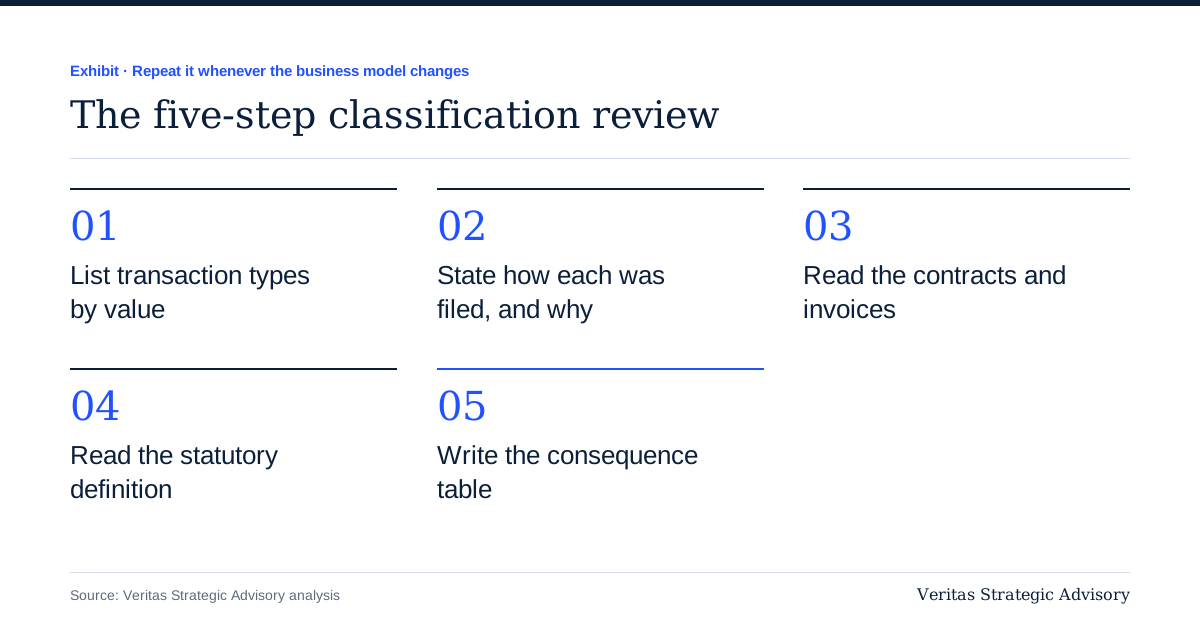
How do you review your income headings in five steps?
List your transaction types by value, not by count. The top twenty by amount usually hold most of the tax at stake.
For each, state what you filed it as and, in one sentence, why. If nobody can give the reason, that is your first finding.
Read the contract and the invoices, not the ledger narration. The ledger records how it was booked; the contract records what it is.
Read the statutory definition, then test the facts against it, one element at a time.
Write the consequence table: rate, deductibility, timing and filing under each candidate heading. Only then compare.
An illustrative example of scale
The figures below are hypothetical, chosen only to show how a heading difference compounds. They are not statutory rates.
| Filed under heading A | Correct heading B | |
|---|---|---|
| Annual income affected | NPR 3.33 crore | NPR 3.33 crore |
| Effective rate | 25% | 10% |
| Tax | NPR 83 lakh | NPR 33 lakh |
| Difference per year | about NPR 50 lakh |
The same income and the same transaction give a different bill under a different heading. The saving in the actual matter came from a different set of facts, and this table shows only the shape of the effect. Over several open years, the amount at stake grows with the number of years still open.
Where is the line between tax planning and avoidance?
Reclassification is planning only when it is honest about what happened. Warning signs that a position has moved into avoidance:
The paper changed after the events. Contracts re-dated, re-worded or created later to fit a treatment.
Form and substance disagree. The document says one thing and the parties do another.
There is no commercial reason for the arrangement other than the tax result.
Treatment is inconsistent across years or across similar transactions without an explanation.
A defensible position is one you would be comfortable explaining to an assessor from the contract, the conduct of the parties and the statute, without any of the four flags.
What will IRD ask to see?
If a reclassified position is questioned, the request is predictable: the contract, the invoices, evidence of how the parties actually performed, how the same item was treated in earlier years, and how comparable transactions were handled. Build the file at the time the position is taken. A justification written after the notice arrives looks like one.
Can you correct past years?
Whether an earlier year can be corrected, and whether tax already paid can be recovered, depends on limitation periods and the procedure available. Do not assume a refund. Take advice on the time limits for each year before committing to a correction plan.
How Veritas Can Help
We run this review across a company's material transactions, set out the consequence of each candidate heading, and document the chosen position so it stands up if IRD asks. Talk to our tax team, or start with our tax consultant service and the related piece on tax evasion, avoidance and planning.
FAQ
Can the same income be taxed under different headings in Nepal?
Yes. The Income Tax Act, 2058 treats categories such as business income, employment, investment and capital gains differently, so the heading affects rate, deductions and timing.
Is reclassifying income the same as tax avoidance?
No, provided it reflects what actually happened and rests on the contract and conduct of the parties. Re-papering a deal after the event to fit a treatment is the avoidance warning sign.
Where should I start a classification review?
List your top transactions by value, state what each was filed as and why, then test the facts against the statutory definition.
Can I recover tax paid under the wrong heading?
Do not assume a refund. It depends on limitation periods and the procedure available for each year; take advice first. See what to do when a tax notice arrives for how limitation works on the IRD side.
General information only, not advice.


