- questions that separate planning from avoidance
- 4
- penalty on tax underpaid by a knowingly false statement
- 100%
- penalty for a genuine mistake
- 50%
- annual interest on unpaid tax
- 15%
Business owners use "evasion", "avoidance" and "planning" as if they were points on one scale. They are not. They differ in what you did, what you can prove and what happens when IRD asks. Most of the risk in this area comes from not knowing which of the three a position actually is.
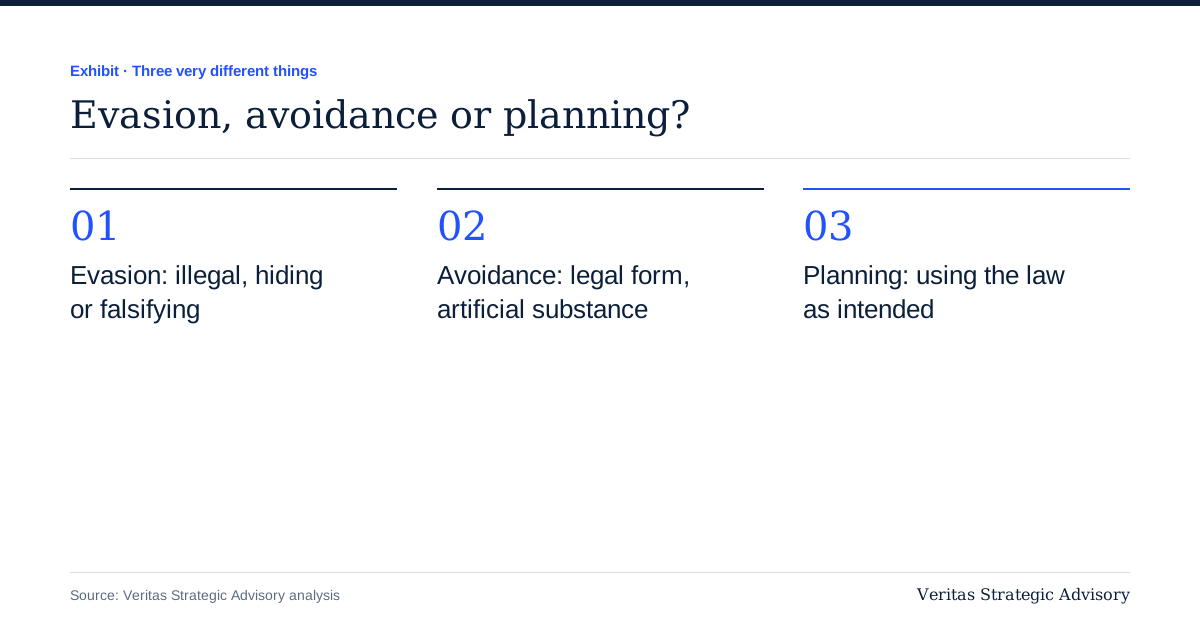
What is the difference between evasion, avoidance and planning?
Evasion is hiding or misstating facts: unrecorded sales, invented expenses, concealed income. It is unlawful, and no amount of documentation makes it defensible.
Avoidance is arranging genuine-looking transactions mainly to obtain a tax result the law was not meant to give. It is not always unlawful on its face, but it is the category assessors challenge, and one that often fails when tested.
Planning is taking the treatment the Act actually provides for a transaction that has real commercial substance, and documenting why.
How do you tell which one a position is?
Ask four questions of any position:
| Question | Planning | Avoidance | Evasion |
|---|---|---|---|
| Did the transaction happen as described? | Yes | Yes, but shaped for the tax result | Not as described, or not at all |
| Is there a commercial reason apart from the tax? | Yes | Weak or none | Not applicable |
| Were the facts disclosed accurately? | Yes | Yes, but presented selectively | No |
| Would the position survive being explained plainly to an assessor? | Yes | Awkwardly | No |
A position that fails the first row is evasion whatever it is called. A position that passes the first and third rows but fails the second is where avoidance lives, and where advice matters most.
Why is "the tax rate is lower under this structure" a weak argument?
A structure adopted only to reach a lower rate is exactly what an assessor looks for. The signals are consistent:
Timing. Contracts, invoices or minutes created or altered after the events they describe.
Form against conduct. The paper says one thing and the parties do another: a "consultant" who works fixed hours inside the company, a "loan" that is never repaid.
Circularity. Money moving through several entities and returning to where it started.
Inconsistency. Similar transactions taxed differently in different years without an explanation.
Round numbers, thin paper and related parties in combination.
None of these is proof on its own. Several together turn a planning position into an avoidance one in an assessor's eyes.
Where do most legitimate tax savings come from?
In practice, the largest and safest savings come from accuracy, not architecture. A company had reported a category of income under a default heading on the assumption that it was the only possible one. A close reading of the Income Tax Act 2058 against the real facts showed a different heading applied. The tax difference was about NPR 50 lakh. No transaction was altered, re-dated or re-shaped. The saving came entirely from applying the law correctly to something that already existed for commercial reasons. The client is confidential, and the full method is in our piece on reclassification.
That is the pattern to look for first, before any restructuring:
Classification. Is the income, payment or asset filed under the heading the facts support?
Timing. Is the item recognised and deducted in the right year?
Elections and reliefs. Are available exemptions, deductions and reliefs actually claimed, and claimed with the required evidence?
Withholding. Was tax withheld at the right rate on payments, and is the credit being claimed correctly?
Record quality. Can each deduction be supported with a document from the time?
What documentation does a planned position need?
A planned position should be supportable from a file built when the decision was made:
The contract and the conduct of the parties.
A short technical note: the provision relied on and why the facts fit.
The alternative treatment considered and why it was rejected.
How comparable transactions were treated in earlier years.
If the file is created after the notice arrives, it reads as a justification and not as a record.
When should you change course?
Change the position if any of the following appear: the commercial reason cannot be explained without mentioning the tax; the documents would need to be altered to support the treatment; or the arrangement only works if nobody looks closely. At that point the useful question is not how to defend it but how to correct it while a voluntary correction is still possible, and with what cost.
What does getting it wrong cost?
The consequences of an unsupported position go beyond the tax itself: interest, additional charges, the time and cost of an assessment and appeal, and the credibility lost with the assessor for the years that follow. That last cost is easily overlooked. A company known to file carefully is assessed more lightly than one known to push.
Frequently asked questions
What is the difference between tax evasion and tax avoidance in Nepal?
Evasion hides or misstates facts and is unlawful. Avoidance uses arrangements mainly to get a tax result the law did not intend; it is the area the Inland Revenue Department most often challenges at assessment.
Is tax planning legal in Nepal?
Yes. Taking the treatment the Income Tax Act 2058 actually provides, for transactions with real commercial substance, and documenting the reasons, is legitimate planning.
What happens if a return is found to be false or misleading?
A penalty equal to the tax underpaid applies where the statement was made knowingly or recklessly, and half of it for a genuine mistake, plus interest at 15% a year on the unpaid tax. Details are in our Nepal Tax FAQ on penalties.
Does Nepal have a general anti-avoidance rule?
Yes. Section 35 of the Income Tax Act, 2058 allows the IRD to recharacterise or disregard an arrangement, or part of one, entered into with the main purpose of avoiding or reducing tax. That is why a commercial reason, recorded at the time, matters so much.
Is it evasion to make an honest mistake in a return?
No. Evasion involves deliberately hiding or misstating facts. A genuine mistake still attracts the tax, interest and the lower penalty, so it is worth correcting as soon as it is found.
How do I defend a position if the IRD challenges it?
With documentation prepared at the time of the transaction: commercial reasons, contracts and calculations. Our tax consultant team in Kathmandu prepares responses to assessments and administrative review applications.
How Veritas Can Help
We review positions against the four-question test, find savings that come from accurate application of the Act, and document each so it stands up if IRD asks. Where a position should not be kept, we say so at the start. Talk to our tax team, or see our tax consultant service and the case study on a tax saving through correct classification.
General information only, not advice. Penalty and interest rules are set by the Income Tax Act, 2058 and the current Finance Act; confirm the position on your facts before acting.