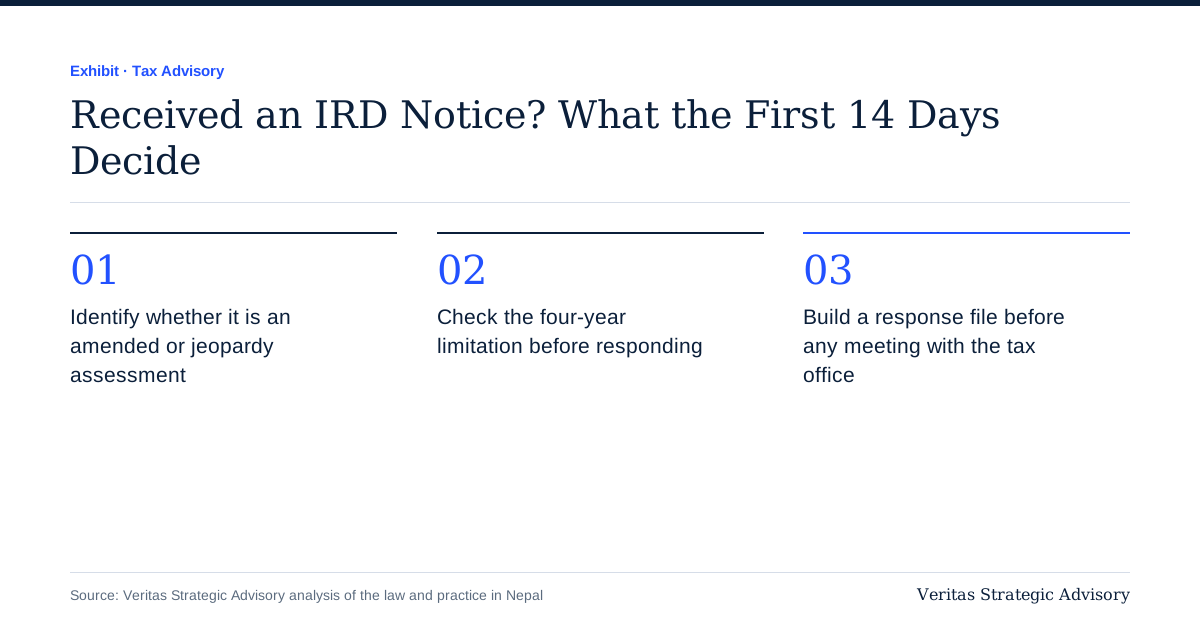
- steps in 14 days
- 5
- month limit for amended assessments
- 4
- notice types to identify
- 2
Day 1: read the notice like a reviewer
Most businesses read a notice once, feel alarmed, and file it. Read it again with a checklist. Note the tax period, the adjustment, the amount assessed, the section cited, the response deadline, and the address it was served to.
The notice states what the tax office believes. Your task in the next two weeks is to establish whether it is right.
Which kind of notice is it?
The Income Tax Act, 2058 recognises self-assessment, jeopardy assessment and amended assessment. A notice is almost always one of the last two, and each calls for a different response.
A jeopardy assessment is issued when collection itself is at risk, for example where a taxpayer is insolvent or about to leave the country. It moves quickly and is uncommon for an operating business.
An amended assessment revises a return already filed. It is the usual case, arising from a desk review, an audit, or a mismatch with third-party data such as TDS certificates. The tax office amends the return under Section 101 and notifies you under Section 102.
Knowing the type sets the pace. An amended assessment allows a structured response. A jeopardy assessment requires a fast reply showing why collection is not at risk.
Check the four-year limit
An amended assessment must generally be made within four months of the return due date, under Section 101 of the Income Tax Act, 2058. This check takes ten minutes and is one of the strongest early defences.
If the notice reopens a period outside that window, record it in writing and raise it in your first response. Do not assume the office will withdraw it on its own.
Days 2 to 4: secure the records
Assemble the file for the disputed period before speaking to anyone. Include the return as filed, the ledgers, bank statements, sales and purchase invoices, TDS certificates, and any earlier correspondence on the same issue.
Reconcile the notice to your records line by line. Where they agree, you have a fact base. Where they disagree, you have the start of your argument. Where the office used incomplete data, such as a missing TDS credit, you have a correction to request.
Create one working document listing each adjustment, its amount, your records and your position. It becomes the spine of everything that follows.
Days 5 to 9: choose your position
For each adjustment, accept it, dispute it in full, or dispute part of it. Accepting an adjustment you could contest wastes money. Disputing one you cannot support damages your credibility on the points you can win.
Price each position: the tax, interest and penalty at stake. A position is worth defending when the amount justifies the effort and the evidence is strong. This prioritisation is the most valuable work in this phase.
Decide whether each point is a question of fact or of law. Facts are won with records. Law is won with precise citation. Most disputes mix both.
Days 10 to 14: respond in writing, on time
Respond before the deadline, in writing, quoting the notice reference. State each disputed point, the provision relied on, the evidence attached, and the outcome sought. Keep it factual and short.
Request a meeting if warranted, but never let a meeting replace the written response. If a meeting produces agreement, get it recorded in writing before you leave.
Keep a dated log of every submission and contact. If the matter moves to administrative review or appeal, this log proves the timeline was respected.
What the first 14 days cannot fix
They cannot change a fact that is wrong in your records. A purchase without a valid invoice stays disallowed. They cannot undo a missed deadline, and they cannot replace documents that should have been kept when the transaction happened.
Their real value is converting alarm into a plan. A plan preserves more money than a reaction.
When to bring in help
Bring in an adviser when the amount is material, several periods are involved, a jeopardy assessment is possible, or the facts are technical, such as transfer pricing or capital gains. Bring them in on day one, not day twelve.
Our IRD assessment defence service runs this sequence from the first read to administrative review. Related: what to do first when you receive a tax notice and tax health check: 15 things to review.
Common mistakes that turn a manageable notice into a costly one
Experience shows the same handful of errors recur. Recognising them early is the cheapest protection you have.
The first is answering the question nobody asked. A notice may challenge one line, and the response wanders into general arguments about the business. The office reads a wide response as evidence that the narrow point is weak. Keep the response tied to each disputed line.
The second is accepting an adjustment by silence. If a point is not answered, the office generally treats it as conceded. Silence feels safer in the moment, but it removes the dispute entirely. Every adjustment should be either accepted in writing or contested in writing.
The third is sending records without an index. A box of photocopied invoices forces the reviewer to do your work, and reviewers form their view of a file within minutes. Number each document, reference it in the response, and summarise the total for each disputed line.
The fourth is relying on a verbal understanding. An officer may tell you informally that a point will be dropped. Unless it appears in the written outcome, it has not happened. Ask for the outcome in writing before you treat any point as resolved.
The fifth is treating a meeting as the process. Meetings clarify, but decisions are recorded on paper. Prepare for each meeting with a written agenda, and follow it with a summary email that records what was agreed and what you still owe.
How the response should be structured
A strong written response has a predictable shape. It opens with the notice reference, the period and the date of the notice. It lists the disputed points in the order they appear in the notice, so the reviewer can follow along. For each point it states the adjustment, your position, the provision you rely on, and the evidence attached with its document number.
It closes with the overall outcome you seek and the reservation of your right to further review. A short response with clear references is more persuasive than a long one that buries the argument in narrative.
Write for a reader who has the notice open beside your letter. Quote the figures exactly as the notice states them. If you dispute a figure, show the calculation that produces your figure, step by step, so the reviewer can check each step without guessing.
What happens after the response
The office reviews your submission and may issue an amended order, reduce the adjustment, or confirm it. A reduction is a partial win and should be recorded as such. A confirmation starts the next stage, which is administrative review and, after that, appeal.
Each stage has its own deadline, which the order or the rules set out. Calendar the deadlines the day you receive each decision, not the day you plan to act. Missing an appeal window is one of the few errors that cannot be repaired afterwards.
Keep the strategy under review. As the process moves, some points will become stronger and others weaker. Conceding a weak point early can protect credibility for the points you will press to the end.
Working with your team during the process
The people who hold the records are often not the people who answer the notice. Your accountant, bookkeeper and operations lead each hold part of the truth. Brief them in writing on what the office has asked, and ask each one to confirm the facts for their area before anything is submitted.
Keep a single version of the working document, controlled by one person. Multiple copies drift apart, and a response built from an outdated copy contradicts itself. Assign one owner for each disputed line, and require sign-off before the line is submitted.
Where a person who handled a past transaction has left, rebuild the facts from the documents, not from memory. Write down what the documents show, and mark any gap clearly. An honest gap is far better than a confident statement that later proves wrong.
Preparing the next notice before it arrives
The best defence is the file you keep every day. Reconcile returns to the ledger each period. File invoices in a system that can be searched by date, supplier and amount. Record the reason for any unusual transaction at the time it happens, while the facts are fresh.
A short annual review helps as well. Pick the three areas where a notice would most hurt, usually the largest expense categories, related-party dealings and any tax credits claimed. Check each one against its documents. The review takes an afternoon and removes most of the surprise from a future notice.
Consider the tax position as part of major decisions. A new branch, a share transfer or a change in pricing each carries tax consequences that are far easier to document before the transaction than afterwards. A short note recording the reasoning and the expected treatment is often what turns a later query into a quick confirmation.
Real-world patterns in how notices are resolved
Most resolved notices share a few features. The taxpayer read the notice carefully and identified the type early. The records were reconciled before the response, not during it. The response addressed each line separately. And the taxpayer kept a dated record of every exchange.
Notices that drag on often share the opposite features: a late response, a broad denial with no evidence, records supplied piecemeal, and no written record of what was agreed. The difference is rarely the merit of the underlying position. It is almost always the quality of the process.
This is why the first fourteen days matter so much. The process you set up in that window shapes every later stage. A business that treats the notice as a project, with an owner, a timeline and a file, is positioned to resolve it well whatever the outcome on the merits.
Frequently asked
Can I ask for more time?
Often yes, but ask in writing before the deadline and give a specific reason. Unexplained requests are often refused.
Should I pay while disputing?
Ask whether paying the undisputed part reduces interest. For the disputed part, decide with an adviser against the process you are in.
Does a notice mean I am under investigation?
Not necessarily. Most notices are routine reviews or data mismatches. Take it seriously, but do not assume the worst from the letter alone.