
- the general minimum FDI that IT and BPO escape
- NPR 20m
- areas reported open to the automatic route
- 102
- registration steps
- 7
- reported automatic-route approval window
- 7 days
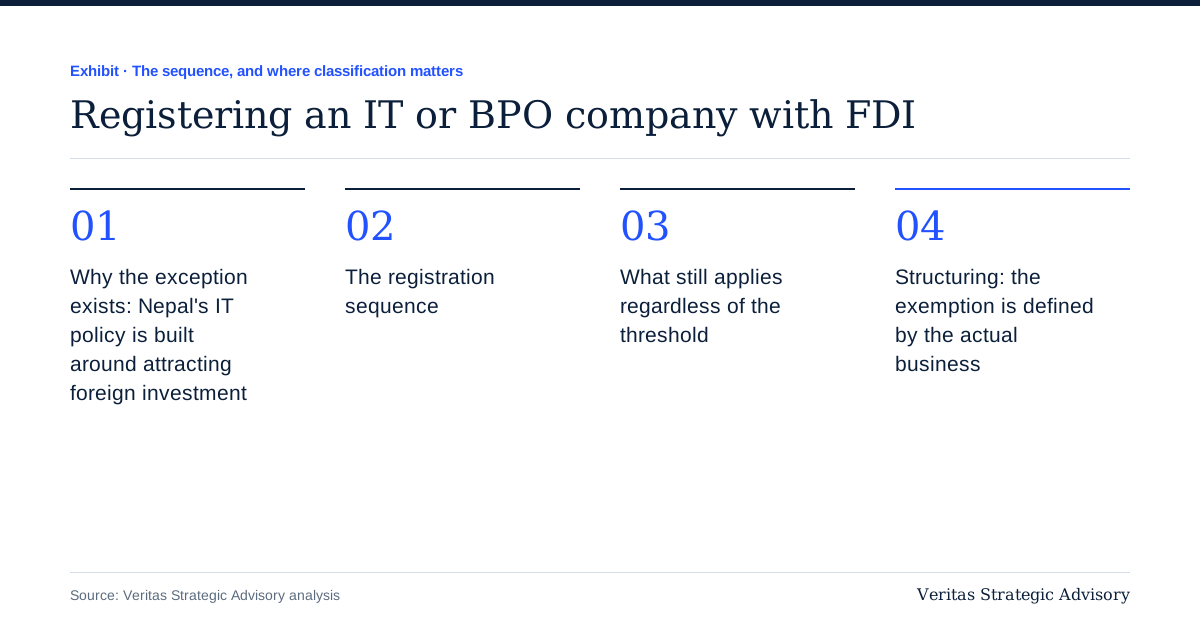
Nepal's general rule is that a foreign-invested company needs a minimum investment of NPR 20 million per investor. IT and BPO are the best-known exception. The exemption has moved over time: a notice dated 2 October 2023 is the one most guides still cite, but published law-firm summaries report that a Gazette notification of 16 February 2026 (2082/11/04) repealed that notice and replaced it with a wider list. This article explains what the exemption does and does not change, and how the registration sequence works in practice for a technology or outsourcing business.
Which IT activities are exempt from the NPR 20 million minimum?
According to Niti Partners' summary of the February 2026 notification, issued by the Ministry of Industry, Commerce and Supplies, the automatic route for foreign investment now covers 102 areas of industry in seven categories, and the NPR 20 million minimum does not apply to nine IT and digital areas. Press reports of the same notification also say the earlier NPR 500 million ceiling for automatic approvals was removed for the listed sectors.
The areas named in that summary are:
Technology park, IT park and bio-tech park
Software development
Data processing
Digital mapping
BPO and KPO
Data centres, data mining and cloud computing
Web portals, web design services and web hosting
We have relied on these published summaries rather than the Gazette text itself. Before you file, ask the Department of Industry (DOI) to confirm the current notification and that your specific activity appears in it. Older material, including some law-firm guides, still refers to the October 2023 notice, so check the date on whatever you read.
Why does Nepal exempt IT and BPO from the minimum?
Nepal wants more IT and outsourcing companies and more export revenue. A small software studio or a back-office team serving overseas clients can be viable with far less than NPR 20 million, so a fixed minimum would shut out exactly the investors the policy is meant to attract. In most other sectors the minimum acts as a filter on very small foreign investments. For IT and BPO the policy goal runs the other way.
What are the steps to register an IT company in Nepal?
The route follows the same backbone as any foreign-invested company. Published guides from Law Bhandari describe the steps as follows:
Foreign investment approval from DOI (or Investment Board Nepal where its mandate applies). For listed sectors this may be done online through the automatic route, described below.
Company incorporation at the Office of the Company Registrar (OCR).
Local business registration at the relevant ward office.
Tax registration, including PAN, at the Inland Revenue Office.
Industry registration at DOI.
A non-blacklisted certificate from the Credit Information Bureau, which the guide lists among the steps.
Bank approval to bring in the foreign investment, followed by a statutory notice to Nepal Rastra Bank (NRB) on the injection.
Published estimates for the whole process run from about two to five months for a subsidiary, depending on the structure and how complete the file is. Treat these as indicative, not promised.
What is the automatic route and who can use it?
Section 42 of the Foreign Investment and Technology Transfer Act, 2019 (FITTA) allows the government to introduce a simplified approval system, and Rule 8A of the FITTA Rules provides the procedure. An investor submits details and documents through the Department of Industry's online system, reviews them, submits the verified details, and receives a confirmation email with an application number and an approval letter. Press reports of the 2026 notification say the approval certificate arrives by email immediately or within seven working days, and that the source of the foreign currency is then verified with NRB.
Two practical cautions. First, earlier press coverage tied the IT minimum exemption to the automatic route, so if your structure falls outside it, ask DOI in writing how the minimum is treated. Second, the automatic route does not remove the later steps: OCR, tax registration and NRB recording still follow.
What still applies even if you are exempt?
The document checklist. For a subsidiary, Law Bhandari lists the investor's incorporation certificate, memorandum and articles, passport copies of directors and shareholders, the authorised representative's identity document, a project report and investment schedule, a financial credibility certificate, the latest financial statements, a board resolution, a company profile and a power of attorney.
The capital injection schedule. Published summaries of the FITTA Rules describe a first injection within one year of approval on a sliding percentage scale, and bringing in 70 percent of the approved investment before commercial operation with the rest within two years afterwards. Ask DOI for the schedule that applies to your approval, because the percentages are tied to the approved amount.
Repatriation and exit. Profit repatriation and exit follow the usual NRB process. The exemption is about entry, not about how money comes back out.
Sector and contract compliance. For BPO in particular, client contracts often carry data-protection and confidentiality duties. These are contractual and legal obligations that sit alongside the registration, so read them before you hire.
How should the business activity be described?
The exemption attaches to defined activities. Law Bhandari notes that BPO is categorised under information technology industries in Nepal's industrial enterprises law, and the 2026 notification, as summarised, lists BPO and KPO by name. An application that blends in non-IT activity, such as trading, retail or general consulting, risks the whole entity being assessed under the general rules, not just the non-qualifying part.
Subsidiary or branch: which structure works better?
We advise clients to word the objects clause and the DOI application so they match the listed activity directly, and to keep unrelated commercial activity in a separate entity. Describe the real service: for example software development for overseas clients, or data processing for a named category of work. Keep the investment schedule, project report and bank documents consistent with that description, because DOI, OCR and the bank will each read them.
Subsidiary versus branch is also worth deciding early. Law Bhandari reports that a branch office of a foreign IT company has no minimum capital rule but is limited to operating costs transferred in, may not invest in other companies' shares or lend money, and needs the approval of the Ministry of Communication and Information Technology. A branch also leaves the foreign parent exposed to Nepal liabilities. For hiring at scale or taking local contracts, a subsidiary is usually the cleaner choice. See our guide to branch and liaison offices.
What happens after approval: tax, payroll and reporting?
Most IT and BPO investors begin hiring within weeks, so PAN, VAT and payroll should be ready on the day the first employee joins. Income-tax incentives for foreign-currency export income and for direct employment of Nepali staff have been changed by successive Finance Acts, and published summaries disagree on current rates, so we do not quote them here. Our article on IT exporters and foreign-currency earnings covers the reporting side, and the FDI approval guide covers the general process.
Frequently asked
Is there a minimum foreign investment for an IT company in Nepal?
The general rule is NPR 20 million per foreign investor, but software development, data processing, BPO and KPO, data centres and cloud computing, digital mapping, web portals and hosting, and technology and IT parks are reported to be exempt in the current Gazette notification. The exemption attaches to the listed activity, so confirm with the Department of Industry that your specific activity is on the current list before you file.
How long does it take to register an IT or BPO company in Nepal?
Published estimates run from about two to five months for a subsidiary, depending on the structure and how complete the document file is. Press reports of the 2026 notification say an automatic-route approval certificate arrives by email immediately or within seven working days, but that is only the first of the seven steps; incorporation at the Office of the Company Registrar, ward and tax registration, industry registration and the NRB recording of the investment all follow.
Can a foreign investor own 100 percent of an IT company in Nepal?
Foreign investment is permitted in IT and BPO activities, which are not on the negative list, and the Foreign Investment and Technology Transfer Act, 2019 contemplates wholly foreign-owned companies. Confirm the position for your specific activity with the Department of Industry, because the approval is granted against the activity described in your application.
What is the automatic route for FDI in Nepal?
It is a simplified online approval system under Section 42 of FITTA and Rule 8A of the FITTA Rules. The investor submits details and documents through the Department of Industry's online system and receives a confirmation email with an application number and an approval letter. Summaries of the February 2026 notification report that it now covers 102 areas of industry across seven categories and that the earlier NPR 500 million ceiling for automatic approvals was removed for the listed sectors.
Should I register a branch office or a subsidiary for an IT business?
A branch of a foreign IT company is reported to have no minimum capital rule, but it is limited to operating costs transferred in, cannot invest in other companies' shares or lend money, needs approval from the Ministry of Communication and Information Technology, and leaves the foreign parent exposed to Nepal liabilities. For hiring at scale or signing local contracts, a subsidiary is usually the cleaner structure. See branch and liaison office registration.
What happens if my company does IT work and trading?
That is the most common way the exemption is lost. If the memorandum of association or the DOI application describes the business loosely, the exemption can be challenged for the whole entity, not just the non-qualifying part. Keep unrelated commercial activity in a separate company and word the objects clause to match the listed activity exactly.

Our team of chartered accountants can structure the application so the sector classification is clear from the first filing, and set up PAN, VAT and payroll as soon as the company is incorporated. See our FDI approval service or talk to us.
*Prepared from published sources, October 2026. General guidance only; confirm against the current text of the law and with the relevant authority.*