
- of last year's foreign-currency earnings accessible (NRB)
- 10%
- steps in the receipts trail
- 4
- documents per export
- 4
- points in the checklist
- 10
Software houses, outsourcing teams, design studios and freelancers registered as companies now sell services to clients in the United States, Europe, Australia and the Gulf. The product leaves Nepal through a laptop and a payment arrives through a bank. That makes the paperwork more important than the technology: the same dollars that prove a business exists also unlock tax treatment, foreign-currency access and bank credit. This guide explains how an owner or finance manager can organise it, using the rules as we understand them at the time of writing (October 2026). Rules change with each Finance Act, so confirm the points flagged below.
What counts as an IT export, and why does it matter?
An IT export is a service delivered to a customer outside Nepal and paid for in foreign currency: software development, web and mobile work, support, data processing, design, or similar. Three things depend on that label:
Tax treatment. Income tax concessions for IT and service exporters have been provided through the Finance Act in different years, and the rate and conditions can change. We do not quote a rate here because published summaries disagree; confirm what applies to your registration for the current fiscal year.
VAT treatment. Services exported are generally treated as zero-rated under the Value Added Tax Act, 2052, which means no output VAT on the export while input VAT on your purchases may be claimable. The conditions, including proof of foreign-currency receipt, should be confirmed with the Inland Revenue Department (IRD) before you file.
Foreign-currency access. NRB facilities for service exporters depend on documented foreign-currency earnings.
If you cannot show that the revenue is export revenue, you lose all three at once. That is why the evidence trail comes first.
How should the foreign-currency receipts trail work?
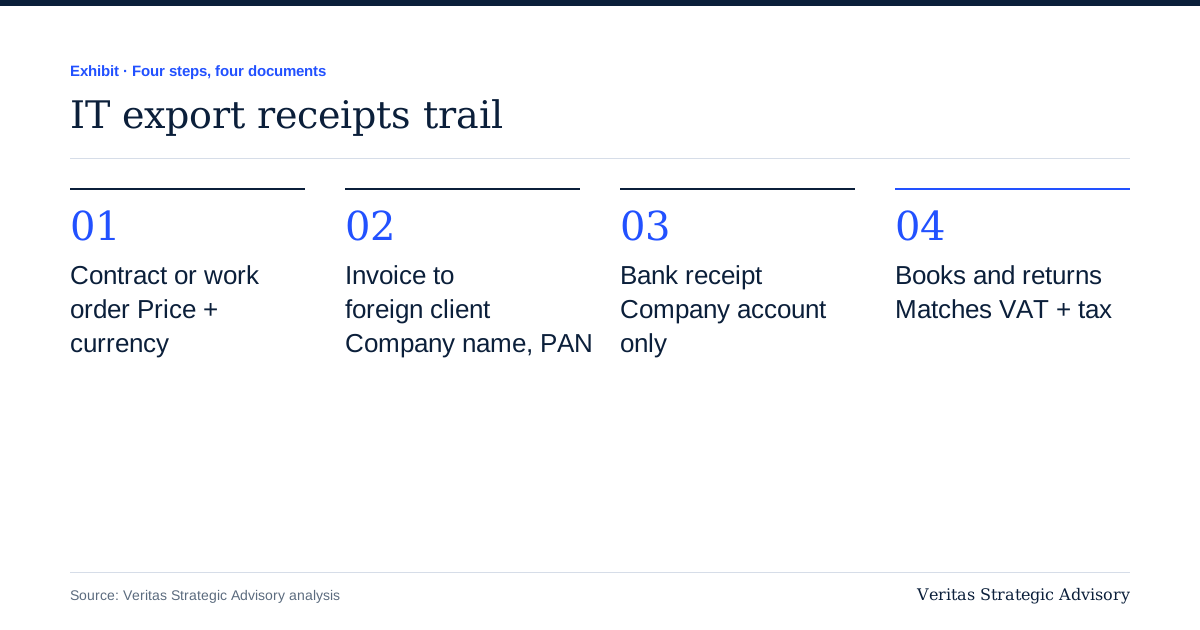
A clean trail has four steps, and each one leaves a document:
Contract or work order. A signed agreement or written order with the foreign client, naming the service, the price and the currency.
Invoice. Issued in the company's name, in the currency agreed, showing the client's foreign address and your PAN.
Bank receipt. The payment arrives in a bank account of the company, with a bank advice showing the amount in foreign currency and the rupee credit.
Books and returns. The receipt is recorded against the invoice, and the same amount appears in your VAT and income tax filings.
What can an exporter do with its foreign currency?
NRB's foreign-exchange arrangements for IT and service exporters, as reported by ShareSansar in 2023, allow exporters to set up contact offices abroad, transfer funds to foreign bank accounts, and buy software, programs and equipment in foreign currency. Access through a commercial bank is capped at a maximum of 10 percent of the foreign-currency earnings recorded in the previous financial year, and the same report mentions a limit linked to taxable income shown in the previous year's tax payment certificate.
To use the facility the report lists documents such as audited financial statements showing the previous year's foreign-currency earnings, bank account details showing foreign-currency conversion, and a self-declaration of compliance with prevailing law. Separate approval is needed to open foreign accounts linked to the facility.
NRB has since widened the picture. Kantipur reported in January 2025 that Nepali IT companies can now invest abroad. The conditions reported elsewhere include a record of continuous foreign-currency earnings over recent years and an investment cap linked to average earnings. Because the exact test can be amended, read the latest NRB foreign-exchange directive or ask your bank before you plan an overseas investment.
A worked example (illustrative figures)
The numbers below are made up to show the method. They are not benchmarks.
A Kathmandu software company invoices overseas clients and earns USD 20,000 a month. Its previous financial year's foreign-currency earnings were the equivalent of NPR 3.2 crore.
| Item | NPR |
|---|---|
| Previous year's foreign-currency earnings | 3.2 crore |
| Facility ceiling at 10% (subject to the other limits) | 32 lakh |
| Planned overseas software subscriptions and a contact-office set-up | 18 lakh |
| Headroom left under the ceiling | 14 lakh |
The company can see before it applies that the planned spending fits, and it knows the bank will ask for audited statements and bank advices. If the owner had banked half of the client payments in a personal account, the base would be lower, the ceiling smaller and the application weaker.
Which costs and tax points trip up IT exporters?
Payments to foreign vendors. Paying a foreign cloud, tool or contractor often attracts withholding. See our guide to TDS on foreign vendor payments.
Exchange differences. Receipts are converted at the rate on the transaction date. A gain or loss between invoice and receipt is an accounting entry, not a surprise; record it.
Advance tax. Profitable exporters pay tax in instalments through the year. See how to calculate advance tax instalments.
Staff costs. Salary TDS, social security contributions and payroll records must match what you report as business expense.
Contractors versus employees. Developers who work only for you under your control may be treated differently from independent vendors. Document the arrangement.
VAT registration. An exporter with zero-rated sales may still need to register to claim input VAT; check the current threshold with our VAT registration guide.
What should reporting under NFRS look like?
Companies in scope of Nepal Financial Reporting Standards prepare accrual-based accounts. For an exporter that means recognising revenue as the service is delivered, not when the client pays; showing foreign-currency receivables at the closing rate; and keeping the exchange difference visible. If you are unsure whether you fall within scope, see NFRS applicability in Nepal.
Audited statements matter here more than for many businesses, because NRB and banks ask for them to confirm foreign-currency earnings. We provide audit support and assistance to your statutory auditor; we do not perform the audit. A tidy ledger that ties every dollar to an invoice makes the auditor's work, and your application, faster. In practice, prepare a one-page schedule each year listing every foreign client, the invoices raised, the amounts received in foreign currency, the rupee credit on the bank advice and any balance still outstanding. The schedule lets the auditor test receipts quickly, lets the bank see the earnings base behind a facility request, and lets you reconcile the figure to your VAT and income tax returns. If the three totals differ, find out why before the year closes rather than after a notice arrives.
A 10-point checklist for an IT exporter
Company registered, PAN and VAT status confirmed.
A written contract or work order for every client.
Invoices in foreign currency, issued in the company's name.
All receipts into a company bank account, never a personal one.
Bank advices filed against each invoice.
Foreign vendors identified and withholding checked.
Exchange differences recorded monthly.
Advance tax instalments planned from profit estimates.
Year-end accounts prepared for audit with a foreign-currency earnings schedule.
Incentive and NRB rules re-checked each fiscal year.
Questions IT exporters ask
Do I have to register a company to export services?
Banks, NRB facilities and tax treatment generally work through a registered entity with a PAN. Operating as an unregistered individual makes the evidence trail much harder. Confirm the right structure for your case.
Can I keep dollars in a foreign account?
Only within the arrangements NRB permits for service exporters, and subject to approvals. Do not assume that money may stay abroad; ask your bank for the current directive.
Is an exported service subject to VAT?
Exported services are generally zero-rated, which is different from exempt. The business may still need to file returns. Check the conditions with IRD.
Is the tax concession automatic?
Not usually. Eligibility and documentation conditions apply, and they change by year. Read the current Finance Act or ask us.
Does a bank loan look at foreign-currency earnings?
Lenders review the statement of receipts alongside accounts. A consistent twelve-month history helps; a monthly management report gives them that history.
What if a client pays late or in a different currency?
Record the receivable at the invoice date, then the exchange difference when paid. Keep the email trail showing why the payment was delayed.
How Veritas can help
We help IT exporters set up the receipts trail, plan advance tax, check withholding on foreign payments and prepare accounts that banks and auditors can follow. See our tax technical capability or book a free call.
General information only, not advice.