- VAT on finished goods inventory tie-up cost
- 13%
- avg days inventory sits unsold in Nepali manufacturing
- 45
- portion of manufacturing businesses that underprice because they ignore fixed costs
- 30%
- ratio of absorbed-cost margin to cash margin when inventory grows
- 2.5x
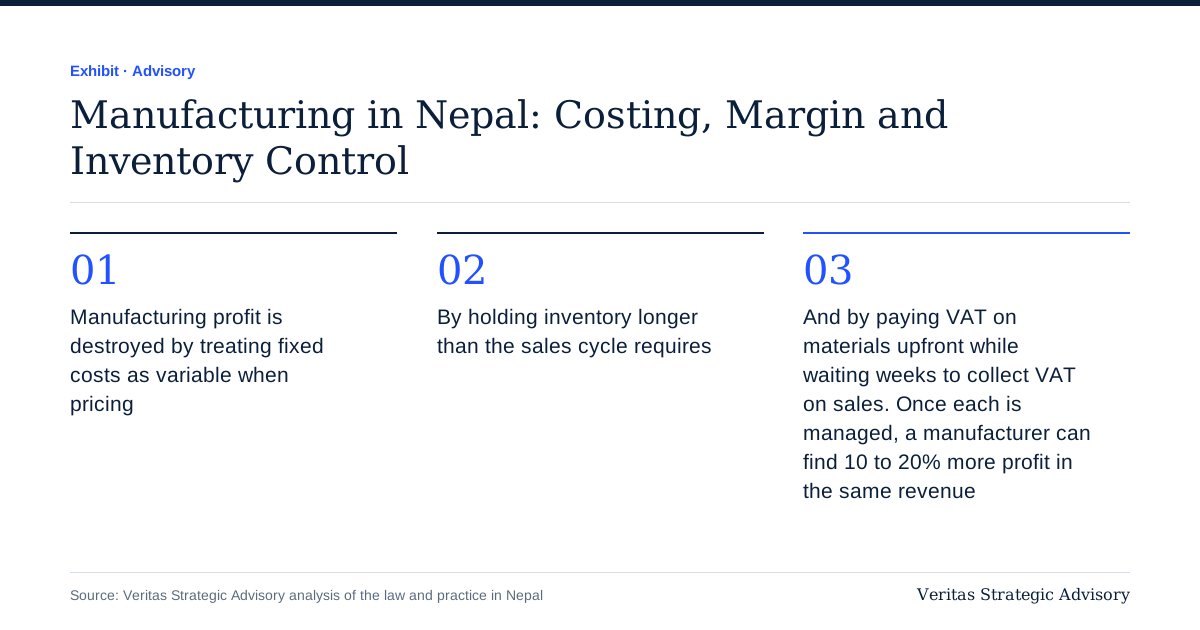
A manufacturing business that shows profit on the cash book and runs out of working capital every quarter has usually fixed the wrong problem. It cut costs when it should have cut inventory, raised prices without adding margin, or confused the cost of goods with the cost of goods sold. None of these are accounting errors; they are practical mistakes about what costs drive margin, and they are fixable.
This guide explains how a Nepali manufacturer should think about its own costs—which ones change when production changes and which ones do not—so that pricing sits above all costs plus a sustainable margin. It then shows how inventory management either amplifies or erodes that margin in practice, and how VAT-registered manufacturers should account for inventory purchases so working capital does not spiral. The underlying rules apply as of FY 2083/84; Finance Acts and NRB directives change VAT treatment, withholding rates, and working capital constraints from year to year, so confirm the current position with your own tax advisor and lender before acting on any single figure here.
The three separate questions in manufacturing cost
Most manufacturers confuse three distinct questions: *What did I spend?*, *How much did it cost me to make the units I sold?*, and *What is the profit I actually earned?* Conflating them produces pricing that feels competitive but destroys margin, and financial forecasts that show profit but produce no cash.
Question 1: What did I spend?
This is cash flow, and it is straightforward: raw materials purchased, utilities paid, salaries paid, equipment bought. Record it in the bank account and the income statement arrives by the end of the period.
Question 2: How much did it cost to make the units I sold?
This is absorption costing, and it is where most manufacturers lose control. When you make 100 units but sell only 60, the cost of the 40 units left in inventory sits on the balance sheet, not in the profit calculation. That is not a choice; NFRS 2 requires it. The cost that counts for profit is only the cost of the 60 units actually sold, so the cost per unit must split out fixed costs (rent, depreciation, supervisory salaries) from variable costs (raw materials, casual labour, power). A unit cost that includes a share of rent is only valid for the units you actually sold; the remaining rent belongs to the units you did not sell and sits in inventory.
| Cost type | Behaviour | Belongs in unit cost for margin? |
|---|---|---|
| Raw material per unit | Changes with volume | Yes—include in unit cost |
| Hourly labour, power | Change with volume | Yes—include in unit cost |
| Factory rent, salaried supervisor | Stays same whether 50 or 100 units produced | No—fixed, separate from unit cost |
| Freight inbound on materials | Changes with volume | Yes—part of cost per unit |
| Freight outbound to customers | Changes with volume | Yes—but often treated as expense not COGS |
| Equipment depreciation | Same every month | No—fixed, separate from unit cost |
Question 3: What profit did I actually earn?
This is the number that matters for tax and for the bank. Start with the cost of goods sold (the absorption cost of the units sold), subtract all other operating costs (selling, distribution, administration), and the remainder is profit before tax. But here is the trap: if you made and sold 100 units at a calculated unit cost that did not properly exclude fixed costs, the unit cost is wrong and the gross profit is overstated. The actual profit you earned is much lower. That is why manufacturers often find they are less profitable than they expect once they separate fixed and variable costs properly.
Pricing: why manufacturers underprice when they ignore fixed costs
A manufacturer with NPR 50 lakh of fixed costs a year (rent, supervisory salaries, insurance, depreciation, interest) and expected sales of 10,000 units will often calculate a unit cost by dividing fixed costs by units: NPR 50 lakh ÷ 10,000 = NPR 500 per unit of fixed cost, plus direct variable costs of say NPR 1,200, for a total of NPR 1,700 per unit.
The mistake is treating NPR 500 as if it changed with volume. If sales drop to 8,000 units, the fixed costs do not drop to NPR 40 lakh; they stay at NPR 50 lakh. The correct unit cost for the 8,000 units is now NPR 625 per unit of fixed cost (NPR 50 lakh ÷ 8,000), not NPR 500. A manufacturer who priced the product at NPR 1,700 assuming 10,000 units will lose margin immediately if sales come in at 8,000, because the unit cost of the goods actually sold has risen by NPR 125, and the price has not moved.
The practical solution is to price all products high enough to cover not the expected fixed cost per unit, but the *expected fixed cost per unit plus a margin*. At 10,000 expected units and NPR 50 lakh fixed costs, the NPR 500 per unit must be recovered from every unit sold, or the business is underwater. A 10% margin on NPR 1,700 means pricing at NPR 1,870. But if the business is seasonal or cyclical, and some months move only 500 units and others move 2,000, the unit cost in high-volume months is NPR 250 and in low-volume months is NPR 1,000. A uniform price of NPR 1,870 does not survive that reality. The right answer is to run the business on a contribution margin model instead.
Contribution margin: the real profit driver
In a contribution margin model, the price of a product minus its variable costs is the contribution available to cover fixed costs and profit. If fixed costs are NPR 50 lakh a year, and each unit contributes NPR 300 in margin (price NPR 1,700 minus variable cost NPR 1,400), then the business needs to sell NPR 50 lakh ÷ NPR 300 = 16,667 units to break even on fixed costs alone.
| Month | Units sold | Total variable cost | Total contribution | Fixed costs | Profit/(loss) |
|---|---|---|---|---|---|
| January (high season) | 2,000 | 28,00,000 | 60,00,000 | 4,16,667 | 15,83,333 |
| February (low season) | 500 | 7,00,000 | 15,00,000 | 4,16,667 | (1,16,667) |
| Six-month cycle average | 1,250 | 17,50,000 | 37,50,000 | 25,00,000 | 12,50,000 |
This simple model immediately shows why so many manufacturers are seasonal loss-makers: they do not sell enough in low-season months to cover their fixed costs, no matter what price they set. The solution is not to raise prices in February (which kills the little volume left), but to reduce fixed costs in low season (hire casual labour instead of permanent staff, negotiate variable rent, or shut a production line). Many Nepali manufacturers run the same overhead all year without this adjustment and wonder why February and monsoon months always lose money.
Inventory management: why holding inventory destroys margin
Inventory is not an asset; it is cash that has been converted to goods and is waiting to be converted back to cash. Every day a unit sits in the warehouse costs the business interest (either borrowed interest or the opportunity cost of equity that could be deployed elsewhere), storage space, insurance, and obsolescence risk.
A Nepali manufacturer with NPR 2 crore of inventory at an annual borrowing cost of 10% is paying NPR 20 lakh a year simply to hold that inventory, whether or not it sells. If that inventory turned only 4 times a year (sales / inventory), the average holding period is 91 days. A faster turn of 8 times a year means only 45 days, and the interest cost falls to NPR 10 lakh a year—a straight NPR 10 lakh swing in profit just from inventory management, no price increase needed.
| Inventory turnover | Holding days | Interest cost (10% on NPR 2cr) | Profit impact vs 4-turn baseline |
|---|---|---|---|
| 4 turns/year (90 days) | 91 | 20,00,000 | Baseline |
| 6 turns/year (60 days) | 61 | 13,33,000 | +6,67,000 |
| 8 turns/year (45 days) | 45 | 10,00,000 | +10,00,000 |
| 12 turns/year (30 days) | 30 | 6,66,000 | +13,34,000 |
The mechanics of inventory turns are simple: reduce the time between a raw material purchase and the sale of the finished product made from it. This means:
Buy and make only against known orders, not against forecast demand. Forecasts are routinely wrong by 20 to 40%; actual orders are certain.
Negotiate payment terms with customers that match your production cycle. If you need 30 days to make and deliver, ask for full or partial payment upfront or 15 days after delivery, not 60 days.
Reduce the production batch size. Making 1,000 units at once ties up 30 days of inventory; making 100 units four times ties up 7.5 days on average. If your setup time is the barrier, reduce setup time (better maintenance, standard procedures).
Use a inventory system to know, every week, what is selling and what is not. A product that has not moved in 6 months is dead and should be marked down, scrapped or donated, because it is earning negative return on the capital tied up in it.
VAT and inventory: why registered manufacturers bleed working capital
A VAT-registered manufacturer buys raw materials (say NPR 50 lakh) and pays VAT at 13% (NPR 6.5 lakh). The manufacturer does not pay the VAT to the government immediately; it becomes an input credit on the manufacturer's own VAT return. But it is still cash paid out of the bank.
The manufacturer then converts the raw materials into finished goods and sells them (say NPR 100 lakh) and collects VAT at 13% (NPR 13 lakh) from the customer. The manufacturer now owes the government the difference: NPR 13 lakh collected minus NPR 6.5 lakh input credit = NPR 6.5 lakh due to the government.
But here is the working capital trap: *the manufacturer paid the NPR 6.5 lakh input VAT the moment the materials were purchased, but will not collect the NPR 13 lakh VAT until the finished goods are sold, and the customer might not pay for 30, 60 or 90 days after that.* If the manufacturer is a cash-poor startup, that timing gap—paying VAT upfront on materials, waiting weeks to collect VAT on sales—is a working capital drain that can exceed the profit on the sale.
| Event | Amount | VAT | Cash flow |
|---|---|---|---|
| Buy materials | 50,00,000 | 6,50,000 input credit | Pay 6,50,000 |
| Manufacture (30 days) | — | — | — |
| Sell goods on credit (30-day terms) | 100,00,000 | 13,00,000 | 0 (customer owes) |
| Customer pays (day 60) | 100,00,000 | — | Receive 113,00,000 |
| VAT settlement | — | 6,50,000 due to govt | Pay 6,50,000 |
| Net cash position at day 60 | +100,00,000 |
The working capital impact is that the manufacturer has paid NPR 56.5 lakh (materials + VAT) by day 30, but will not receive NPR 113 lakh from the customer until day 60. That is a 30-day funding gap of NPR 56.5 lakh, and if the manufacturer is repeating this cycle monthly, the funding gap is permanent. A business that is expanding (more sales each month) will see the gap widen, not narrow.
The solution is to negotiate payment terms with VAT-registered customers that require upfront payment of the full amount including VAT, or a deposit that covers the material cost and VAT upfront. A customer who will not pay until delivery or invoice is asking the manufacturer to finance the customer's operations, and that financing cost should be explicitly priced into the sale or the margin disappears.
A worked example: the NPR 50 lakh manufacturer
A small Nepali manufacturing business produces plastic containers. Fixed costs are NPR 30 lakh a year (rent NPR 5 lakh, three salaried staff at NPR 20 lakh combined, equipment depreciation NPR 5 lakh). Variable costs are NPR 35 per unit (raw material NPR 20, hourly labour NPR 10, power NPR 5). Current annual sales are NPR 100 lakh of containers at an average price of NPR 50 per unit (2 million units a year). Current inventory is 50 days of sales, or about NPR 13.7 lakh.
| Metric | Current | Improved |
|---|---|---|
| Annual sales (units) | 2,000,000 | 2,000,000 |
| Revenue | 100,00,000 | 100,00,000 |
| Variable cost/unit | 35 | 32 |
| Total variable cost | 70,00,000 | 64,00,000 |
| Contribution margin | 30,00,000 | 36,00,000 |
| Fixed costs | 30,00,000 | 30,00,000 |
| Profit | — | 6,00,000 |
| Inventory (50 days holding) | 13,70,000 | 6,85,000 |
| Interest cost on inventory (10%) | 1,37,000 | 68,500 |
| Adjusted profit (after interest) | (1,37,000) | 5,31,500 |
The current business is operating at a loss once inventory carrying costs are included. Three changes produce profit:
Reduce inventory holding from 50 days to 25 days by pushing for faster customer payment or switching to smaller production batches. Interest cost falls from NPR 1.37 lakh to NPR 0.68 lakh, a swing of NPR 0.69 lakh.
Reduce variable costs from NPR 35 to NPR 32 per unit by negotiating better raw material pricing or reducing power consumption. At 2 million units, this is a NPR 6 lakh swing in contribution margin.
Do not raise prices. The combination of inventory reduction and cost control produces NPR 5.31 lakh of actual profit on the same NPR 100 lakh revenue, without losing sales to a price increase.
If the business instead tries to solve the problem by raising prices from NPR 50 to NPR 55 per unit, it will lose volume (price elasticity in most commodities sits around 1.2, meaning 10% price increase causes 12% volume loss), and the solution fails. Margin is found in cost control and working capital, not in price increases on commodity products.
Frequently asked
What is the difference between absorption costing and contribution margin?
Absorption costing allocates all fixed and variable manufacturing costs to each unit produced, so inventory on the balance sheet includes a share of fixed costs. Contribution margin shows only variable costs as part of unit cost, and treats fixed costs separately. Contribution margin is clearer for pricing and break-even decisions because it shows what each sale contributes toward covering fixed costs and profit, free of the distortion that arises when production volume changes.
How much inventory should a manufacturing business hold?
The optimal inventory is the minimum needed to satisfy customer demand without losing sales, minus any safety stock needed to buffer against supply delays. In practice, this is usually 20 to 45 days of sales for commodity goods, and 10 to 20 days for made-to-order goods. If your inventory is 60+ days, either your sales forecasting is poor or your production batch sizes are too large.
Does VAT on inventory ever become deductible?
VAT paid on materials is deductible as an input credit when the materials are purchased and the invoice is received, not when the finished goods are sold. If inventory is sitting unsold, the input credit is still live and can be carried forward. However, if inventory becomes obsolete and is written off or donated, the input credit may be subject to disallowance by the tax authority, since it was taken on materials that were never sold. Track this carefully with your VAT advisor.
How does NRB credit policy affect a manufacturer's working capital?
The Nepal Rastra Bank sets a prime lending rate, and banks add a margin above that. The prime rate has been in the range of 7 to 9% in recent years, meaning a manufacturer might borrow working capital at 9 to 12% depending on the bank and the loan tenor. High borrowing costs increase the effective cost of holding inventory and raw materials in progress. Manufacturers sometimes reduce inventory not to improve operations but simply because the cost of borrowing to finance inventory has risen; monitoring NRB policy is part of planning for working capital.
What does NFRS say about inventory valuation?
NFRS 2 requires inventory to be valued at the lower of cost or net realisable value. Cost includes all direct costs of manufacture (materials, labour) plus a reasonable allocation of fixed overhead. The key word is "reasonable"; absurd allocation methods (e.g., allocating corporate CEO salaries to production units) are not acceptable. If inventory becomes obsolete or slow-moving, NRV (what it could actually sell for) is likely below cost and inventory must be written down.
How Veritas supports manufacturing businesses
We work with manufacturers to set up variable cost models that separate fixed costs from unit economics, so pricing is sustainable through sales cycles. We build inventory trackers and cash flow forecasts that show the working capital impact of inventory holding and production cycle changes. We reconcile VAT-input credit timing on materials purchases against sales cycles so the timing gap between input credit and collection is visible and manageable. Explore our business performance and financial strategy capabilities or NFRS and financial reporting if you are not yet sure your business is in scope.
*General information only, not advice. Rates, thresholds, credit policies and standards change with each Finance Act and NRB directive; confirm the current position with your own CFO and lender before acting.*