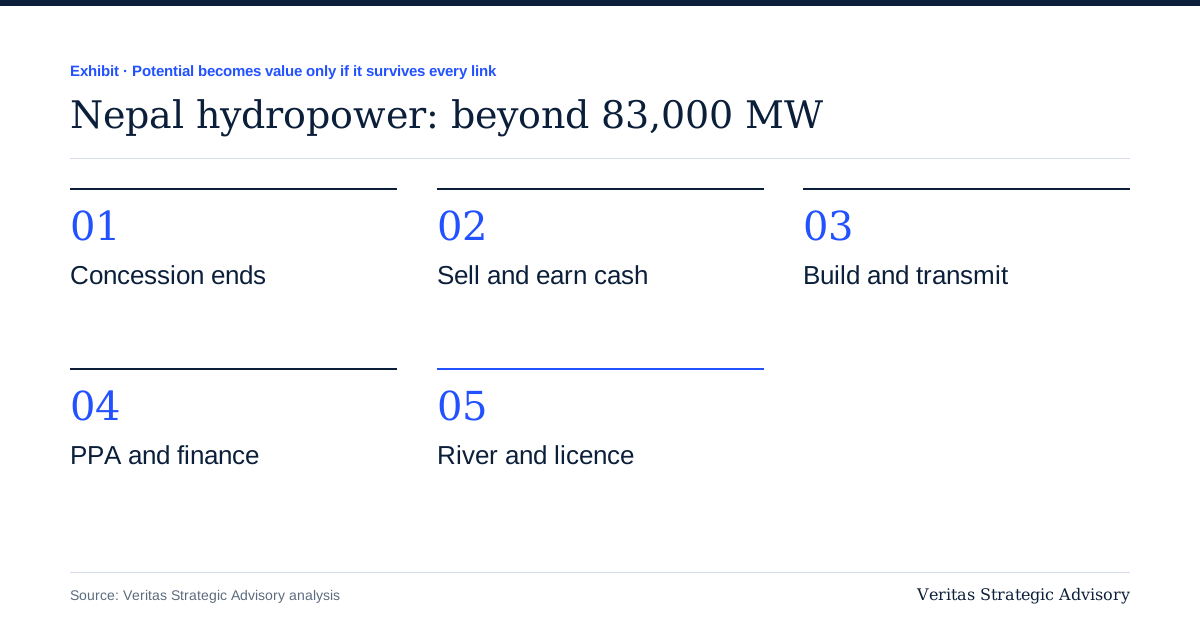
It does not say which projects can be financed, which can generate in the dry-season shortage, which can reach a paying buyer, which can survive Himalayan geology and climate, or what happens to shareholders when a concession ends.
This article follows the full chain, from river to revenue to the day the asset returns to the state. The central question is simple: can Nepal turn hydropower potential into dependable electricity, industrial growth, exports and sustainable economic value?
*Data and regulatory information reviewed through October 2026. This is analysis, not investment advice.*
The short version
Potential is not value. Theoretical, licensed, operating, dependable, exportable and cash-generating capacity are different things.
The binding constraint is moving. Nepal increasingly needs transmission, storage, market access and bankable offtake, not only more project proposals.
Dry-season energy is worth more. A project that generates mostly in the monsoon can be worth less than a smaller project with strong winter output.
A PPA is not bankability. A signed power purchase agreement does not remove construction, transmission, financing or generation risk.
Climate risk is a financial-model variable. Floods, landslides and sediment change cash flow, debt service and insurance.
The BOOT clock matters. A shareholder owns a claim on a company's finite concession cash flows, not the river or the dam forever.
Where Nepal stands today
| Measure | Latest reported figure |
|---|---|
| Installed generating capacity | About 3,600 MW at the end of FY 2024/25 (reported 3,591 MW) |
| Electricity exported to India | Up to about 1,200 MW |
| Electricity imported | Around 750 MW |
| Medium-term export deals | 400 MW to Haryana, up to 200 MW to Bihar |
| Reported export earnings | About NPR 29.3 billion |
Sources: NEA, A Year in Review; Nepal Republic, installed capacity tracker.
Against the 83,000 MW headline, Nepal has built a small fraction. That is why the useful question is not how much potential exists, but how much of it can pass every stage from resource to cash.
1. The hydropower value ladder
Each stage removes a different kind of uncertainty. Investors and lenders care about the last rows, not the first.
| Stage | What it means | What it does not prove |
|---|---|---|
| Theoretical potential | Physical energy in the rivers | That any project is buildable |
| Technically developable | Possible with available engineering | That it makes money |
| Economically viable | Acceptable return after cost, tariff and market access | That a licence or financing exists |
| Licensed | Survey or generation rights granted | That it is bankable |
| Financially closed | Funding legally committed | That it will be built on time or on budget |
| Under construction | Physically being built | That geology, cost and climate risks are resolved |
| Operational | Built and connected | That it is dependable in the dry season |
| Dependable | Available when the system needs it | That the power can be sold |
| Exportable | Has a buyer, a line and a legal route | That it earns enough after debt |
| Cash-generating | Pays costs, debt service and taxes with cash left | Nothing further |
The Department of Electricity Development publishes a large pipeline of survey and generation licences (DoED licence lists). A large pipeline can mean real interest. It can also mean speculative licensing, fragmented development and future bottlenecks on transmission and PPAs.
2. From river to revenue
Hydropower turns water flow and height into electricity. In simplified form, power depends on flow, head (the height the water falls) and equipment efficiency. Nepal's advantage is steep terrain, which gives high head over short distances. But physical advantage does not create financial value without year-round flow, workable geology, a bankable PPA, affordable finance, transmission and a paying market.
Installed capacity is not annual energy
A 100 MW plant at a 50% capacity factor produces about 438 GWh a year (100 MW x 8,760 hours x 50%). That does not mean it supplies 50 MW all year. It may run near full output in the monsoon and a fraction of that in the dry season. Keep these separate:
| Term | Meaning |
|---|---|
| Installed capacity | Maximum instantaneous output |
| Annual generation | Total electricity produced in a year |
| Capacity factor | Actual output compared with the maximum possible |
| Firm energy | Energy reliably available under defined conditions |
| Peak capacity | Capacity available in high-demand hours |
Three project types
| Type | Strength | Weakness |
|---|---|---|
| Run-of-river | Faster, cheaper, familiar to lenders | Large seasonal swings, weak dry-season output, flood and sediment exposure |
| Peaking run-of-river | Can shift output to evening peaks | Extra storage cost must be justified by the value of flexibility |
| Reservoir | Dry-season supply, firm capacity, grid stability | Large capital need, resettlement, complex geology, long build time |
Run-of-river plants let Nepal add capacity quickly. They do not, on their own, solve the winter deficit. Storage does, but it needs a different approach to tariffs and risk allocation.
Plan by river basin, not by project
Projects on the same river interact. A cascade can reuse water and share roads and lines, but it also stacks cumulative risk: altered sediment flow, blocked fish migration, repeated land acquisition and shared exposure to one flood. A project that looks good alone may look worse when the whole basin is counted. Serious feasibility work therefore needs long-term river gauging, sediment data, flood-frequency analysis and climate-adjusted scenarios. A 10% generation shortfall can cut equity returns far more than 10%, because debt service and fixed costs do not fall.
3. The bankability chain
A project can fail at any link in this chain:
Resource, licence, PPA, finance, construction, transmission, market, cash flow, valuation, concession.
A survey licence is not a project. A PPA is not financial closure. Financial closure is not commissioning, and commissioning is not stable operation.
Nepal's licensing rests on the Electricity Act, 2049 and the Hydropower Development Policy, 2058, which promotes private investment through a BOOT model. The exact rights and duties of any project come from its own licence, PPA, project agreement, approvals and financing documents.
4. Engineering and construction risk
Nepal's hydropower is a geology business as much as a water business. The Himalayas are young and tectonically active, so projects face fault zones, weak rock, high groundwater, landslides and heavy sediment. Tunnels are often the most uncertain cost. Weak rock or unexpected water slows excavation, and every month of delay adds interest during construction, contractor claims and lost revenue, while the concession clock keeps running.
Sediment adds a second problem. Silt-heavy monsoon flows wear turbines, block intakes and force outages, so desanding, flushing and turbine materials belong in the financial model, not only the engineering report.
Cost overruns become equity risk. If cost rises, lenders may ask for more promoter equity, more collateral or a revised loan. If promoters cannot pay, shareholders face rights issues, dilution, lower dividends or a distressed sale. The dangerous project is not the one with the highest cost. It is the one whose model cannot absorb a delay, an overrun, a generation shortfall or a transmission failure.
5. The PPA and the value of electricity
A PPA converts generation into contracted cash flow. It sets capacity and energy, seasonal tariffs, escalation, the commercial operation date, dispatch, curtailment, payment security and termination.
Nepal's framework values dry-season energy more than wet-season energy. For run-of-river projects, the NEA tariff is:
| Season | Tariff for run-of-river energy |
|---|---|
| Wet (June to November) | NPR 4.80 per kWh |
| Dry (December to May) | NPR 8.40 per kWh |
| Escalation | 3% on the base tariff, applied eight times after 12 months of operation |
Sources: Kathmandu Post; Nepal Energy Forum. Peaking and storage projects have separate rates, and these rates depend on each project's own PPA and regulatory approvals, so check the signed document.
A reservoir provides energy, capacity, flexibility and dry-season security. If its PPA pays only per kilowatt-hour, it is not paid for most of the value it creates. A fuller framework would add capacity, peak-hour, availability and ancillary-service payments, plus inflation and foreign-exchange protection.
A signed PPA is necessary but not enough. Lenders also test the buyer's ability to pay, transmission readiness, sponsor equity, construction schedule, approvals, export arrangements and change-in-law protection.
6. Transmission and the market
A plant is not finished when the turbine spins. It is finished when power reaches a paying customer. A plant can be technically ready yet constrained because the evacuation line is late, the corridor is blocked, the grid is congested or an export link is missing. That is curtailment: the plant could generate, but cannot sell. Debt, salaries, insurance and maintenance still have to be paid.
Nepal cannot rely on exports alone. Productive domestic demand is more valuable: manufacturing, cement, steel, irrigation, cold storage, agro-processing, electric cooking and electric vehicles. Industry runs at high load factors, absorbs surplus power, creates jobs and cuts fuel imports.
Regional power trade
India is the natural export market, with proximity, scale and existing links. Nepal and India agreed to a framework under which India would facilitate imports of up to 10,000 MW from Nepal over ten years (Xinhua). Export capacity is not export revenue, though. A project still needs eligibility, a buyer, a price, payment security, curtailment terms and political continuity.
Bangladesh offers diversification, but power must transit India, which adds wheeling charges and coordination. A China route has strategic value but faces high-altitude terrain and long lead times. Exports should serve domestic industrialisation and resilience, not create dependence on one buyer.
7. Environmental and social licence
Hydropower is renewable, not impact-free. Projects can clear forest, fragment rivers, change sediment flow, block fish migration, take farmland, displace households and raise landslide risk. The useful question is which projects create the most net public value after counting energy, climate, ecology and social justice.
Project-by-project assessments can miss cumulative damage, so basin-level assessment matters. Environmental flows should follow the river's seasons, not a single fixed percentage. Compensation is not livelihood restoration; serious resettlement plans cover replacement land, income, skills, local jobs and grievance channels. Local shares can share benefits and build acceptance, but they do not replace fair compensation, safeguards or consultation.
8. Climate risk is a financial-model variable
Nepal's hydropower is exposed to extreme rain, flash floods, landslides, debris flows, glacial lake outbursts, changing snowmelt and sediment.
The 26 August 2026 flood showed the scale. A debris surge down the Bhote Koshi removed about 431 MW of operating capacity from the grid, close to a tenth of national installed capacity. A further 470 MW of plants under construction was damaged, a major 220 kV substation at Trishuli was destroyed, and around 13 projects were hit, with damage estimated near NPR 100 billion (Fortune; Mongabay; 2026 Nepal floods). One plant, Rasuwagadhi, was destroyed after having been rebuilt at the same site following a similar failure 14 months earlier (Nature).
The loss reached beyond physical assets: exports, domestic supply, transmission, access roads, debt service, insurance claims and investor confidence. Projects now need updated flood design, spillway and intake protection, slope stability, early-warning systems and recovery plans. The cost of resilience is visible before a disaster. The cost of too little becomes visible when revenue stops and debt does not.
9. Financing the Himalayan megaproject
Hydropower is commonly financed with roughly 65 to 70% debt and 30 to 35% equity, though structures vary. Debt lifts equity returns when a project performs, and magnifies losses when it does not.
The key measure is the debt-service coverage ratio (DSCR): cash available for debt service divided by debt service due. A project can show accounting profit and still have weak cash after principal, interest, tax, maintenance and working capital. Other useful measures are project and equity IRR, loan-life coverage, cost per MW and debt per MW.
Delay is expensive. If a project carries NPR 10 billion of debt at 10% and is two years late, interest alone can approach NPR 2 billion before capitalisation and lost revenue. A project-finance model should therefore be tested against a two-year delay, a 15 to 20% cost overrun, a generation shortfall, higher interest, curtailment, a flood outage and an extra equity call.
10. The BOOT clock
BOOT stands for build, own, operate, transfer. Under the 2058 policy framework, generation licences were generally structured around 35 years for domestic-supply projects and 30 years for export projects. These are not a rule for every project. The actual period comes from the project's licence, PPA, agreement, approvals and any amendments, and the Electricity Act allows other periods in some cases.
For projects under a BOOT framework, private economic rights are finite. A shareholder owns shares in the project company. They do not own the river, the licence in perpetuity, or the asset after transfer unless the contracts say so. The investment is a claim on the company's cash flows during the concession, plus any other assets and rights it holds.
The BOOT discount
Take two companies, each with 100 MW, similar revenue, dividends and profit. One has 28 years of concession left, the other 12. They should not be worth the same. The shorter one has less time to recover equity, a bigger terminal-value problem, nearer rehabilitation costs and more transfer risk. That gap is the BOOT discount: an adjustment for the finite economic life of the concession.
A worked example
Suppose annual free cash flow is NPR 500 million, 20 years remain and the discount rate is 12%.
| Valuation approach | Value |
|---|---|
| Finite concession, 20 years, no terminal value | About NPR 3.73 billion |
| Treated as a perpetual company (500 / 12%) | About NPR 4.17 billion |
| Overstatement from ignoring the end date | About NPR 0.44 billion, or roughly 12% |
A BOOT project should be valued as: present value of cash flows until licence expiry, plus present value of other assets, minus net debt, minus transfer obligations. It should not be valued as if it lasts forever.
At transfer, outcomes differ by case. The company may wind down and distribute cash; continue with other projects; seek a renewal, which should not be assumed without legal support; receive compensation where an agreement provides it; or be restructured under a new concession. How listed shareholders are treated at transfer remains a legal and valuation question, and investors should not assume a listed share automatically keeps the value of a transferred project.
11. Listed hydropower and the value of a share
Hydropower companies raise capital through IPOs, rights issues, promoter and local shares, institutional debt and debentures. A share issued at a nominal NPR 100 does not mean every project is worth the same. The price does not reflect construction risk, debt, PPA quality, transmission, remaining concession or sponsor strength.
Before buying, an investor should look at project stage, PPA, cost per MW, debt-to-equity, interest rate, schedule, financial closure, sponsor history, transmission, remaining BOOT life and the use of funds. A rights issue can fund a viable expansion or repair past mistakes; the question is whether new capital creates future value or covers old losses.
On the secondary market, a buyer purchases an existing holder's claim and the company receives nothing directly, but price discovery and liquidity still affect its ability to raise capital later. Fundamental value rests on generation, tariff, costs, debt, taxes and remaining licence. Market price also reflects sentiment, IPO supply, interest rates and rumour. The two can diverge for a long time. Two 50 MW companies can differ widely in value because of cost, debt, tariff, dry-season output, transmission, sponsor quality, remaining concession and maintenance needs, which is why market value per MW alone says little.
12. The Veritas hydropower test
Every project should pass six tests.
| Test | Core question | What to check |
|---|---|---|
| Resource | Is the hydrology reliable? | Years of flow data, gauge location, dry-season output, sediment, climate scenarios |
| Execution | Can it be built at the assumed cost and time? | Tunnel geology, fault mapping, contractor, access roads, contingency, two-year-delay case |
| Market | Can the power actually be sold? | Signed PPA, buyer, dry-season value, export approval, curtailment terms, domestic demand |
| Finance | Can it service debt and reward equity? | Cost and debt per MW, DSCR, fixed vs floating rate, refinancing, ability to fund overruns |
| Concession | What happens when the licence ends? | Years left, PPA end date, transfer duties, rehabilitation, compensation, other assets |
| Resilience | Can it survive climate and disaster risk? | Flood design, GLOF and sediment plans, road and line redundancy, insurance, recovery time |
A project that passes the resource test but fails the market, finance or concession test is not a strong investment. Quality is multidimensional.
13. What comes next
Storage is the most important gap. Reservoir and pumped-storage projects can supply dry-season and peak power, absorb monsoon surplus and support solar. Batteries can provide short-duration balancing and frequency regulation, but are unlikely to replace seasonal reservoirs at national scale under current economics. Nepal should also avoid becoming only a raw electricity exporter. A stronger path combines domestic industry, electric cooking, irrigation, storage, transmission and regional exports.
Three plausible sector scenarios, none a forecast:
| Scenario | What would have to be true | Likely pattern |
|---|---|---|
| Strong rerating | Transmission completed, export approvals widen, industrial demand grows, interest rates fall, NEA pays on time | Operating and dry-season assets lead; the market may price in exports before the infrastructure exists |
| Selective consolidation (plausible base case) | Capacity keeps rising faster than the system can finance and transmit it; PPAs become selective; banks tighten | Strong operators outperform; weak developers face dilution; valuation shifts from MW to cash flow |
| Stress | Delays continue, rates stay high, generation falls short, floods recur, BOOT treatment stays unclear | Rights issues dilute, dividends fall, near-expiry assets trade at a discount |
14. What Nepal needs to reform
Integrated planning with a transparent least-cost power plan covering demand, exports, seasonal balance, storage and transmission sequence.
Pay for what the system needs: bulk energy, dry-season energy, peak capacity, reserve and flexibility are different services and cannot all be bought with one energy-only tariff.
Transmission first: link generation approvals to evacuation capacity, corridors, funding and curtailment rules.
Reservoir reform: independent geological review, open-book cost checks, capacity payments, foreign-exchange protection and strong project offices.
BOOT clarity: publish transfer conditions, shareholder treatment, compensation, renewal and rehabilitation rules. Unclear treatment is itself an investment risk.
Climate resilience built into design, standards and insurance.
Capital-market transparency on PPA status, generation, cost, debt, delay history, ownership, related-party deals and licence expiry.
The takeaway
The 83,000 MW figure is not an investment thesis. The investable thesis is harder: build the right megawatts, at realistic cost, with transmission ahead of the bottleneck, paid for flexibility and not only energy, used to build domestic industry, exported strategically, designed for climate extremes, and valued on cash flow, debt and remaining concession life.
The strongest opportunities are likely to be operating cash-generating plants, strong dry-season and storage projects, low-cost projects with credible sponsors and transmission access, and the grid and engineering businesses around them. The weakest are likely to be high-cost projects without transmission certainty, plants that generate mainly in the oversupplied monsoon, developers dependent on repeated rights issues, and near-expiry projects with unclear transfer treatment.
The question that matters is not how many megawatts Nepal can theoretically build. It is how much dependable, commercially valuable and fairly shared economic value those megawatts can create before each project returns to the state.
How this matters for sponsors and lenders
A hydropower project should be judged on the interaction of its economics, contracts, financing, construction risk, transmission, tax, accounting, cash flow and concession life, not on installed capacity or headline cost. Veritas works on the valuation, financial modelling and loan documentation side of that picture. See our business valuation, financial advisory and modelling and bank loan documentation services.
Sources
Nepal Electricity Authority: A Year in Review
Nepal Republic: installed capacity tracker
Department of Electricity Development: licences
Electricity Act, 2049
Hydropower Development Policy, 2058
Kathmandu Post: electricity purchase bill
Nepal Energy Forum: small hydropower PPAs
Xinhua: Nepal-India power trade agreement
Fortune: Nepal floods and hydropower
Mongabay: flood disaster and hydropower-first strategy
Nature: rebuilt Rasuwagadhi plant re-destroyed
2026 Nepal floods
*This article is general analysis for information. It is not investment, legal or tax advice, and it does not recommend buying or selling any security. Figures should be checked against the project's own documents and the latest NEA and regulator releases before any decision.*