By the time the first NFRS accounts are signed, the work has already covered two prior year ends.
What adoption requires
a transition date, being the start of the earliest comparative period presented
a restated opening balance sheet at that date
restated comparatives for the prior year
reconciliations of equity at both dates and of profit or loss for the comparative year, between the previous framework and NFRS
So to report under NFRS for a year ending Ashadh 2084, with one comparative year, the transition date is the start of the comparative year. Your opening balance sheet is built from a position that closed two years ago.
Why the opening balance sheet overruns
Everything else follows from it arithmetically. The opening balance sheet requires information about transactions nobody expected to revisit.
What typically has to be reconstructed:
Property, plant and equipment. Component-level detail and useful lives, where the fixed asset register was maintained at a summary level.
Leases. Contract terms, renewal options, and a discount rate as at a historical date.
Employee benefits. An actuarial valuation as at the transition date, not just the current one.
Financial instruments. Classification of balances and an impairment assessment on receivables outstanding at a date already closed.
Deferred tax. Recomputed on temporary differences across every restated item above.
Each is answerable. Each takes longer than expected because the source information was never collected for this purpose.
Where the time goes
In our experience the split is roughly: a quarter of the effort on deciding accounting policies, three quarters on assembling evidence for the opening position. Teams plan for the reverse.
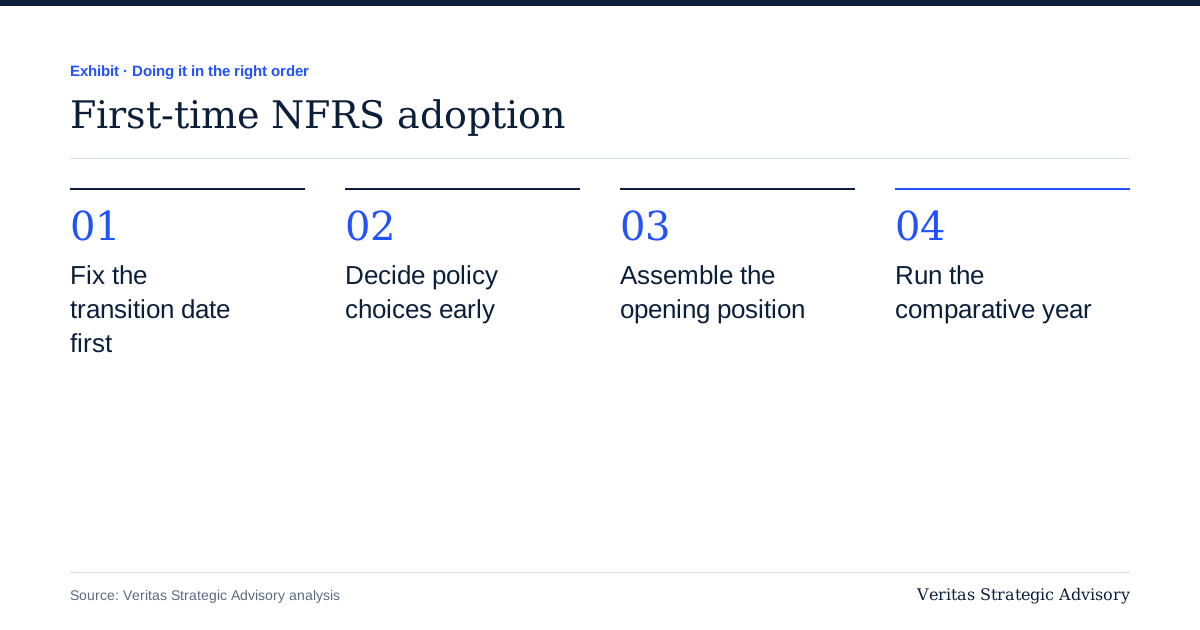
Doing it in the right order
Fix the transition date first. Everything else is defined relative to it.
Decide policy choices early, including any first-time adoption exemptions you intend to use. Changing a policy after the opening balance sheet is built means rebuilding it.
Assemble the opening position before touching the current year.
Run the comparative year on the new basis.
Prepare the reconciliations as you go, not at the end. They are a disclosure requirement and they are also your own check that the restatement holds together.
Brief the board on what moves, before the numbers appear. Adoption changes reported profit and gearing without anything changing in the business, and that explanation lands better in advance.
The one decision that saves the most time
Start the exercise before the transition date has passed, where you can. Knowing in advance that a year will become a comparative year changes what you collect during it, and collecting contemporaneously costs a fraction of reconstructing later.
Where the date has already passed, the project is still entirely doable. It is just an evidence exercise rather than a bookkeeping one.
The dates, worked out
Suppose your first NFRS accounts are for the year ending Ashadh 2084, with one year of comparatives. The comparative year is Shrawan 2082 to Ashadh 2083, so the transition date is 1 Shrawan 2082, and the opening balance sheet is the position at the close of Ashadh 2082.
That arithmetic matters because, as of October 2026, that date has already passed. You are not choosing whether to prepare an opening balance sheet at a historical date; you are reconstructing one. The advice below is written for that case, and it works equally if you are still ahead of the date.
First-time adoption exemptions: choose them deliberately
The first-time adoption standard lets a new adopter *elect* some reliefs, and requires some exceptions. Elections are one-way: you decide once, at transition, and apply them to the opening balance sheet. The most used:
Deemed cost for property, plant and equipment. Instead of rebuilding original cost less depreciation component by component, you may take fair value (or a previous revaluation) at the transition date as the new cost. For businesses with poor historical records it is often the difference between a project that finishes and one that does not. It also resets future depreciation, so the profit effect should be modelled first.
Leases. A first-time adopter may assess whether contracts contain a lease, and measure the liability, using facts and a discount rate *at the transition date* rather than at lease inception.
Employee benefits. Cumulative actuarial gains and losses may be set to zero at the transition date, with the adjustment taken to retained earnings, rather than recomputing back to inception.
Business combinations. You may choose not to restate combinations before the transition date.
Mandatory exceptions limit the other direction. For example, estimates made at transition must be consistent with those made under the previous framework for the same date, unless there is evidence of error. Hindsight cannot be used to improve the opening position.
What the reconciliations must show
Two reconciliations are required, and a third is good practice:
Equity under the previous framework to equity under NFRS, at the transition date and at the end of the comparative year.
Profit or loss for the comparative year, previous framework to NFRS.
Cash flows, where the previous framework presented them differently, with the explanation.
Each adjustment is labelled by cause: PPE deemed cost, lease recognition, employee benefits, expected credit losses, deferred tax. A reader should be able to see which standards moved the numbers, by how much, and why.
Worked pattern for one adjustment
Take an employee benefit liability that was previously unprovided (illustrative figures). At the transition date an actuary measures the gratuity obligation at NPR 8 million. The entry debits opening retained earnings and credits a liability, for 8 million, and a deferred tax asset is recognised on the temporary difference if recoverable. The reconciliation shows equity down by the net amount. In the comparative year, the current service cost and the interest cost go through profit, and the reconciliation of profit shows them as an NFRS adjustment. The same pattern, a debit to opening equity and a ripple through the comparative year, repeats for leases, impairment and the rest.
A realistic work plan
Weeks 1 to 2: scope. Fix the transition date. List the standards that change your numbers and decide the elections. Agree what the auditor expects to see.
Weeks 3 to 8: evidence. Assemble the contracts, registers and balances at the transition date. This is the longest phase, and its quality determines the rest.
Weeks 9 to 10: opening balance sheet. Post the adjustments and reconcile equity.
Weeks 11 to 14: comparative year. Re-run the year on the new basis and prepare the profit reconciliation.
Weeks 15 to 16: disclosures and review. Complete the disclosure checklist, prepare the board paper, and agree the position with the auditor before the current year closes, not after.
These are planning ranges for a mid-sized company with a handful of leases and a manageable asset base. Complex groups take longer.
Questions the board should ask
What is the effect on equity at the transition date, and on profit in the comparative year?
Which elections did we make, and what does each do to future profit?
Does any loan covenant or dividend policy depend on figures that have now moved?
Who has signed off the opening balance sheet, and what is the evidence behind it?

---
*Reviewed by Roshan Bhattarai, Strategic Advisory Lead, September 2026. General guidance, not advice on your circumstances.*
If you want help scoping the transition, see our NFRS and financial reporting capability. To confirm which standard applies first, read NFRS applicability in Nepal.