- borrowed to buy the shares
- Rs. 30 crore
- interest claimed
- Rs. 2.78 crore
- interest rate
- 9.25%
- Income Tax Act section
- 14(1)
A hotel borrows from a bank and uses the money to buy shares in another hotel company. Can it deduct the interest on that loan? The Large Taxpayers Office said no. The Supreme Court said yes, and the reasoning matters to any business that finances an investment with debt.
In simple terms: when you take a business loan or an overdraft (OD) and the cash goes toward stock, machinery or salaries, nobody argues about the interest, it is deductible. The confusion starts when that same borrowed money goes toward buying shares in another company instead. Tax officers have often treated that as a capital purchase, something you invest in for the long term, and disallowed the interest entirely. This case is the clearest answer yet on whether that view is correct.
What was the dispute about?
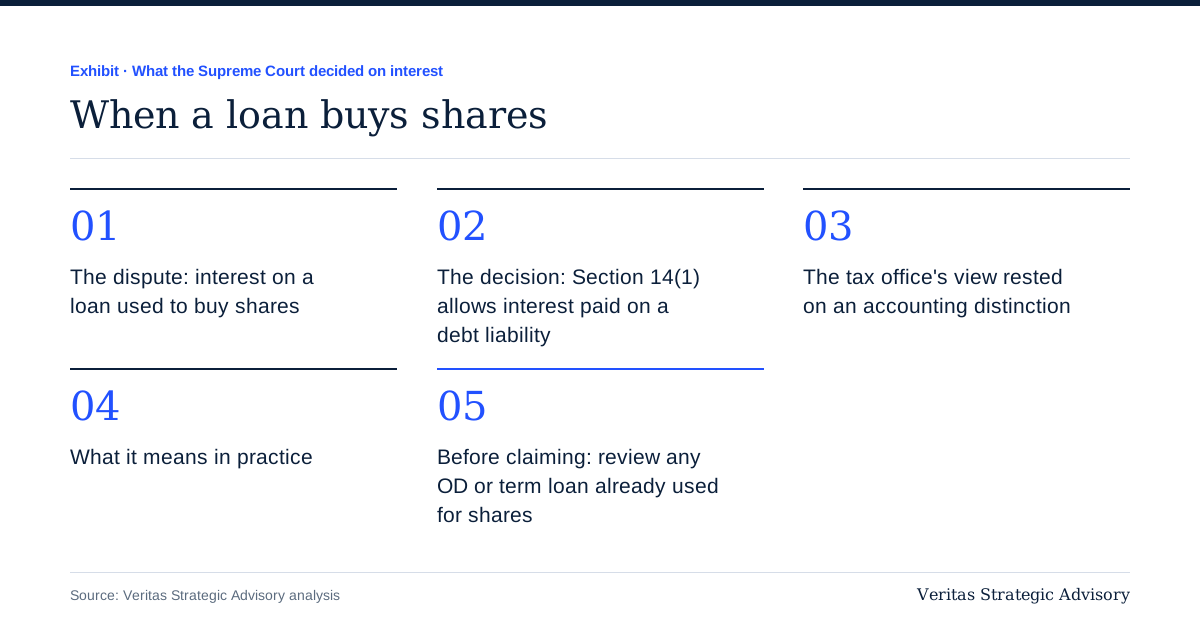
In FY 2061/62, Yak & Yeti Hotel Ltd. used Rs. 30 crore of bank borrowing to buy right shares in Taragaon Regency Hotel Ltd., a related business in the same hospitality sector. It claimed the interest, about Rs. 2.78 crore at 9.25%, as a deductible expense under Section 14(1) of the Income Tax Act, 2058.
The Large Taxpayers Office disallowed it and added the amount back to taxable income, arguing that interest on a loan used to buy shares is a capital cost, not an expense tied to earning business income in that year. The Inland Revenue Department upheld that view on review. The Revenue Tribunal disagreed and allowed the deduction. The LTO appealed to the Supreme Court.
What did the Supreme Court decide?
Section 14(1) allows interest paid on a debt liability to be deducted where that debt was created to derive income from a business or investment. The Court found nothing in the Act that bars a business from borrowing to buy equity in an allied company, and no provision that strips the deduction simply because the asset acquired is shares rather than plant or stock.
It dismissed the LTO's appeal and upheld the Tribunal's decision: interest on a loan taken to buy shares in an allied enterprise in the same line of business is deductible under Section 14(1).
*Supreme Court of Nepal, Joint Bench, Poush 27 2077 (11 January 2021). Large Taxpayers Office v. Yak & Yeti Hotel Ltd., case no. 153893.*
Why did the tax office say the interest was not deductible?
The LTO's position rested on a common accounting distinction: revenue expenditure (day-to-day costs of running the business) versus capital expenditure (money spent acquiring an asset you hold). Shares are a textbook capital asset. On that logic, any interest tied to buying them should sit with the asset, not reduce this year's taxable income.
The Court's answer was narrower and more useful than a broad ruling either way. Section 14(1) does not ask what the borrowed money bought. It asks whether the debt was created to derive income from a business or an investment. Shares in a company are, by definition, an investment. So a loan taken to acquire them already satisfies the test Section 14(1) sets, regardless of whether the shares themselves throw off cash immediately. The "capital asset" label the LTO relied on turned out to be legally irrelevant to this specific question.
What does this mean in practice?
The link the Act requires is "investment," not "same-year revenue." Money borrowed to acquire an income-producing asset, including shares, can carry deductible interest even though the shares themselves generate no immediate operating income.
"Allied enterprise, same industry" mattered to the facts here. The ruling does not say every share purchase automatically qualifies; it says the tax office cannot disallow one on the say-so that shares are capital in nature, without a specific statutory bar.
Document the commercial purpose at the time of borrowing. Board minutes, loan agreements and the stated purpose of the facility are what a taxpayer relies on if the deduction is later questioned. Yak & Yeti's ability to show a hospitality-sector rationale was central to its case.
This does not open every interest deduction. Loans used for personal purposes, or for assets with no connection to deriving business or investment income, remain outside Section 14(1). The test is the purpose of the debt, not merely that it was incurred.
What should you check before claiming the interest?
If you have already used an OD or term loan to buy shares, or you are planning to, these are the practical questions an assessment will turn on:
What did the loan agreement and the board resolution say the money was for? If the paperwork is silent or vague, the tax office has more room to argue the purpose was something else.
Is there a plausible business or investment rationale, on paper, at the time of borrowing? Yak & Yeti could point to the fact that Taragaon Regency was in the same hospitality line. A random, unrelated shareholding is a weaker position, even though the statute does not name "related industry" as a formal requirement.
Is the interest rate and loan structure normal, or does it look designed purely to generate a deduction? Assessors look harder at arrangements that seem set up for the tax result rather than the business result.
Are you tracking the loan against the specific share purchase, not blended into general working capital? If the OD funds ten different things, showing which rupees went where matters when you are questioned two or three years later.
None of this changes the law the Court applied. It changes whether you can prove your facts fit it.
Frequently asked
Is interest on a loan used to buy shares deductible in Nepal?
In the Yak & Yeti case the Supreme Court held that it was, under Section 14(1), where the debt was created to derive income from a business or investment.
Does the ruling apply to any share purchase?
Not automatically. The shares in that case were in an allied company in the same hospitality line, and the borrower could show its commercial purpose. Facts matter.
Does it matter that the shares pay no dividend straight away?
According to the Court's reasoning, the test is the purpose of the debt, not whether the shares produce income in the same year.
What records should we keep?
The loan agreement, the board resolution stating the purpose, and a record tying the borrowing to the specific purchase.
Where else does the tax office challenge deductions?
See income tax reclassification in Nepal and how the IRD selects companies for tax audit.
How Veritas can help
If your business is financing a share purchase, an acquisition or an intra-group investment with debt, talk to our team before the loan is drawn down (see our tax consultant service). How the purpose is documented at that point is what determines whether the interest survives an assessment later.
General information only, not advice.