This is how a food business builds that answer, and why it comes before the pitch.
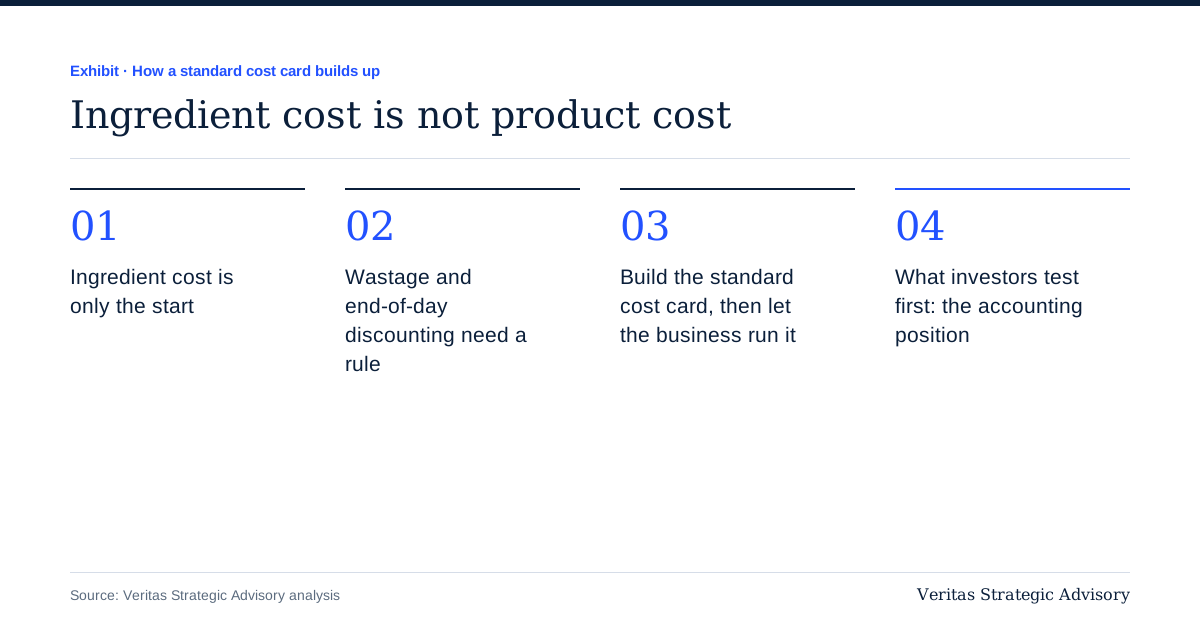
Ingredient cost is not product cost
Most food businesses price on ingredients plus a mark-up, then adjust to whatever the nearest competitor charges. That number leaves out most of what it costs to make and sell a product. A defensible unit cost has seven layers:
| Layer | What goes in | Where it usually hides |
|---|---|---|
| Ingredients | Recipe quantities at current purchase prices, including trim and yield loss | Price changes not reflected in the recipe |
| Direct labour | Minutes of production time per unit multiplied by the loaded wage rate | Skilled decoration time averaged with simple bakes |
| Energy and equipment | Oven, refrigeration and mixing time per batch | Treated as general overhead |
| Packaging | Box, board, ribbon, card, labelling per unit | Bought in bulk and charged to expenses |
| Wastage | Failed batches, expiry, end-of-day unsold stock | Accepted as unavoidable and costed to nothing |
| Delivery and channel cost | Rider cost, fuel, platform commission, payment fees | Sits in general expenses, not against the order |
| Allocated overhead | Rent, management, marketing, apportioned on a stated basis | Not allocated, so every product looks profitable |
Build the standard cost card, then let the business run it
The most useful output is not a spreadsheet of results but a format the business can use to cost any new product itself. A standard cost card per product has: recipe and yield, labour minutes by stage, equipment minutes, packaging list, expected wastage, channel costs and the overhead allocation rule. The team updates it when input prices change, and the price follows the card, not the competitor.
An illustrative cost card
The numbers below are hypothetical. They show how a product that looks profitable on ingredients can be marginal once everything is included.
| Line | NPR |
|---|---|
| Selling price (delivered) | 1,800 |
| Ingredients | 520 |
| Direct labour (55 minutes) | 210 |
| Energy and equipment | 60 |
| Packaging | 110 |
| Wastage allowance (6%) | 60 |
| Delivery and payment fees | 190 |
| Contribution before overhead | 650 |
| Allocated overhead | 420 |
| Profit after overhead | 230 |
On ingredients alone, this cake appears to earn NPR 1,280 on a 1,800 sale (71%). After the seven layers it earns NPR 230 (13%). A plain everyday cake with lower labour and packaging might earn more per unit than the signature cake the business promotes most. That is the finding that changes pricing and mix.
Wastage and end-of-day discounting need a rule
Wastage is the line most often accepted and never costed. Track it by product, since some products lose far more than others. Then set a floor price for end-of-day stock so that outlet staff are not discounting without a rule. A sensible floor is at least the variable cost that cannot be recovered any other way. Selling below it turns unsold stock into a loss instead of a smaller profit.
What investors actually test
An investor will not start with the pitch deck. They will start with the questions the costing answers:
Contribution margin per order, after delivery and channel costs.
Average order value and repeat rate, and how each moves with product mix.
Which products drive the margin, and whether growth comes from those or from the low-margin ones.
Working capital, meaning how quickly cash goes out for ingredients and comes back from sales.
Whether the accounts support the numbers. If the books are behind, diligence finds it within days.
A raise is won or lost on whether the unit economics survive questioning. The costing is not preparation for the pitch. It is the substance of it.
The order of work
Assess the accounting position first, and list what must be corrected before an investor sees the books.
Build the costing model and the standard cost card format.
Build the financial section (unit economics, revenue build, projections) from the same model.
Prepare the deck around those numbers, so the story and the model reconcile to each other.
An engagement of this shape typically runs six to eight weeks.
How Veritas Can Help
We build the costing model and cost-card format, tidy the accounts an investor will test, and build the financial section and pitch deck from the same numbers. Talk to our team, or see our business performance capability and the related case studies on bakery costing and cake delivery and fundraising.