What now?
Two mistakes are common. Some taxpayers assume the assessment is final and pay it. Others hope to settle it informally and let the legal deadlines pass. Both can be costly. Nepal has a structured route for disputing an assessment, with fixed deadlines and deposits. This guide explains it under the Income Tax Act, 2058. Other taxes follow similar routes under their own Acts, so check the one that applies to you.
This is general information, not advice on a specific dispute. Deadlines are strict, so confirm the current law and your own dates with an adviser straight away.
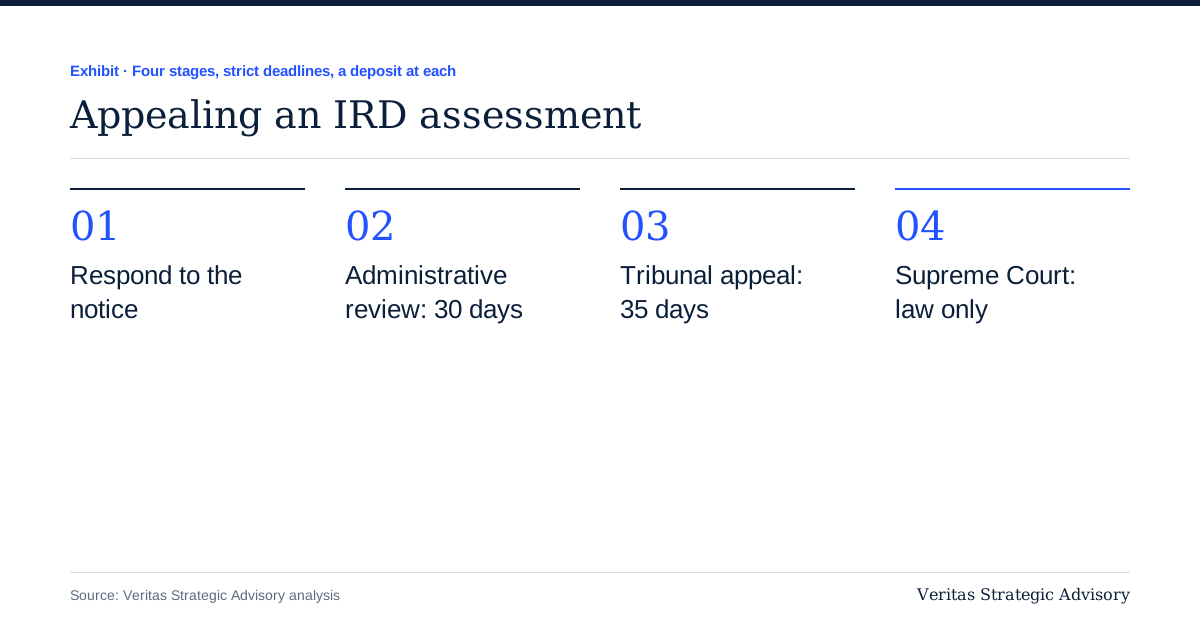
The route at a glance
| Stage | Where | Deadline | Deposit |
|---|---|---|---|
| 1. Respond to the notice | The tax office | As stated in the notice | None |
| 2. Administrative review (Section 115) | The Department (IRD) | 30 days from receiving the decision | Undisputed tax, plus 25% of the disputed tax |
| 3. Appeal (Section 116) | Revenue Tribunal | 35 days from receiving the review decision, or from the date it is deemed rejected | Undisputed tax, plus 50% of the disputed tax, charge and fine, or a bank guarantee for that amount |
| 4. Further appeal | Supreme Court | Check the current procedure | Check the current procedure |
Sources: Section 115 and Section 116; see also Mondaq on tax litigation in Nepal.
If the Department does not decide the review within 60 days, the application is treated as rejected. You do not have to wait. The 35-day clock for the Tribunal starts from that date.
Stage 1: the response to the notice
Your response to the first notice is the foundation of any later challenge. What you submit and the positions you take will matter in every later stage. Prepare it with the care of a legal submission, because it will be read that way if the matter escalates. Our guides on what to do when a tax notice arrives and how the IRD selects companies for audit cover this stage.
Stage 2: administrative review
An application for administrative review goes to the Department within 30 days of receiving the decision. The deposit is the undisputed tax plus 25% of the disputed tax. The deposit is not an admission. If you succeed it is adjusted or refunded, and it counts toward the larger deposit at the Tribunal.
Stage 3: the Revenue Tribunal
An appeal under Section 116 must be filed within 35 days of the review decision, or of the date it is deemed rejected. Missing this deadline can close the appeal.
To file, you provide the undisputed tax, and 50% of the disputed tax, charge and fine, or a bank guarantee for the same amount. The 25% already paid at the review stage counts toward it. The option of a bank guarantee instead of cash helps companies that have a strong case but limited cash.
Worked example (hypothetical numbers). An assessment of NPR 10 million of disputed tax and a fine of NPR 1 million, with NPR 2 million of tax not in dispute:
| Step | Amount |
|---|---|
| Review stage: undisputed tax | NPR 2.0 million |
| Review stage: 25% of NPR 10 million disputed tax | NPR 2.5 million |
| Tribunal: 50% of NPR 11 million (tax plus fine) | NPR 5.5 million |
| Less the 25% already paid | NPR 2.5 million |
| Further amount to provide for the Tribunal (cash or guarantee) | NPR 3.0 million |
Confirm how the credit is applied in your case, because exact calculation depends on how charge and fine are treated.
The Tribunal is a full forum. It does not simply review the Department's reasoning; it can examine the law and the facts. That is an opportunity and a duty: you must present a complete case, not only argue that the tax office was wrong. A further appeal to the Supreme Court is limited mostly to questions of law, and its procedure should be checked at the time.
What wins
| Ground | What it means | Strength |
|---|---|---|
| Error of law | Wrong section applied, or the law read beyond its words | Strongest. It does not depend on disputed facts. |
| Error of fact | A contract misread, a payment ignored, a transaction placed in the wrong period | Strong, with evidence |
| Evidence ignored | Relevant records were submitted but the assessment does not address them | Strong |
| Unfair procedure | No fair chance to respond, or assessed on a basis different from the issue raised | Strong. Courts have treated a fair hearing as essential. |
| Wrong amount | The principle is right but the figure is wrong | Good, if you give the correct computation |
| Unsupported assumptions | An estimate not backed by your records | Good, if your records are sound |
On fair hearing, the Supreme Court in the *Dish Media* case (writ 080-WO-0380) treated denial of an administrative review to a taxpayer who was gravely ill as a breach of the right to a fair hearing, and held that the civil procedure rules can fill gaps where tax law is silent (Sushil Parajuli, judicial trends). Read the judgment itself before relying on it for a particular situation.
What does not win: arguments based on hardship or fairness alone. The Tribunal applies the law. "The tax is too high" or "we cannot afford it" is not a legal ground.
Build the case around evidence
An appeal is won on law and evidence together. Four things decide most appeals: filing on time, challenging the right decision on recognised grounds, supporting every important assertion with contemporaneous records, and giving a clear computation of the correct tax.
Organise evidence by issue, not as a box of documents:
| Issue | Tax office's position | Your position | Evidence |
|---|---|---|---|
| Expense disallowed | Not for business | Directly linked to income | Contract, invoice, bank payment, ledger |
| VAT credit | Supplier invoice unreliable | The supply was received and tax paid | Tax invoice, delivery note, payment record |
| Share transfer gain | Higher sale value used | Consideration and cost differ | Agreement, valuation, bank record |
| Withholding tax | Payment is subject to it | Falls outside the rule | Agreement, analysis, payment schedule |
| Transfer pricing | Price not arm's length | Comparables support the price | Benchmarking, group policy, invoices |
Assume you carry the burden of proving the facts: that the transaction happened, in the period claimed, with you as a party, for the stated amount, and that conditions for the deduction were met. The best evidence is cumulative: contract, invoice, proof of delivery or performance, bank payment, accounting entry and business purpose. A tax invoice alone may not prove goods were received, and a bank payment alone may not prove business purpose.
The strongest appeals pair a legal argument with a quantified alternative: "the adjustment is unlawful, and if any adjustment stands, the correct amount is NPR X because of this computation."
Preparing for the hearing
Prepare a chronology, an issues list, agreed and disputed facts, a document index, witnesses, any expert reports, legal authorities, computation schedules and the exact relief you want. A short dated chronology often persuades more than a long narrative.
| Date | Event | Evidence | Tax significance |
|---|---|---|---|
| 10 July | Agreement signed | Signed contract | Establishes the transaction |
| 18 July | Payment made | Bank statement | Confirms consideration |
| 25 July | Share register updated | Register | Establishes ownership |
State clearly what you ask for: cancelling the assessment, reducing the tax, removing or cutting a penalty, recalculating interest, accepting a deduction or credit, sending the matter back for fresh computation, or a refund.
Settle or fight?
Not every dispute should run to a final judgment. Weigh the likelihood of success times the tax saved, against legal and financing costs, delay, interest and enforcement risk. Also consider the value of a precedent, effect on future audits, cash flow, the strength of your records and whether the dispute is about principle or only about arithmetic. Settling is not an admission of wrongdoing, and litigating is not automatically a sign of strength.
Run it from a deadline register
Keep a register with the date of assessment, date of service, last date for review, last date for appeal, filing dates, hearing dates and payment or guarantee deadlines. Give each an owner and a backup. Do the internal approval before the last day, because signatories fall ill and filing systems fail.
A simple structure for the appeal
Parties; decision challenged; jurisdiction; timeliness; brief facts; issues; grounds; evidence; alternative computation; relief; document list; authorisation. Write each ground specifically: "the authority erred in law by treating the payment as royalty because the agreement grants no right to use intellectual property; the invoices and service reports show routine technical support; the adjustment of NPR Y should be cancelled" is stronger than "the officer wrongly treated the payment as royalty."
Frequently asked questions
What is the deadline for an administrative review?
30 days from receiving the decision (Section 115).
What is the deadline for the Revenue Tribunal?
35 days from receiving the review decision, or from the date it is deemed rejected after 60 days (Section 116).
What deposit is needed?
For review: undisputed tax plus 25% of disputed tax. For the Tribunal: undisputed tax plus 50% of disputed tax, charge and fine, or a bank guarantee for the same amount, with the 25% credited.
Can the Tribunal change the decision?
Yes, it can examine the law and facts and can confirm, change or set aside the decision.
Can I go to the Supreme Court?
Further appeal is generally limited to questions of law. Check the current procedure and deadline.
Do I need an adviser?
The Tribunal is a legal forum. Representation by a qualified tax adviser or advocate usually improves the submission.
How Veritas helps
We help taxpayers prepare responses, review applications and appeals, organise the evidence and computation, and decide whether to settle. See our IRD assessment defence service, or talk to us before a deadline passes.
Sources
Income Tax Act, 2058, Section 116
Section 115, administrative review
Section 116, appeal in the Revenue Tribunal
Mondaq: tax litigation in Nepal
Sushil Parajuli: judicial trends under the Income Tax Act
*This article is general information, not tax or legal advice. Deadlines and deposits change, and every dispute is different. Speak to a qualified adviser before acting on anything here.*