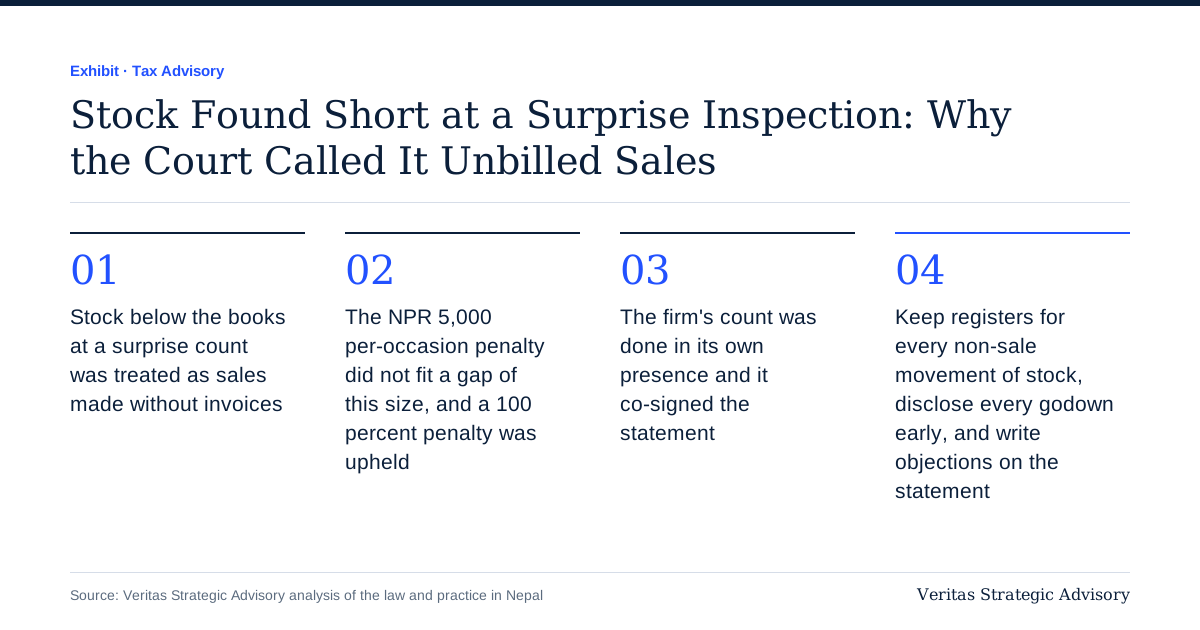
- Value of stock found short, in NPR
- 78,49,302.56
- VAT assessed on it, in NPR
- 10,20,409
- Penalty imposed, equal to the VAT
- 100%
- Per-occasion penalty the firm argued should apply, in NPR
- 5,000
Most businesses with stock have a number in the books that does not match the number on the shelf. Counting is imperfect, goods get damaged, a few items walk out. A small difference is part of running a shop.
The question this case answers is what an officer is allowed to do when the difference is large and the visit was a surprise. The answer, on the facts in front of the Supreme Court, was to treat the gap as sales that were never invoiced, charge VAT on them, and add a penalty equal to the tax.
The case in outline
The appellant was Arbind Stores, a proprietorship in Biratnagar Sub-Metropolitan City, Ward 14, Morang, run by Jagdish Prasad Agrawal. The respondent was the Inland Revenue Office, Biratnagar. A joint bench of Justice Bishwambharprasad Shrestha and Justice Sushmalata Mathema decided it in case no. 151349 on 2076 Kartik 25. It is reported at pages 11 to 15 of the Institute of Chartered Accountants of Nepal's collection of Supreme Court decisions on the VAT, Income Tax, Customs and Excise Acts.
The sequence of events is worth setting out in order.
| Date | Event |
|---|---|
| 2066.5.24 and 2066.5.26 | Inspectors from the Inland Revenue Office carried out a surprise physical check of the firm's stock |
| 2066.7.12 | The inspection report was submitted |
| 2066.7.15 | The report was accepted and a preliminary assessment issued for the shortage |
| 2066.8.4 | The firm sent a written reply, saying the preliminary assessment was defective |
| 2066.8.9 | The Inland Revenue Office issued the final assessment order |
| 2066.11.9 | The Director General of the Inland Revenue Department upheld it |
| 2068.12.24 | The Revenue Tribunal, Biratnagar, upheld it |
| 2076 Kartik 25 | The Supreme Court upheld it |
The final order was for tax of NPR 10,20,409 and a penalty of NPR 10,20,409, a total of NPR 20,40,818. The tax is 13 percent of the NPR 78,49,302.56 shortage, and the penalty equals the tax, so the figures are internally consistent (p.12, para 5).
How the inspectors reached the number
The way the number was reached matters as much as the number.
The Court records that the firm kept no stock books in the form the Income Tax Act and the VAT Act require. The inspectors therefore built the book position themselves. They took the closing stock shown in the firm's balance sheet and profit and loss account for the fiscal year 2064/65, as at the end of Ashadh 2065, as the starting point. They reviewed and tested the purchase and sales bills from 1 Shrawan 2065 up to the day of the inspection. From that they worked out what the stock should have been on the inspection day. They then compared it with the physical stock found at the business premises and the godown, counted in the presence of the taxpayer himself (p.14, para 12).
Two things followed. For the clothing, the physical count was below the calculated stock by NPR 78,49,302.56. The shortage was added to income and extra tax was assessed. For areca nut, the count was above the calculated stock, and the taxpayer was ordered to enter the surplus in the stock book, record the income and sell it against invoices.
The taxpayer also co-signed the statement of stock found short or extra. That detail will matter later.
What the firm argued
The firm made four points.
The inspectors had not inspected the warehouse. It said the office had shown "missing stock" without checking the warehouse.
The penalty was the wrong size. Under s.14(1) and (4) of the VAT Act, a violation attracted a penalty of up to NPR 5,000 each time, so a 100 percent penalty was contrary to law.
Nothing else was unsold. In its written reply of 2066.8.4 the firm said that apart from the goods sold there were no other goods, and that the preliminary assessment was defective because the office's statement mixed sales and stock.
A godown had not been checked. The firm later said a warehouse at a house in Ward 12 had not been inspected (p.11, para 1; p.13, paras 8 and 9).
What the Court said
The seller's duty and the shortage
The Court started from the seller's duty. When goods are sold, the duty to issue an invoice to the buyer lies with the seller, and VAT is determined on that basis. Where the physical stock found at a surprise inspection is lower than the stock shown by the books, it "clearly appears", the Court said, that the shortfall was sold without a tax invoice (pp.13 to 14, para 10).
That is an inference, and the decision is open about it. The logic is simple. Goods leave the stock in a limited number of ways. If the firm does not explain the gap by another route, the sale is the natural explanation, and an unissued invoice is the natural consequence.
The statute
The Court then set out the provisions. As it quoted them, s.20(1)(Ja) of the VAT Act lets the tax officer assess tax where goods were sold without issuing an invoice. Section 14(1) requires every registered person to give an invoice when supplying goods or services, subject to what is prescribed. Section 14(4) requires a person moving goods with more than NPR 10,000 of tax outside the area the Department specifies to carry a tax invoice. Section 29(1)(Ga) allows a penalty of NPR 5,000 each time for violating s.14(1) and (4). And s.29(2) deals with preparing false accounts, invoices or other documents, and with evading tax by fraud, where the officer may impose a penalty of 100 percent of the tax evaded, or imprisonment of up to six months, or both (p.14, para 11).
Why the NPR 5,000 argument failed
This is the part of the judgment a trader should read twice. The firm's best argument on penalty was that s.29(1)(Ga) caps the penalty at NPR 5,000 each time.
The Court read "each time" as a reference to the repeated small dealings between a seller and individual buyers, such as failing to issue an invoice to one customer after another. That is a particular kind of lapse. What the record showed was different: not repeated small transactions, but a shortage of NPR 78,49,302.56 and bills not properly kept. In the Court's words, a business of that size cannot be given the label of "each time". The taxpayer, it said, must be taken to have knowingly committed forgery to conceal his business (pp.14 to 15, para 13).
Intent
The Court then explained why it saw intent. The firm had issued sale bills only partly for the goods it bought on VAT invoices, so the physical stock fell below the books. It had also bought goods without VAT invoices, so it could not produce invoices to match the stock. From that, the Court concluded that the firm appeared to have acted with the intention of not paying tax (p.15, para 14).
On that footing the extra tax under s.20(1)(Ja) and the 100 percent penalty under s.29(2) were upheld, together with the final order, the Department's decision and the Tribunal's decision.
The other godown
The Court dealt briefly with the claim that a godown had been missed. The firm had co-signed the statement of stock found short or extra. Its written reply of 2066.8.4 did not mention the Ward 12 godown, and it did not apply on the spot to have other godowns checked. The Court's view was that where a taxpayer used warehouses for the business, the duty to tell the inspector in time and have the stock checked was the taxpayer's own (p.13, para 9).
Why the decision is the mirror of the purchase-side cases
Our earlier articles on Bhatbhateni and B.S. Bania Store were about the purchase side: a buyer who claims credit must prove the purchase and the payment. This case is about the sales side. A seller who cannot account for stock may be treated as having sold it without an invoice.
The thread running through all three is the same. The system depends on documents that tie goods to transactions. Where the documents do not tie, the officer is entitled to ask the taxpayer to explain, and in these decisions the Court was not receptive to explanations that had not been documented.
What the decision does not decide
It does not hold that every stock difference is a sale. The record had a count in the taxpayer's presence, a statement he co-signed, the firm's own accounts as the base, partial invoicing, and purchases without VAT invoices.
It does not show the taxpayer offering a documented explanation for the gap, such as theft, damage, wastage or samples, and the Court does not discuss one. We cannot say how it would have treated a well-documented explanation.
It does not apply the imprisonment limb of s.29(2). The Court named it, but the sanction imposed was the 100 percent penalty.
It does not say that an officer must inspect every godown. It says the taxpayer must disclose them in time.
The events date from 2066 and the penalty and invoicing provisions may have changed. The present Act must be checked.
It is one bench, one decision.
A worked illustration
The numbers below are invented to show the arithmetic. They are not a client case.
An electrical goods wholesaler in Birgunj has a book stock of NPR 60,00,000 on the day of a surprise count. The physical count, done in the presence of the owner, comes to NPR 45,00,000. The gap is NPR 15,00,000.
If the gap is treated as sales without invoices, VAT at 13 percent is NPR 1,95,000. A penalty equal to the tax, on the structure of the Arbind Stores assessment, adds another NPR 1,95,000, so the figure is NPR 3,90,000 before any fee or interest. Whether the same penalty applies today must be checked against the Act in force.
Now two different files.
File one. The wholesaler has monthly stock counts for the last year, each signed, with the book balance reconciled to the count. The gap of NPR 15,00,000 shows up as NPR 4,00,000 of damaged goods written off with photographs and a supplier credit note, NPR 6,00,000 of goods at a second godown that was disclosed on the first day with its own register, and NPR 5,00,000 of goods issued as samples under a sample register. Nothing is left unexplained.
File two. The wholesaler has annual counts, no sample register, no damage records, and a second godown that was not mentioned until the final order. The owner signed the inspection statement without comment.
On file one the officer's inference loses its footing, because each part of the gap is accounted for. On file two the Arbind Stores reasoning applies in full. The invoices and the stock are the same in both cases. The paperwork is not.
Our view
In our view, the decision is less about penalty arithmetic than about who has to tell the story of the stock. An inspector's count is a snapshot, and the Court treated a gap between that snapshot and the books as a sale unless the taxpayer shows otherwise. The explanation has to come from the business, and it has to come from records that existed before the inspector arrived.
The practical answer is usually to count more often than the law strictly requires, and to treat every movement out of stock other than a sale as a transaction that needs its own record. Damage, wastage, theft, samples, returns and transfers between godowns should each have a register, a reason and a signature. A business that can name the cause of every gap, with paper to match, does not look like the firm in this case.
We would also say something about the inspection day itself. The record shows the owner counted in the presence of the inspectors, signed the statement, and then relied on points that were not raised on the spot. If the owner disagrees with a figure or knows of a godown not yet counted, the time to say so is during the inspection, in writing, on the statement itself. We would not advise anyone to refuse to sign. We would advise writing the objection beside the signature.
Last, the decision is a warning about purchases without VAT invoices. The Court used them as part of the reasoning on intent. A business that buys partly outside the invoice system will find it difficult to show that its sales and its stock add up.
Practical action points
Count stock regularly and reconcile each count to the books. Sign and date the reconciliation.
Keep a register for every way stock leaves other than a sale: damage, wastage, theft, samples, returns and transfers.
List every warehouse and storage point and keep a stock register for each. Disclose all of them at the start of an inspection.
Check that every sale of invoiced stock is itself invoiced. Reconcile sales invoices to stock movements monthly.
Avoid buying stock without VAT invoices. If it happens, record it and deal with it, rather than letting it sit in the stock unexplained.
During an inspection, read the statement before signing. Write any disagreement or missing godown on it at the time.
Answer a preliminary assessment with the full evidence in the first reply. The firm's reply here said the statement was defective, but gave no documented explanation of the gap.
Where a gap is genuine and unexplained, take advice early, before the final order.
Frequently asked
Does every stock shortage become a taxable sale?
No. The Court reasoned from the record in front of it, which included a count in the taxpayer's presence, a co-signed statement, partial invoicing and purchases without VAT invoices. A shortage that is fully explained by documented damage or similar causes is a different case, which this decision does not decide.
Can I explain a gap as damage or theft?
The decision does not address a documented explanation of that kind. We would keep the evidence for each cause, in the form of registers, photographs, police reports where relevant and supplier credit notes, because the unexplained version is what the Court dealt with.
What if there is a godown the inspector did not count?
The Court said the duty to tell the inspector in time and have the stock checked is the taxpayer's. Raise it on the day, in writing.
Is a 100 percent penalty automatic?
The Court applied it on its reading of intent, from the partial invoicing and non-invoice purchases. It also rejected the argument that the NPR 5,000 per-occasion penalty applied to a gap of this size. We would not treat any penalty as automatic, but we would treat a large unexplained gap as a serious risk.
What does "each time" mean in the NPR 5,000 provision?
The Court read it as repeated small dealings, such as failing to issue an invoice to individual customers, and not as a way to describe a large-scale shortage.
Should I sign the inspection statement?
We would not advise refusing. We would advise reading it first, and writing any objection or missing godown next to your signature.
Is this still the law?
We have read the decision, which concerns inspections in 2066. We have not reviewed the current Act, so check the invoicing and penalty provisions in force before applying any figure.
Sources and limits
Arbind Stores (proprietor Jagdish Prasad Agrawal) v. Inland Revenue Office, Biratnagar, Supreme Court of Nepal, joint bench of Justice Bishwambharprasad Shrestha and Justice Sushmalata Mathema, case no. 151349, decided 2076 Kartik 25, reported at pp.11 to 15 of the Institute of Chartered Accountants of Nepal's collection of Supreme Court decisions on the VAT, Income Tax, Customs and Excise Acts (2079/2080). Every statement about the decision was read from the published page images, and the money figures were checked against each other.
We did not review the VAT Act, 2052 itself. Sections 14, 20 and 29 are described as the judgment quoted them.
General information only, not advice.