
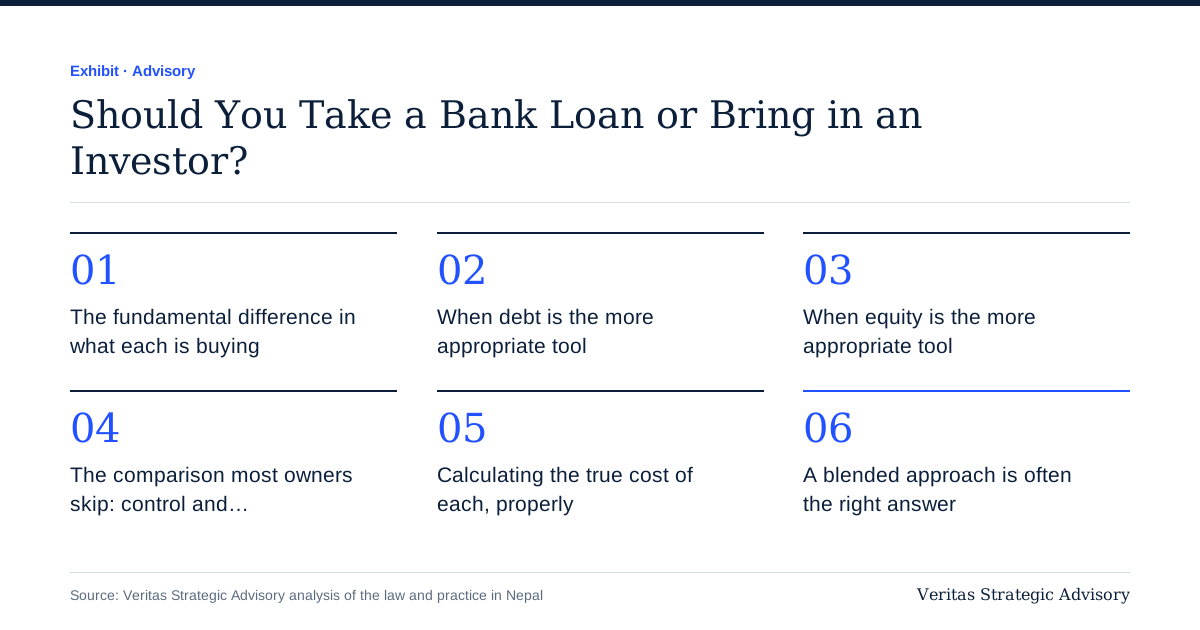
The fundamental difference in what each is buying
A bank loan is a fixed obligation: a defined repayment schedule, defined interest, and a defined maturity, regardless of how the business actually performs. An investor's capital carries no fixed repayment obligation, but it comes at the cost of a permanent share of ownership and, usually, some degree of ongoing influence over decisions. In plain terms: debt is cheaper when things go to plan, and more dangerous when they do not; equity is more expensive when things go well, and far less dangerous when they do not.
When debt is the more appropriate tool
Debt fits best when the cash flow being financed is predictable and near-term: working capital to support an already-proven sales cycle, equipment with a clear, calculable return, or a specific, well-understood expansion with a defined payback period, as set out in before opening a new branch: 10 financial questions to answer. In these cases, the business already has reasonable confidence in the cash flow that will service the debt, and taking on a fixed obligation against a reasonably certain outcome is both cheaper and simpler than giving up equity to fund something the business could comfortably repay on its own trajectory.
When equity is the more appropriate tool
Equity fits best when the venture being financed is uncertain, longer-horizon, or would be dangerously over-leveraged by debt: an unproven new product line, a market expansion with an uncertain timeline to profitability, or growth so rapid that debt service would consume cash flow the business cannot spare during the ramp-up period. An investor bears genuine downside risk alongside the founder in these situations, in exchange for upside if the venture succeeds, which is precisely the right risk allocation when the outcome is genuinely uncertain rather than merely unproven-but-predictable.
The comparison most owners skip: control and time horizon
Debt is time-limited: once repaid, the lender has no further claim on the business. Equity is effectively permanent: an investor's stake, and any control rights attached to it, persist indefinitely unless specifically bought back, an outcome that is often expensive or impractical later. A founder trading equity for a financing need that could realistically have been serviced by debt is giving away a permanent claim on the business to solve what was, in substance, a temporary financing problem. This is one of the most common and most regretted financing decisions we see in hindsight.
Calculating the true cost of each, properly
For debt, calculate the effective all-in cost, not just the headline interest rate, following the same discipline set out in before taking a bank loan: 8 things to calculate. For equity, calculate the cost differently: the percentage of the business given up today, valued not at today's valuation but at a realistic projection of what that same percentage could be worth at a future exit, since that, not the cash received today, is the real cost being paid. A relatively small equity stake given up early, in a business that goes on to succeed, is frequently a far larger true cost than an equivalent amount of debt would have been, which is exactly why the choice deserves this level of scrutiny rather than a quick comparison of what feels available right now.
A blended approach is often the right answer
Many growth situations are best served by neither pure debt nor pure equity but a structure combining both: equity to fund the genuinely uncertain, longer-horizon parts of a growth plan, and debt to fund the predictable, working-capital-driven parts once the equity-funded growth has established a track record. Founders who default entirely to one financing type across every situation, always debt, or always equity, are usually paying more, in interest or in dilution, than a more deliberately structured mix would cost.
Questions to answer before choosing
Is the cash flow this financing will fund predictable within a reasonably narrow range, or genuinely uncertain?
What is the realistic payback period, and does the business have the cash flow headroom to service debt against it without strain?
What percentage of the business, valued at a realistic future exit rather than today's valuation, would this equity round actually cost?
How much operational and strategic control is the business prepared to share, and for how long?
Does the business already carry enough fixed debt obligation that adding more would create dangerous leverage, regardless of how attractive the rate looks?
How Veritas supports this decision
We model both financing paths against your specific growth plan, quantify the true cost of each including the future value of equity given up, and help structure a blended approach where that fits better than either option alone. See our financial advisory and modelling service or our bank loan documentation service for how this analysis is run.
Frequently asked
Is equity always more expensive than debt in the long run?
Not always, particularly for genuinely uncertain or high-risk ventures where debt would either be unavailable or dangerously over-leverage the business; the comparison only favours debt when the underlying cash flow is genuinely predictable enough to service a fixed obligation safely.
Can a business change its mind and refinance equity with debt later, or vice versa?
Refinancing debt is generally straightforward once the business has a track record. Buying back equity already given to an investor is usually far more complex and expensive, which is exactly why the equity decision deserves more upfront scrutiny than the debt decision in most cases.