1. What is the full cost of opening, not just the headline capex?
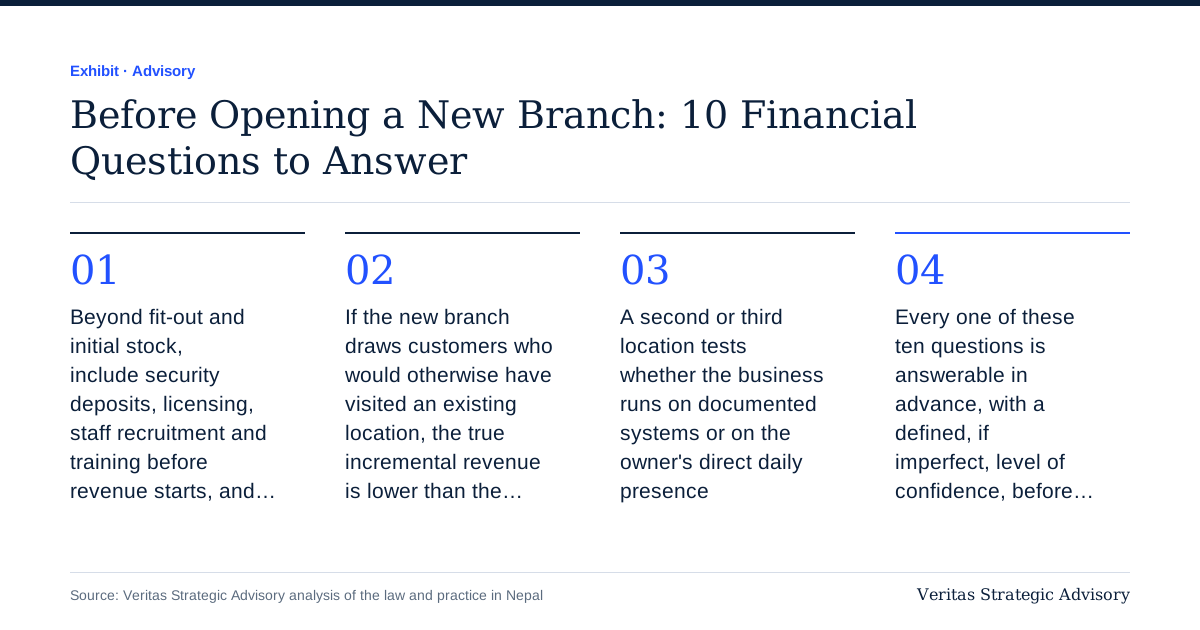
Beyond fit-out and initial stock, include security deposits, licensing, staff recruitment and training before revenue starts, and a cash buffer for the months before the location breaks even. Businesses consistently underestimate this total by focusing only on the visible capital expenditure line.
2. What is the realistic payback period, and does it match how the expansion is financed?
Calculate the number of months until the branch's own cash generation repays the initial investment, under a conservative revenue ramp, not the optimistic case used internally to justify the decision. If the expansion is financed with short-term debt but the realistic payback period is considerably longer, that mismatch is a financing risk built in from day one.
3. How much incremental working capital will this branch require?
A new location needs its own inventory, its own receivables if it extends credit, and its own operating float, calculated the same way as the working capital requirement covered in how much working capital does your business actually need, applied specifically to this location's expected volume, not folded invisibly into group-wide working capital assumptions.
4. What is the cannibalisation risk against existing locations?
If the new branch draws customers who would otherwise have visited an existing location, the true incremental revenue is lower than the new branch's standalone sales figure suggests. This calculation is uncomfortable to run honestly, and it is exactly the one most often skipped, which is why it belongs on this list explicitly.
5. What fixed costs does this location commit the business to, regardless of how it performs?
Rent, minimum staffing, and any long-term lease or equipment commitment represent a fixed cost floor the business is obligated to cover whether the branch performs to plan or not. Understand this floor explicitly, and understand what happens to group-level cash flow if this specific location underperforms for an extended period.
6. What is the break-even revenue for this specific location?
Calculate the monthly revenue level at which this branch, on its own, covers its own fixed and variable costs, using the same break-even logic covered in 10 financial numbers every business owner should know, applied to this one location rather than the business as a whole.
7. How will this expansion be funded, and what does that financing actually cost?
A loan, retained cash, or outside investment each carry a different cost and a different risk profile, covered fully in our companion piece on should you take a bank loan or bring in an investor. The right financing choice depends on the payback period and risk profile of this specific expansion, not a default preference carried over from how the business has financed things before.
8. What happens to management bandwidth, and does the business have the systems to support a location the owner cannot personally supervise daily?
A second or third location tests whether the business runs on documented systems or on the owner's direct daily presence. This is the same readiness question addressed in how to know whether your business is ready to scale, and it is worth answering honestly before, not after, the new location opens and immediately exposes the gap.
9. What is the realistic exit or downside plan if this specific location does not work?
Understand the lease break clause, the disposability of any location-specific fit-out and equipment, and the true cost of closing this location if performance does not meet a defined threshold within a defined period. A business that has not thought through the downside case is more likely to keep an underperforming location running out of reluctance to admit the decision, well past the point that capital would be better redeployed elsewhere.
10. Does this location strengthen or dilute the core business's brand and customer experience?
Not a purely financial question, but one with real financial consequences: a poorly performing or poorly located new branch can damage the reputation built by the core business, a cost that does not appear on the new location's own profit and loss statement but affects the group's results nonetheless.
Why running this before signing changes the outcome
Every one of these ten questions is answerable in advance, with a defined, if imperfect, level of confidence, before a lease is signed or capital is committed. The businesses that run this analysis before committing consistently make better expansion decisions, not because the analysis eliminates uncertainty, but because it surfaces the specific assumptions the decision actually depends on, so they can be tested and challenged rather than left implicit.
How Veritas supports expansion decisions
We build the payback, break-even, and working capital model for a specific proposed location before the lease is signed, and structure the financing decision around the resulting numbers rather than a default assumption. See our financial strategy and performance capability or our virtual CFO service for how this analysis is run.
Frequently asked
How long should this analysis take before a decision is needed?
For most single-location expansions, a focused analysis against the ten questions above can be completed in a small number of days once the specific location's cost and revenue assumptions are gathered; the time is well spent relative to the multi-year commitment a lease and fit-out represent.
Should this level of analysis be applied to every new location, even a second branch of a very small business?
Yes, in a scaled-down form; the specific numbers matter less at small scale than the discipline of asking the questions, and a business that builds this habit early carries it forward more easily as expansion decisions grow larger and more consequential.