- calculations before signing
- 8
- types of need
- 2
- key tests: cover, cost, covenants
- 3
- real cost, not the headline rate
- 1
The most common lending mistake we see is not borrowing too much or too little in absolute terms. It is signing a facility whose structure, repayment schedule, security, and term do not match how the business actually generates cash, discovered only once repayments start colliding with the business's own operating cycle. Every one of the calculations below can, and should, be run before signing, not after the first missed cash flow projection reveals the mismatch.
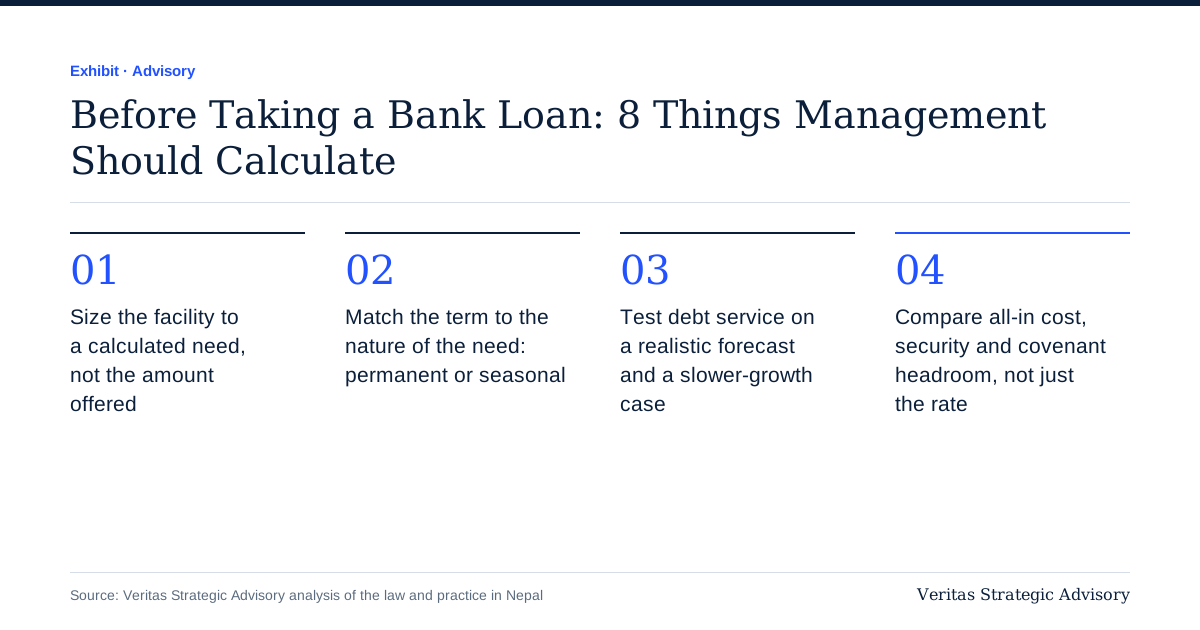
1. The actual working capital requirement the loan is meant to cover
Before requesting or accepting a facility sized against a round number or the bank's own suggestion, calculate the specific requirement it is meant to finance: the cash conversion cycle in days, multiplied by average daily operating cost, as set out in full in our companion piece on how much working capital does your business actually need. A facility sized against an actual calculated need is defensible in front of a board or a subsequent lender; a facility sized against a round number invites exactly the wrong amount, in either direction.
2. Whether the need is permanent or seasonal
A base, permanent working capital requirement should be financed with a facility structured for that permanent nature; a genuinely seasonal peak above that base is the right candidate for a shorter-term or revolving facility that draws up and pays down within the year. Financing a permanent need with a facility structured and priced as temporary is one of the most common structural errors in Nepalese SME lending, and it creates renewal risk every year that a correctly structured facility would not carry.
3. Debt service coverage against realistic, not optimistic, cash flow
Calculate the ratio of cash available for debt service, operating cash flow before financing costs, to the total principal and interest due in the period, using a conservative, realistic forecast rather than the most optimistic case used to justify the loan internally. A facility that only works if every projection lands exactly on plan is a facility that is under-covered against ordinary business variation.
4. The true, all-in cost of the facility
The stated interest rate is rarely the full cost. Processing fees, mandatory insurance, valuation charges for secured lending, and any minimum balance or compensating balance requirement all add to the effective cost of the facility; calculate the effective annual cost including every one of these, not just the headline rate, before comparing facilities or comparing debt against equity as a financing choice.
5. Repayment schedule against the cash conversion cycle, month by month
Overlay the loan's specific repayment schedule against the business's own monthly cash generation pattern, particularly for a seasonal business, rather than assuming an even monthly repayment matches an uneven cash generation pattern. A mismatch here, uniform monthly instalments against a business that generates most of its cash in two or three months of the year, is one of the most common and most avoidable causes of covenant stress after a loan is disbursed.
6. What happens to the ratio if growth is slower than planned
Recalculate debt service coverage under a slower growth scenario than the one used to justify the loan, not only the base case. Nepalese businesses seeking growth capital naturally build their projections around a successful growth case; the loan structure needs to survive a materially slower outcome as well, since that is the scenario in which the facility's structure actually matters.
7. The security being pledged, and what its loss would mean
Calculate not just the value of the collateral being pledged, but the operational consequence to the business if that specific asset were called upon, particularly where personal guarantees or property used in daily operations are involved. A facility that is marginally cheaper but pledges an asset critical to daily operations, or a personal guarantee disproportionate to the loan size, is not automatically the better choice once this is weighed properly.
8. Covenant headroom against the NFRS-restated numbers, if applicable
For a company that has adopted or is transitioning to NFRS, calculate covenant ratios, leverage, interest cover, tangible net worth, against the NFRS-restated figures, not the prior-basis figures, since fair value adjustments, lease capitalisation, and deferred tax recognition under NFRS can each move these ratios independently of any change in the underlying business. A covenant breach caused purely by an accounting transition, rather than by actual business performance, is an entirely avoidable and foreseeable problem if this calculation is run in advance. See our companion piece on does your company need NFRS if this transition applies to you.
Why this discipline matters more than the negotiation itself
Most business owners focus their negotiating energy on the interest rate, which is usually the smallest lever in the entire decision relative to the structural fit between the facility and the business's actual cash generation. A slightly higher rate on a well-structured facility, correctly sized, correctly timed against the cash cycle, and covenant-tested against a realistic scenario, is very often the cheaper and safer choice over the life of the loan compared with a marginally lower rate on a facility that does not fit the business at all.
How Veritas supports this decision
We build the cash flow model and the calculations above against your specific numbers before you sign, and review the term sheet itself against that model to identify any structural mismatch before it becomes a live problem. See our bank loan documentation and structuring service or our virtual CFO service for how this fits into an ongoing financing discipline.
Frequently asked
Should we always negotiate for the longest possible repayment term?
Not automatically. A longer term reduces monthly repayment pressure but usually increases total interest cost and can extend covenant exposure over a longer period; the right term is the one that matches the underlying asset or working capital cycle being financed, not simply the longest one on offer.
Is it worth paying for an independent review of a term sheet before signing?
For any facility material to the business, yes. The cost of a structured review is small relative to the cost of discovering a structural mismatch, a covenant breach, or an unaffordable repayment schedule after the funds have already been disbursed and spent.