
It is also, in practical terms, frequently less consequential to the founder's long-run outcome than several other terms that receive far less attention in the excitement of a term sheet arriving. Understanding what actually matters, before the first serious conversation, changes both what is negotiated and how confidently a founder negotiates it.
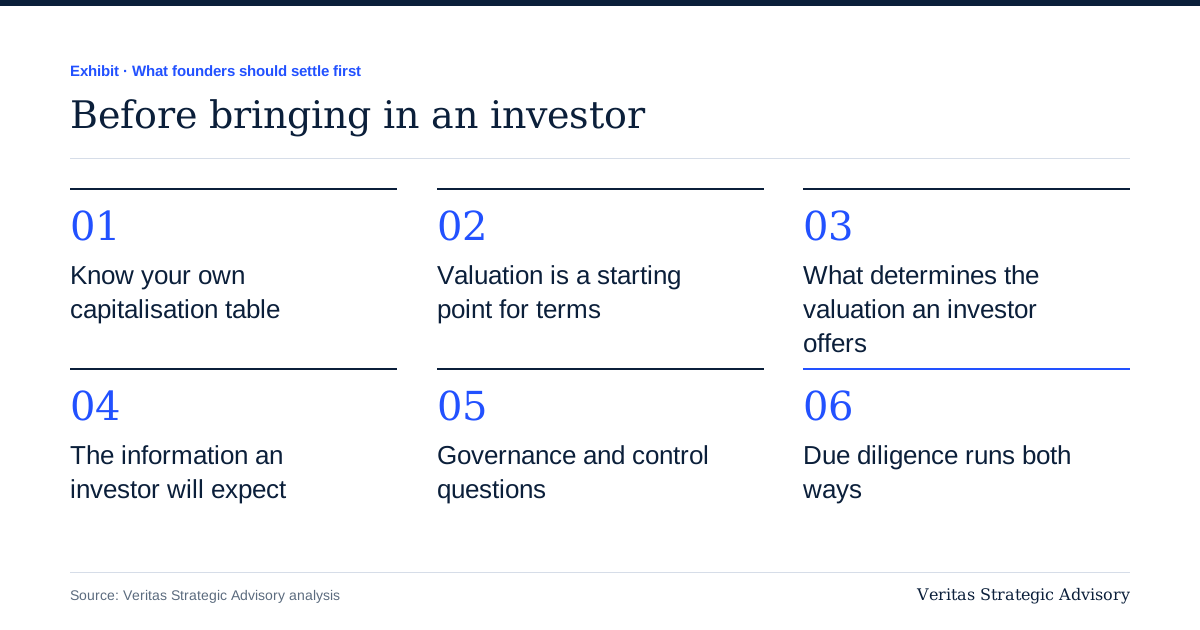
Know your own capitalisation table before anyone else asks about it
A founder should be able to state, without needing to check a spreadsheet mid-conversation, exactly who owns what percentage of the company today, on what terms, and whether any existing shareholder holds rights, anti-dilution protection, a veto over certain decisions, a liquidation preference, that a new investor needs to know about. Investors read hesitation or vagueness about the existing cap table as a governance red flag, independent of how good the underlying business is, and it is one of the fastest ways to lose momentum in an early conversation.
Valuation is a starting point for terms, not the terms themselves
A high valuation attached to onerous terms, an aggressive liquidation preference, heavy anti-dilution protection, or broad veto rights over ordinary operating decisions, can leave founders with less real value and less real control than a lower valuation on clean, standard terms. The specific terms to understand before any negotiation begins include:
Liquidation preference: what the investor is entitled to receive before other shareholders in an exit or wind-down, and whether it is a straightforward return of capital or a multiple of it.
Anti-dilution protection: how the investor's stake is protected if a future round happens at a lower valuation, and how much that protection could cost founders in a down round.
Board composition and voting rights: exactly which decisions require investor approval going forward, and whether that scope is proportionate to the size of the investment being made.
Vesting on founder shares: increasingly standard even for existing founders as a condition of investment, and worth understanding fully before it is presented as a fait accompli.
What determines the valuation an investor will actually support
An investor's valuation is built from the same drivers set out in our companion piece on what determines a company's valuation: growth trajectory, margin quality, and the risk profile of the business, examined through the specific lens of whether this business, with this capital, can generate a return that justifies the investor's own required rate of return. Founders who understand this framework going in can build a case grounded in the same logic the investor will apply, rather than anchoring only on what a comparable company reportedly raised at.
The information an investor will expect to see, and when
Serious investors will not commit meaningful time to a business that cannot produce clean historical financials, a credible forward forecast built from real unit economics, an accurate cap table, and its material contracts, in an organised form, promptly when asked. Assembling this after an investor has already expressed interest costs weeks of momentum at exactly the point momentum matters most; assembling it in advance is one of the highest-leverage things a founder can do before ever starting a conversation. Our companion piece on what makes a business investment-ready sets out this preparation in full.
Governance and control questions to settle internally first
Before a term sheet is even on the table, founders should have a clear, ideally written, internal view on: how much board control they are prepared to give up at this stage of the company's life, what decisions they consider non-negotiable to retain founder control over, and what a realistic future dilution path looks like across two or three further funding rounds, not just this one. Negotiating these questions for the first time under the pressure of a live term sheet, rather than having already thought them through, consistently produces worse outcomes for founders than deciding the position calmly in advance.
Due diligence runs both ways
Founders often treat diligence as something done to them, and forget that the same discipline should apply to evaluating the investor. A cap table with the wrong investor on it, one whose incentives, timeline, or involvement style do not fit the business, is a problem that persists for years after the money has been spent, longer than almost any other consequence of a poorly negotiated round. Reference-checking a prospective investor, speaking to founders they have previously backed, particularly through a difficult period, is time well spent before signing.
How Veritas supports founders through this
We help build the financial model and forecast an investor will actually rely on, review term sheets against the specific points above before they are signed, and support the valuation conversation with a defensible, evidence-based position rather than an anchored number. See our financial advisory and modelling service or our business valuation service for how this fits into a fundraising preparation engagement.
Frequently asked
Should a founder negotiate the valuation or the terms first?
Both need to be understood together, since a change in one materially affects the economics of the other; a term sheet should always be evaluated as a complete package, not valuation in isolation from the protective provisions attached to it.
Is it normal to bring in professional advice before the first term sheet, or only once one is offered?
Preparing the financials, forecast, and cap table in advance, and understanding term sheet mechanics before one is on the table, consistently produces a stronger negotiating position than starting that preparation only once an offer has already been made.