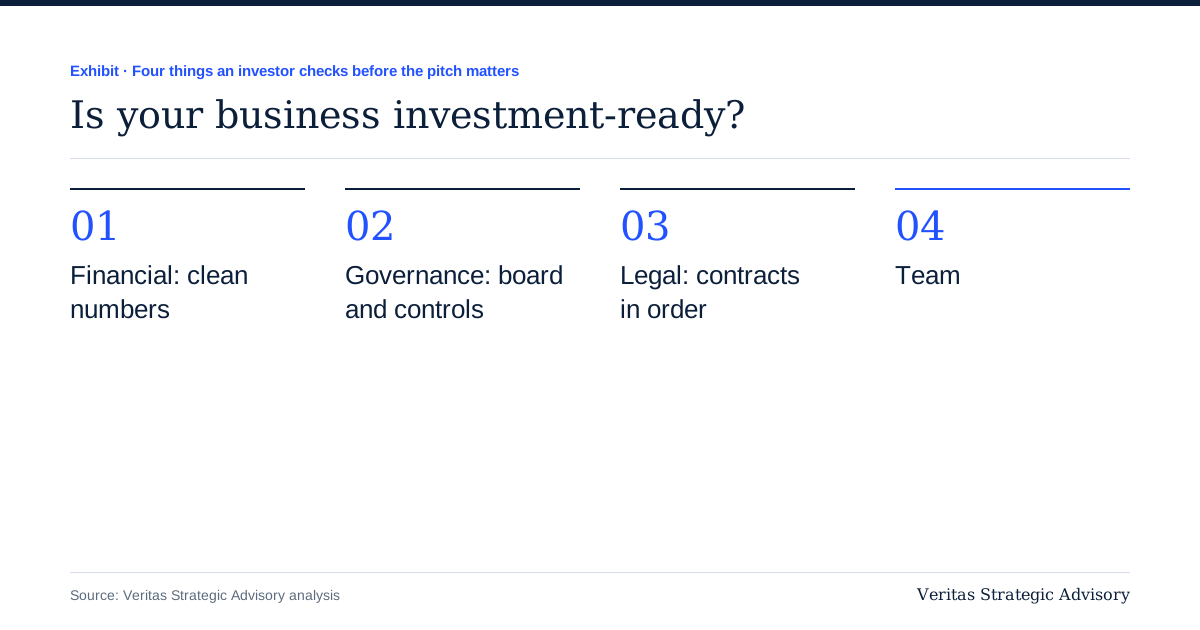
Investment-readiness is not a vague quality; it is a specific, checkable set of gaps that founders can close in advance, and the businesses that close them before the first serious conversation consistently raise faster and on better terms than those that start preparing after an investor has already expressed interest.
Financial readiness
This is where diligence begins, and where most avoidable delay happens.
Clean, current financial statements. Investors expect at least the last two to three years of financial statements, ideally already prepared under the applicable NFRS framework rather than needing restatement mid-process. See our companion piece on does your company need NFRS if this transition has not yet happened.
Monthly management accounts, not just annual statements. An investor wants to see how the business performs month to month, not only what it looked like on the last two year-end dates. A business that can produce this immediately signals a functioning finance discipline; a business that cannot signals the opposite.
A credible forward forecast. Not an optimistic projection built to justify a valuation, but a bottom-up model, built from actual unit economics, that a sophisticated investor can interrogate line by line without it falling apart.
A sustainable, normalised earnings picture. Owner compensation, related-party transactions, and one-off items should already be identified and explained, rather than left for the investor's diligence team to discover and question.
Governance readiness
A clean, accurate capitalisation table, showing exactly who owns what, on what terms, and whether any existing shareholder has rights, such as anti-dilution or veto rights, that a new investor needs to know about before committing.
Board and decision-making structure, even in a small company. An investor wants to understand how decisions actually get made, and a business run entirely on informal owner authority, with no documented governance at all, raises a specific and common concern about control and accountability after investment.
Related-party arrangements disclosed and priced fairly, not discovered during diligence, since an undisclosed related-party arrangement discovered late in a process is one of the more common reasons deals slow down or lose trust.
Contractual and legal readiness
Material contracts organised and available: customer contracts, supplier agreements, leases, and loan agreements, ideally with a summary of key terms rather than requiring an investor's counsel to read every contract from scratch.
Employment and founder arrangements formalised, including vesting terms for founders and key employees, which sophisticated investors increasingly expect to see addressed before, not after, they commit capital.
Intellectual property and key assets clearly owned by the company, not personally by a founder or an affiliated entity, a gap that is common in founder-led businesses and can materially complicate or delay a transaction once discovered.
Team and operational readiness
A management team that can operate without the founder in every decision. Investors are underwriting the business's ability to execute after investment, not just the founder's individual capability, and a business that visibly depends entirely on one person is a specific, named risk in most investment memos.
Key-person and succession risk addressed, at least in outline, particularly where a single founder or a small handful of people hold most of the operational and relationship knowledge in the business.
Why this matters more than the pitch
An impressive pitch gets a first meeting. Investment-readiness, in the sense used here, is what determines whether the diligence that follows that meeting confirms the pitch or contradicts it. A gap discovered during diligence does not just cost time to fix, it changes the investor's confidence in management's own understanding of their business, which affects both the valuation an investor is willing to support and the terms they will insist on to protect against risks the founder had not already identified and addressed.
Preparing the numbers before the investor's diligence does it for you
The most effective single step a founder can take is to commission an internal readiness review, essentially a light version of the buy-side diligence an investor will eventually run, before that investor's own diligence team starts. See our related piece on buying a business in Nepal? Start with financial due diligence for the same categories of review, applied here from the seller's or fundraiser's side of the table rather than the buyer's.
How Veritas helps founders prepare
We run a structured investment-readiness review across the financial, governance, and contractual areas above, and help build the forecast and normalised financials an investor will actually rely on, before the first serious conversation begins rather than in the middle of it. See our financial advisory and modelling service or our business valuation service if a specific number needs to be defended alongside the readiness review.
Frequently asked
How long does it take to become investment-ready from a standing start?
For a business with reasonably organised books already, a focused readiness review and remediation typically takes a small number of weeks. For a business that has never formalised governance, contracts, or monthly reporting, it can take considerably longer, which is exactly why this preparation should start well before an investor conversation is imminent, not once one is already underway.
Does becoming investment-ready cost more than it is worth if the raise does not happen?
No. Every element above, clean monthly reporting, a documented cap table, organised contracts, a credible forecast, improves the quality of the business's own decision-making whether or not a specific fundraise ever closes.