
Our companion piece on how to value a private company in Nepal sets out the three recognised methods, income, market, and asset-based, used to arrive at a valuation figure. This piece answers a different, and in some ways more useful, question: once a method is chosen and applied, what are the underlying business characteristics that actually push that number up or down? Understanding the drivers, not just the methodology, is what lets an owner or founder actually act to improve their own valuation over time, rather than simply receiving a number at the end of a calculation.
The three fundamental drivers
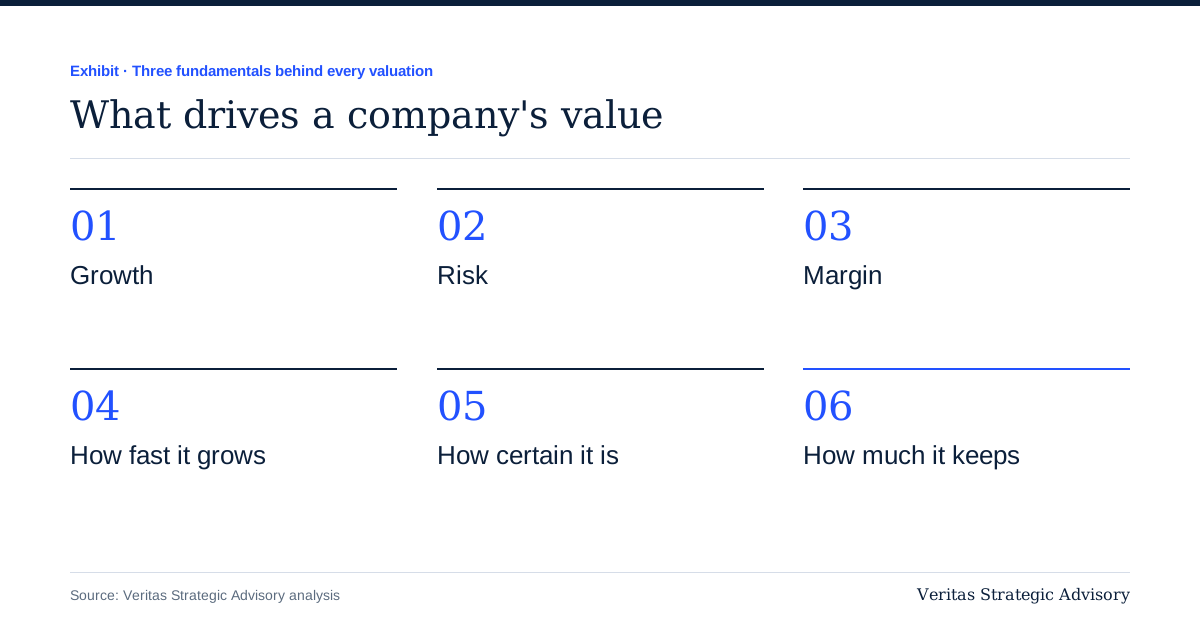
Growth. How fast, and how reliably, the business's cash flows are expected to grow. This is the single most powerful driver in almost every valuation method, because value is fundamentally a claim on future cash flows, and a business growing quickly compounds that claim far faster than one growing slowly or not at all. Critically, it is not simply the historical growth rate that matters, it is the credibility of continued growth going forward: a business that grew quickly for reasons unlikely to repeat, a one-off contract, a temporary market condition, is valued very differently from a business whose growth reflects a durable, repeatable driver.
Margin. The proportion of revenue that converts into sustainable profit and, ultimately, cash. Two businesses with identical revenue and identical growth rates can carry very different valuations if one converts that revenue into profit twice as efficiently as the other, because the actual cash flow being valued is fundamentally different even though the top-line story looks similar. This is also where the normalisation work described in our valuation and due diligence pieces matters most: reported margin and sustainable, buyer-relevant margin are frequently two different numbers, and a valuation built on the unadjusted figure is built on the wrong number.
Risk. How uncertain or how dependent on fragile factors the future cash flow actually is. A business heavily concentrated in one customer, one key employee, one product, or one regulatory permission carries meaningfully more risk than an otherwise identical business without that concentration, and that additional risk is reflected either through a higher discount rate in an income approach or a lower multiple in a market approach. Risk, in this sense, is not a single factor but an accumulation: customer concentration, key-person dependency, competitive exposure, and regulatory or supply-chain fragility all feed into the same underlying judgment about how confidently the projected cash flows can actually be relied upon.
Why two similar-looking businesses can carry very different valuations
Consider two businesses with identical current-year revenue and identical current-year profit. If one is growing at twice the rate of the other, it will typically command a meaningfully higher valuation, because more of its value sits in future years still to come. If one depends on a single customer for 60% of revenue and the other's revenue is broadly spread across dozens of accounts, the concentrated business carries materially more risk and, correspondingly, a lower valuation, even with identical current financial results. If one business's margin is inflated by a related-party arrangement priced away from market terms, and the other's margin reflects genuine, arm's-length economics, the first business's true, sustainable value is lower than its reported numbers suggest, once properly normalised. None of this shows up by looking at revenue and profit alone; it only becomes visible once the three drivers are examined specifically.
What this means practically for an owner planning ahead
If a sale, investment round, or ownership transition is anticipated in the coming years, the most effective way to improve the eventual valuation is not to manage the headline revenue or profit number in the final year before that event, it is to deliberately strengthen the three underlying drivers over time: building genuinely repeatable, diversified growth rather than one-off spikes, improving and defending margin through better cost control and pricing discipline rather than through unsustainable related-party arrangements, and actively reducing concentration risk, in customers, key people, and suppliers, well before a transaction is imminent. A valuation prepared the week before a sale reflects years of decisions that were made, or not made, long before that week.
How this connects to due diligence
A buyer's or investor's due diligence process, described in full in buying a business in Nepal? Start with financial due diligence, exists precisely to test whether the growth, margin, and risk profile presented in a valuation actually holds up under scrutiny. A valuation built on an optimistic reading of these three drivers that does not survive diligence does not just fail to close a deal at the hoped-for price, it damages the credibility of the entire negotiation. The strongest position is a valuation built on drivers that are already documented and defensible before diligence begins, not a number that has to be walked back once it does.
How Veritas approaches this
We build valuations that explicitly identify and quantify the growth, margin, and risk position of the specific business, rather than applying a generic multiple, and we work with owners well in advance of a planned transaction to identify which of the three drivers offers the most realistic opportunity to improve the eventual outcome. See our business valuation service for how this analysis is structured.
Frequently asked
Can a business meaningfully increase its valuation in a short period before a sale?
Genuine, durable improvement to growth, margin, or risk profile generally takes longer than a few months to build credibly; what can be done quickly is ensuring the existing genuine performance is properly documented, normalised, and presented, so the valuation reflects the business's true position rather than understating it through poor preparation.
Which of the three drivers matters most?
It depends on the specific business and its stage. A young, fast-growing business is often valued predominantly on its growth trajectory even at thin or negative current margins, while a mature, stable business is typically valued more heavily on sustainable margin and lower risk; understanding which regime your business sits in changes which lever is actually worth the most attention.