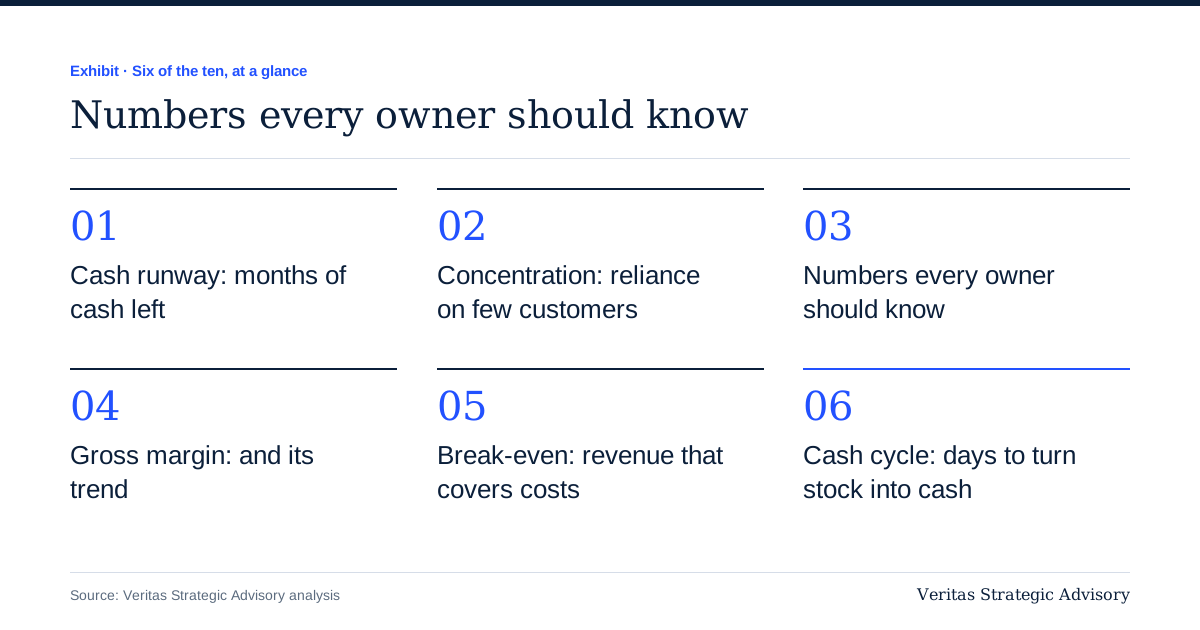
These ten are the ones worth knowing without checking.
1. Cash runway
How many months the business can continue operating at its current burn rate, or its current rate of cash generation, before cash runs out or a financing gap opens. For a growing business, this needs to account for the working capital effect of growth itself, covered in our companion piece on why is my business profitable but always short of cash, not just the profit and loss trend.
2. Gross margin, and its trend
Not the number for the year, the trend over the last three to six months. A gradually eroding gross margin, on stable or even growing revenue, is one of the earliest and most reliable warning signs of a pricing, cost, or product-mix problem that has not yet shown up in the bottom line.
3. Cash conversion cycle
The number of days between paying suppliers and collecting from customers, combining receivables days, inventory days, and payables days into one figure. A rising cash conversion cycle, tracked monthly, gives earlier warning of a coming cash squeeze than almost any other single number available to management.
4. Customer concentration
The percentage of revenue coming from the largest customer, and from the top three or five combined. High concentration is not automatically a problem, but an owner who does not know this number cannot properly assess how exposed the business is to a single customer's decision to leave, delay payment, or renegotiate terms.
5. Break-even revenue
The monthly or annual revenue level at which the business covers all its fixed and variable costs exactly. Knowing this number turns every revenue conversation, a slow month, a new hire, a price change, into a concrete question of distance from break-even, rather than a vague feeling of things being "up" or "down."
6. Debt service coverage
The ratio of cash available for debt service to the actual principal and interest due in the period. An owner who knows this number going into a loan negotiation, rather than discovering it once repayments begin, is negotiating from a position of genuine understanding rather than hope, a point developed fully in before taking a bank loan: 8 things to calculate.
7. Receivables ageing beyond terms
The proportion of outstanding receivables that are past their agreed payment terms, not just the total receivables figure. A business can have healthy total receivables and still be sitting on a growing pile of genuinely overdue money that the aggregate number conceals.
8. Contribution margin by product or service line
Which specific products, services, or client segments actually generate the most profit once their true, directly attributable costs are allocated, as distinct from which generate the most revenue. Businesses frequently discover, once this is calculated properly, that their highest-revenue line is not their most profitable one.
9. Owner's dependency on the business for decisions
Not a financial ratio in the traditional sense, but a number worth knowing plainly: how many material decisions, pricing, hiring, a customer dispute, genuinely require the owner personally, versus how many the business can make and execute without them. This number determines both the business's resilience and, eventually, its value to an outside investor or buyer, a point we return to in what makes a business investment-ready.
10. Working capital requirement as the business scales
Not a static figure but a rate: how much additional working capital a given amount of revenue growth actually requires, calculated from the business's own cash conversion cycle. An owner who knows this rate can plan financing for growth in advance; an owner who does not is planning to discover it the hard way, as covered in how much working capital does your business actually need.
Why these ten, and not the standard financial ratios taught in textbooks
Every number on this list was chosen because it is forward-looking, decision-relevant, and specific to how this particular business actually behaves, not a generic ratio calculated the same way regardless of the business it is applied to. A textbook current ratio or quick ratio has its place in a lender's covenant, but it rarely tells an owner anything they did not already sense; the ten above consistently surface something the owner did not already know, which is the entire point of tracking them.
How to start tracking these if you currently cannot answer most of them
The honest starting point for most owners is admitting that today's answer to several of these is "I don't know," and that is a completely normal starting position, not a failure. What matters is building a monthly discipline, a management report that surfaces these ten specifically, rather than a generic profit and loss export, a distinction covered fully in our companion piece on what should a monthly management report include.
How Veritas builds this for clients
We build a monthly reporting pack around exactly this set of numbers, calculated consistently and tracked as a trend rather than recalculated ad hoc, so that an owner can answer every one of these without needing to check. See our virtual CFO and outsourced finance function service for how this fits into an ongoing engagement.
Frequently asked
Do all ten matter equally for every business?
The relative weight shifts with the business, a business with thin margins should watch gross margin trend and break-even revenue most closely, while a business with concentrated customers should watch customer concentration and receivables ageing most closely, but every business benefits from tracking all ten consistently rather than picking and choosing.
How often should these be recalculated?
Monthly, at minimum, as part of a standing management report; recalculating them only annually defeats the purpose, since the entire value of these numbers is in catching a shift in trend early enough to act on it.