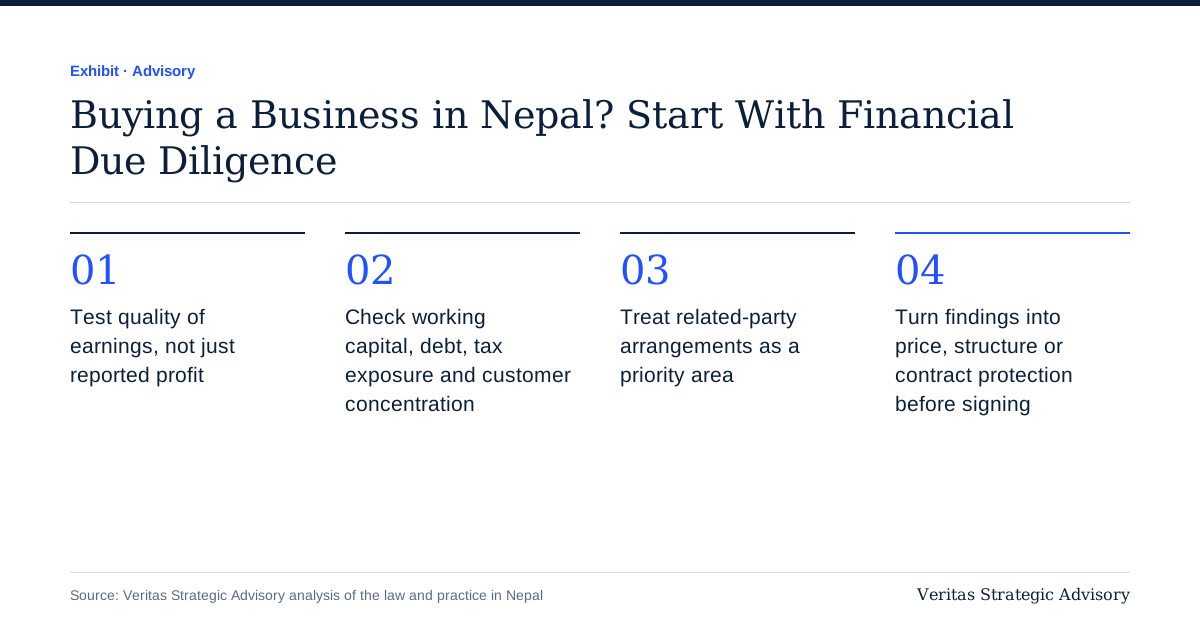
- areas examined
- 6
- typical history reviewed
- 3-5 yrs
- process steps
- 5
- goal: price, structure, protection
- 1
The most expensive mistake in a private business acquisition is not overpaying for a business you understood correctly. It is paying a fair price for a business you misunderstood, because the financial statements you were shown were accurate on their face but incomplete in ways that only a structured diligence process would have surfaced. Financial due diligence exists precisely to close that gap before, not after, the transaction closes.
Why financial statements alone are not enough
Audited or filed financial statements answer whether the numbers were compiled correctly according to an accounting framework. They do not answer several questions a buyer actually needs answered: is the reported profit sustainable or inflated by one-off items? Are the receivables genuinely collectible? Is working capital adequate to run the business at its current scale, or is the seller quietly under-investing in it before sale? Are there liabilities, contractual, tax, or legal, that do not appear on the balance sheet at all? A statutory audit is not designed to answer these questions from a buyer's perspective, and a due diligence exercise is a fundamentally different and more probing exercise, even when it starts from the same set of books.
What a financial due diligence review actually examines
Quality of earnings. This is the centrepiece of most diligence engagements. It normalises reported profit by removing owner compensation set above or below market rate, related-party transactions on non-arm's-length terms, and one-off or non-recurring items, to arrive at a sustainable earnings figure that a buyer can actually rely on to project forward. Reported profit and sustainable, buyer-relevant profit are very often two different numbers.
Working capital adequacy. Reviewing receivables, inventory, and payables to confirm the business is being handed over in a normal operating condition, not stripped of working capital in the months before sale to inflate apparent cash generation, or carrying receivables and inventory that are overstated relative to what is actually collectible or sellable.
Debt and off-balance-sheet obligations. Confirming every loan, guarantee, lease commitment, and contingent liability, including pending tax assessments, disputed contracts, or litigation, that could transfer with the business or crystallise after closing.
Tax exposure. Reviewing VAT, TDS, and income tax filing history and compliance status. An unresolved tax position or an assessment risk inherited with the business can materially change its real value, and in many structures the buyer inherits exposure for pre-acquisition tax periods.
Customer and revenue concentration. Identifying how much of revenue depends on a small number of customers or contracts, and whether those relationships are secured by contract or by informal goodwill that may not survive a change of ownership.
Related-party dependencies. Many private Nepalese businesses run informally through the owner's personal relationships, guarantees, or unrecorded arrangements with related entities. Diligence has to identify which of these the business genuinely depends on to continue operating normally after the sale.
Red flags that most often surface
Revenue or margin trends that do not match the industry or the seller's own narrative, without a specific, verifiable explanation.
Receivables growing consistently faster than sales, suggesting either loosening credit control or revenue recognised before it is genuinely collectible.
Related-party transactions priced away from market terms, which distort both revenue and cost lines and need to be normalised out before the numbers mean anything to a buyer.
Frequent changes in accounting policy or presentation between periods, which can mask a deteriorating trend or make comparison across years unreliable.
Undisclosed guarantees, related-party loans, or contingent liabilities discovered only through direct confirmation with banks, lenders, and legal counsel, rather than from the financial statements themselves.
A gap between management accounts and filed financial statements that management cannot fully explain.
None of these automatically kills a deal. Each of them changes either the price, the structure (holdbacks, earn-outs, warranties), or the specific protections written into the purchase agreement, which is exactly why they need to surface before signing, not after.
How the diligence process should be structured
Scoping, agreeing what is being examined and over what historical period, typically three to five years, based on the size and complexity of the target.
Information request, a structured list covering financial statements, tax filings, bank statements, material contracts, and related-party arrangements.
Analysis, quality-of-earnings normalisation, working capital review, debt and contingent liability confirmation, and tax exposure review, run in parallel.
Findings report, setting out what was verified, what could not be verified, and what specifically should change in price, structure, or contractual protection as a result.
Negotiation support, translating the findings into concrete adjustments: a price change, an escrow or holdback against a specific identified risk, or a representation and warranty addressing a gap the diligence could not fully close.
Diligence and valuation are two different exercises, done together
Diligence tells you whether the numbers underlying a valuation are reliable; valuation then tells you what a reliable set of numbers is actually worth. Running valuation on unverified numbers, or running diligence without a valuation framework to apply the findings to, both leave a buyer exposed. See our companion piece on how to value a private company in Nepal for the valuation side of the same transaction.
How Veritas runs this
We scope the review to the specific transaction and its risk areas rather than running a generic checklist, and deliver findings a buyer can act on directly in negotiation, not a lengthy report with no bottom line. See our financial due diligence service for how an engagement is structured from scoping to closing.
Frequently asked
Is due diligence only necessary for large acquisitions?
No. The proportion of a buyer's capital at risk in a smaller acquisition is often just as large relative to their means as in a bigger deal, and the seller's information is typically less formal and less independently verified in smaller private companies, which makes a structured review, scaled to the size of the deal, just as important.
Who normally pays for due diligence, buyer or seller?
The buyer commissions and pays for buy-side diligence, since it exists to protect the buyer's decision. A seller may separately commission sell-side or vendor due diligence in advance to present a cleaner, pre-verified position to prospective buyers, which can speed up a sale process considerably.