
They are two different jobs, answering two different questions, and a company can have an outstanding accountant while having no CFO function at all, or vice versa in a smaller way. Understanding the actual boundary between the two is the difference between hiring the right kind of help and paying for a title without getting the function you need.
The core distinction: recording vs deciding
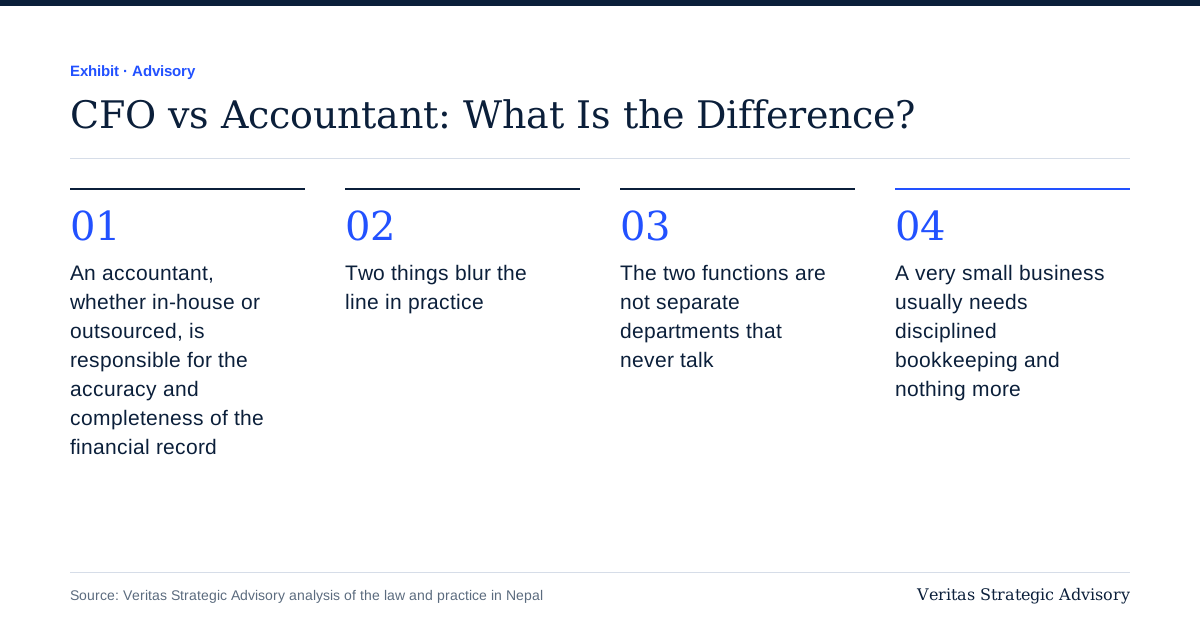
An accountant, whether in-house or outsourced, is responsible for the accuracy and completeness of the financial record. That means:
Recording sales, purchases, and expenses correctly and on time
Reconciling bank accounts and ledgers
Processing payroll and statutory deductions
Filing VAT, TDS, and income tax returns within deadline
Preparing year-end financial statements for audit and for the Office of the Company Registrar
Every one of these tasks is essential, and none of them is optional. But every one of them is backward-looking: it records or reports what has already happened. The accountant's core question is "is this correct?"
A CFO function takes the same underlying data and asks a forward-looking question: "given this, what should we do next?" That covers:
Building a cash flow forecast and updating it as actuals come in
Analysing which products, services, or branches are actually profitable once true costs are allocated
Modelling the financial effect of a decision, a new hire, a price change, a loan, before it is made
Preparing the numbers and narrative that a lender, investor, or board needs to make a decision
Setting and tracking the financial targets the business is actually trying to hit
A business can have flawless bookkeeping and financial statements and still have no one doing any of the second list. That gap is exactly why the question "do I need a CFO" keeps coming up even in companies whose accounts are in perfect order.
Where the confusion comes from
Two things blur the line in practice.
First, in small companies, one senior finance person often does both jobs informally. A capable finance manager who closes the books and also flags a cash flow problem to the owner is doing CFO-type work without the title, part-time and unevenly. This works while the business is simple, and stops working the moment the business has more than one lender, more than one significant product line, or an investor conversation on the table, because CFO work at that point needs dedicated time and a defined process, not something squeezed in between closings.
Second, "chartered accountant" is a professional qualification, not a job description. A person can be a qualified accountant and either close books for a living or run a CFO function for a living; the qualification tells you they are trained to a standard, not which of the two jobs they are actually doing for you day to day. When evaluating any finance hire or engagement, the useful question is not "are they a CA," it is "what outputs will I actually receive, and how often."
A side-by-side comparison
| Accountant | CFO function | |
|---|---|---|
| Core question | What happened? | What should happen next? |
| Time orientation | Backward-looking | Forward-looking |
| Typical outputs | Ledgers, VAT/TDS filings, financial statements | Cash flow forecasts, management reports, decision models |
| Frequency | Ongoing, transaction by transaction | Periodic, monthly or quarterly review cycle |
| Failure mode if missing | Late filings, penalties, unreliable financial statements | Decisions made on gut feel; cash surprises; weak lender and investor conversations |
Why the overlap is real, not a trick
The two functions are not separate departments that never talk. A CFO function is only as good as the underlying records: forecasts built on inaccurate or late bookkeeping are worthless, and a CFO's first job in a disorganised business is often to fix the closing process before analysis can be trusted at all. Equally, a good accountant's discipline, consistent monthly closes, clean reconciliations, is what makes CFO-level analysis fast and cheap to produce rather than a forensic exercise every quarter. The two roles need each other; they are not competing for the same job.
How to tell which one you are actually short of
Ask three questions:
Are the books accurate and closed on a reliable monthly schedule, with VAT, TDS and payroll filed on time? If the answer is no, the gap is in the accounting function itself, and that has to be fixed before anything else is worth paying for.
Once the books are accurate, does anyone use them to answer "what should we do about this"? If the answer is no, that is a CFO gap, not an accounting gap, regardless of how good the bookkeeping is.
Are you making pricing, hiring, financing, or expansion decisions based on a forecast, or based on the bank balance the day the decision is made? The bank-balance answer is the clearest sign a forward-looking function does not yet exist in the business.
Most growing Nepalese businesses eventually need both functions running well at the same time, but rarely need to build them at once. Fix the accounting discipline first if it is not solid; layer a CFO function on top once it is.
How this typically plays out as a company grows
A very small business usually needs disciplined bookkeeping and nothing more; the owner is close enough to every transaction to make decisions without a separate analytical layer. As the business adds a second location, a second lender, or its first outside investor conversation, the volume and stakes of decisions grow faster than any one person's ability to track them from memory, and that is the point at which a defined, recurring CFO function, whether hired full-time or engaged on a fractional basis, starts paying for itself. See our related piece on virtual CFO in Nepal: who actually needs one for the specific signals that mark that transition.
What we offer at each stage
Veritas provides both functions, and deliberately keeps them distinguishable rather than bundling them into one vague "accounting services" package: bookkeeping, payroll and statutory filing on one side, and a structured virtual CFO and outsourced finance function on the other, so you know exactly what you are paying for and what you should expect to receive each month.
Frequently asked
Can the same firm do both for us?
Yes, and there is an efficiency advantage when it does, since the CFO analysis is built directly on records the same firm already controls and trusts. The important thing is that the two scopes and their outputs stay clearly defined, not blended into a single ambiguous retainer.
Do we need a full-time CFO once we outgrow bookkeeping-only support?
Not necessarily. A fractional or outsourced CFO arrangement, engaged monthly or quarterly, gives most growing businesses the same quality of forward-looking analysis and decision support as a full-time hire, at a cadence that matches how often the business actually needs to make significant financial decisions.