
- signals you have outgrown bookkeeping
- 5
- rolling cash forecast
- 13 wks
- planning view
- 12 mo
- management pack
- Monthly
Most Nepalese businesses do not have a cash flow problem. They have a visibility problem: the owner finds out the business is short of cash the week it happens, not the month before. A virtual CFO exists to close that gap without the cost of a full-time hire.
The difference between an accountant and a CFO
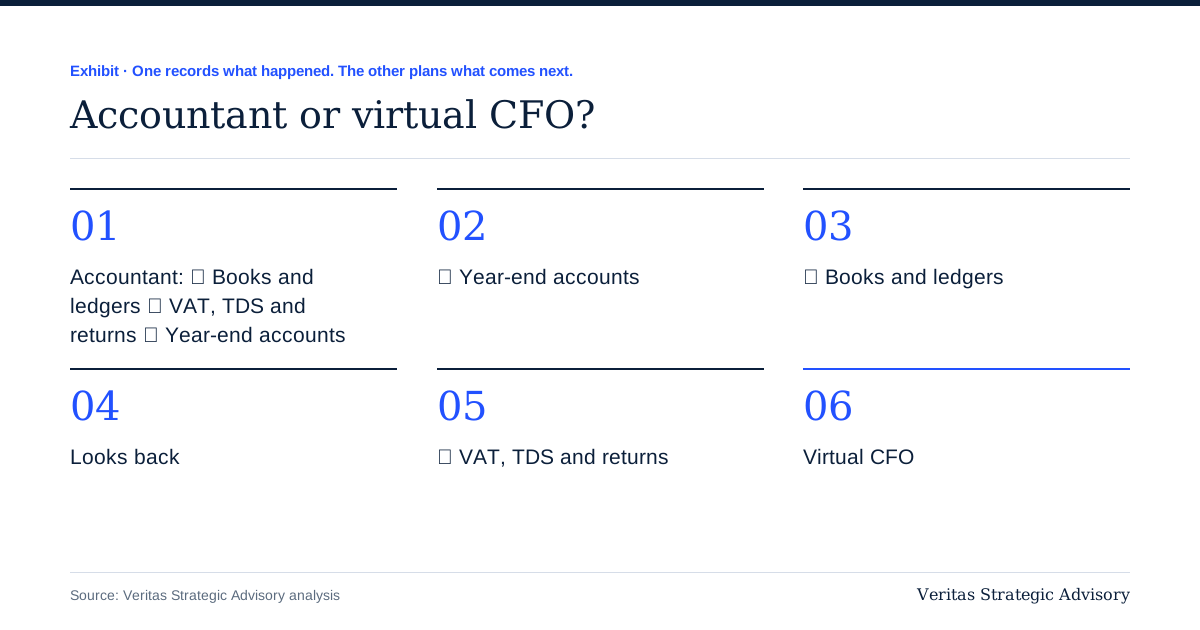
An accountant, in-house or outsourced, is responsible for recording transactions correctly and closing the books: sales, purchases, payroll, VAT and TDS filings, and year-end financial statements. That work answers one question: what happened?
A CFO function answers a different question: what should happen next? It sits on top of the same numbers and turns them into cash flow forecasts, pricing decisions, financing choices and board-level reporting. A business can have an excellent accountant and still have no one asking whether the company can afford to open a second branch, or whether the bank loan on the table makes sense against next year's repayment schedule.
The signals that you have outgrown bookkeeping-only support
You see your numbers a month after the fact, not before a decision. If every financial question gets answered after the transaction is done, there is no forward-looking function in the business.
You are dealing with more than one bank or lender. Covenant tracking, renewal documentation and lender reporting become a part-time job on their own.
Revenue is growing faster than cash. This is the single most common reason mid-sized Nepalese companies bring in outside financial help. (See our companion piece on why a profitable business runs short of cash.)
An investor, buyer or new partner is in the picture. Diligence, valuation and structuring conversations need someone who can represent the numbers, not just produce them.
You are making pricing or product-mix decisions on gut feel. Without product or service-level costing, growth can quietly erode margin.
If two or more of these are true, the business has reached the point where a finance function, not just a bookkeeping function, adds more value than it costs.
What a virtual CFO actually delivers, month to month
A working virtual CFO engagement is not a single annual report. It is a recurring cycle:
Monthly management pack: profit and loss by segment, cash flow actual vs forecast, receivables and payables ageing, and a short written commentary on what changed and why.
Rolling cash flow forecast: typically 13 weeks for near-term liquidity and a longer 12-month view for planning, updated as actuals come in.
Cost and margin review: which products, branches or clients are actually profitable once true costs are allocated, not just revenue share.
Financing support: preparing the numbers lenders or investors ask for, and reviewing loan terms before they are signed.
Decision support: modelling the financial effect of a specific decision, a new branch, a price change, a hire, before it is made rather than after.
Full-time hire vs outsourced CFO: the real trade-off
The comparison is not "cheaper vs more expensive" in isolation. A full-time CFO makes sense once the business is large and complex enough to need daily, in-house judgment: multiple business units, a large finance team to manage, frequent capital-markets activity. Below that size, an outsourced or fractional arrangement gives access to the same calibre of judgment on a schedule that matches the actual decision cycle of the business, monthly or quarterly, without carrying a senior full-time salary for work that does not arise daily.
The honest failure mode on the other side is treating an outsourced CFO as a once-a-year exercise. A CFO function that only shows up at year-end audit time is not a CFO function; it is a compliance function with a different name.
How the engagement works with Veritas
We start with a short diagnostic: a review of your current reporting, bank position and the two or three decisions you are actually facing in the next two quarters. From there we agree a reporting cadence and the specific outputs (management pack, cash flow model, board pack) that match the size and stage of the business, not a fixed template regardless of need.
See our virtual CFO and outsourced finance function service or our broader outsourced CFO capability for what a typical engagement includes.
Frequently asked
Can a small business afford this?
The engagement is scoped to what the business needs, a monthly cash flow review for a smaller company looks very different from a full board-reporting package for a larger one. The right question is not the cost in isolation, but whether the decisions being made without this support are costing more.
Does this replace my accountant?
No. Bookkeeping and statutory filing continue as they are. A CFO function uses that same data and adds forward-looking analysis and decision support on top of it.