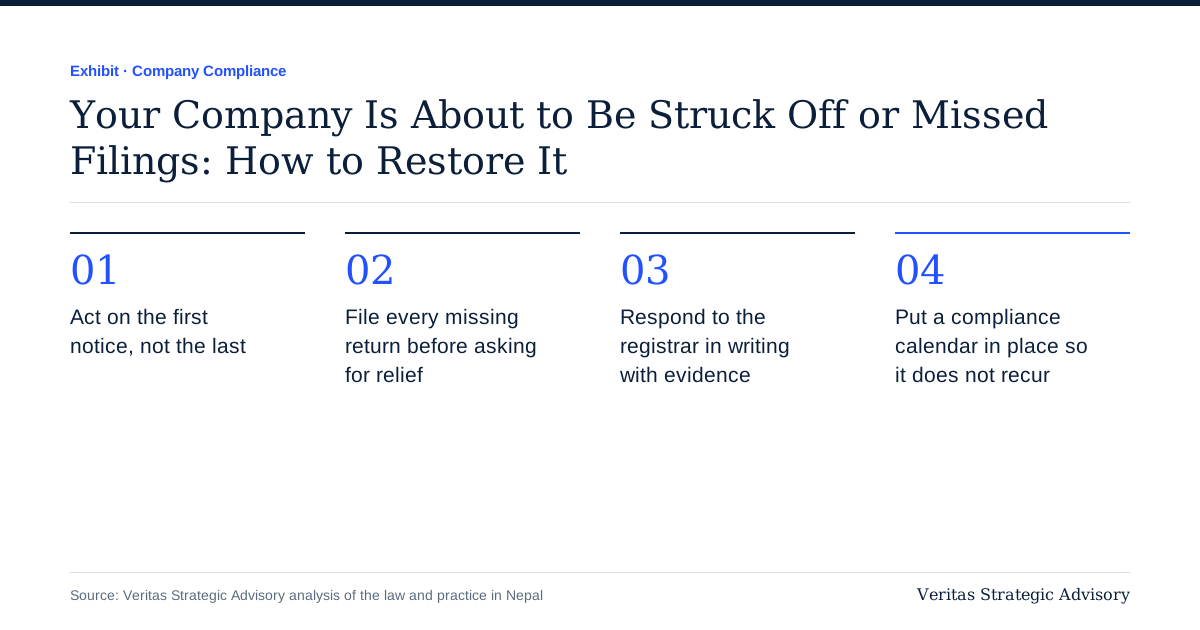
- restoration steps
- 4
- notice to act on before removal
- 1
- types of filing to check
- 3
Why companies end up here
Companies rarely decide to stop filing. They stop because the responsible person leaves, the accountant changes, a notice goes to an old address, or the business goes quiet and nobody checks the register. Months pass and the default compounds.
Start by establishing exactly where the company stands. Check the Office of the Company Registrar for status, any notices issued, and the list of outstanding filings. Do not rely on memory or a single letter.
Understand the stages
A company that misses required annual filings typically moves through a reminder, a penalty or fee, a notice warning of possible striking off, and finally removal if the default continues. The exact timings and penalty rules are set by the Companies Act and the registrar's rules, and they can change. Confirm the current position with the registrar before acting on any figure.
Each stage is easier to exit than the next. A notice of intended striking off is serious, but a company that responds within the period still has options.
Step 1: confirm the default in writing
Obtain the company's compliance status from the registrar and list every outstanding filing by year and type: annual returns, audited statements where required, unreported changes in directors or shareholders, and other statutory submissions.
Check the registered office and the contact details the registrar holds. Many defaults start with a notice that never reached the company. Update the details first so future notices arrive.
Step 2: file the missing returns in order
File the oldest outstanding return first, unless the registrar directs otherwise. Later statements depend on earlier ones. Prepare each set from the books, check it reconciles, and have directors approve it before submission.
Where the books are incomplete, rebuilding them comes first. Filing from estimates creates a second problem.
Step 3: pay the fees and penalties
Pay what the registrar's records show as due. Keep receipts and payment references, since the registrar checks them against its records. A partial payment can leave the default open, so reconcile amounts before paying.
Step 4: respond to the registrar in writing
Where a notice of intended striking off has been issued, respond before its deadline. State the reasons for the default, confirm the steps taken, attach evidence of filing and payment, and request that the company remain on the register. Explain what has changed so the default does not recur.
If the company has ceased trading and should close, apply for a voluntary strike-off through the proper route rather than letting the default run. Voluntary closure gives you control over timing.
If the company has already been struck off
Restoration is possible in many cases, but it is a formal application with its own requirements. It usually needs all outstanding filings, payment of fees and an explanation of the default, and it may need registrar consent and sometimes a court process. Timelines can be long.
The cost is higher than resolving the default early, and the company may have lost bank accounts, contracts and licences in the meantime. This is why the time to act is the first notice.
Keep the company compliant
Restoration fixes the past. A compliance calendar prevents the next default. List every filing with its due date, a named responsible person, and a reminder two months before each deadline. Review it quarterly. Record changes in directors and shareholders on the day they happen.
Name one person accountable for compliance, and make sure a second person knows where the records are. Many defaults happen when one person leaves with the knowledge.
Our company registration service and bookkeeping service cover the filings and records that keep a company compliant. Related: company act compliance checklist and 8 warning signs of weak internal controls.
Why a company falls off the register without anyone deciding it should
A company is removed from the register through a sequence of defaults rather than a single decision. Each default looks minor when it happens: a return filed a few weeks late, a change in directors not notified because the person who would notify it has moved on, a notice sent to an address the company stopped using. Individually these feel manageable. Together they produce a removal that surprises the owners.
Understanding the sequence helps you see where you are. The first default is usually small and recoverable. The second and third are often the ones that trigger formal notices. By the time a notice of intended striking off arrives, several defaults are already on the record, and the response must address all of them. This is why a company that discovers one default should check the whole filing history, not only the one that prompted the check.
Reconstructing the compliance history
The first practical task is to build a complete compliance history. For each year since incorporation, list the filings required, the dates they fell due, the dates they were made, and any notice received. Record changes in directors and shareholders with their dates. This schedule shows exactly what is outstanding and what is merely late.
Where records are missing, rebuild them from the best available sources: bank statements, correspondence with the registrar, the minutes of meetings, and the statutory registers. Do not guess at figures or dates. Mark each reconstructed item as such, and note the source. A reconstructed history that is clearly labelled is far more credible to the registrar than one that presents estimates as facts.
The financial statements that must be rebuilt
Missing financial statements are usually the largest part of the work. Before you file them, the books must be complete for each year. That means the ledgers, the bank reconciliations, the fixed asset register, the payables and receivables, and the tax position for each period. Rebuilding a year of books is substantial work, and it cannot be shortcut without creating a second problem.
Prepare each year's statements in order, because the opening balances of each year depend on the closing balances of the one before. Have the directors review and approve each set before it is filed. A set filed without director approval is a defect, and the registrar may return it.
Where the company had an auditor, or was required to have one, the audit must be completed before the statements are filed. Where the company is exempt from audit, confirm the exemption applies on the facts for each year, because an exemption that does not apply will be challenged.
Dealing with penalties and fees accurately
Penalties and fees accumulate, and the amounts due should be taken from the registrar's own records rather than estimated. Request a statement of account if one is available. Reconcile the statement to your payments and to the defaults on your history. Where the registrar's figure differs from your own, raise the difference in writing and ask for a corrected statement before paying the disputed part.
Paying the undisputed amount promptly shows good faith. Leaving the whole account unpaid while disputing a part is one of the most common reasons a default remains open. Pay what is clearly due and dispute what is genuinely wrong, separately and in writing.
The response to a notice of intended striking off
A notice of intended striking off is the last point at which the company can remain on the register without a formal restoration. The response must arrive before the deadline stated in the notice, and it must be complete. A late or partial response leaves the company exposed to removal.
The response should state the reasons for each default, honestly and briefly. Explain any circumstances that caused the default, such as the departure of a responsible officer or a change of address, without making them an excuse. Confirm the steps taken, list the filings submitted and attach their references, and confirm the payments made. Request that the company remain on the register and state the measures now in place to prevent recurrence.
A response that acknowledges the default, shows it has been corrected and describes the control now in place is the most likely to succeed. The registrar is looking for evidence that the company is now compliant and will remain so.
When the company should be closed instead
Not every company should be restored. A company that has ceased trading, has no assets or liabilities of consequence, and has no intention of continuing may be better closed through a voluntary strike-off. The process requires the directors to confirm that the company has no outstanding debts or claims and that it has ceased business. Confirm these facts before applying, because a false declaration creates personal exposure.
Closure is also cleaner than restoration when the company's history is so poor that restoration would be expensive and uncertain. Weigh the cost of restoration against the value of the company's name, contracts and licences before deciding. Where the company holds assets, closure must deal with them properly, through distribution or transfer, and the tax consequences of that must be checked.
Restoration after removal, step by step
Where a company has been removed and the owners want it back, restoration is a formal application with specific requirements. Expect to provide all outstanding filings, pay the fees and penalties, explain the default, and demonstrate that the company is compliant. The registrar will consider the circumstances, and in some cases a court process may be required.
Plan for time. A restoration can take months, and during that period the company cannot trade normally, sign contracts or operate its accounts with confidence. Inform customers, suppliers and banks early, and agree a plan for any contracts that must continue. The restored company also inherits the consequences of the period in which it was off the register, so check whether any liabilities arose and how they will be handled.
The compliance system that prevents a repeat
The most valuable output of this work is a system that stops it happening again. Build a compliance calendar with every filing, its due date, the person responsible and the date of the reminder. Assign a deputy for each responsibility, so that a departure does not stop a filing. Record all changes in directors, shareholders and registered address on the day they occur, not at the next annual filing.
Review the calendar quarterly with the owners. Check that each filing is on track, that the register of members and directors is current, and that the registered address still receives the registrar's post. A quarterly review of this kind takes an hour and removes almost all of the risk of a repeat default.
Keep a single compliance file for the company, with the filing confirmations, the registrar's correspondence, the payment receipts and the minutes of meetings. A new director or a new accountant should be able to take over the file and understand its status within a day. A company that can hand over its compliance cleanly is one that is unlikely to fall off the register again.
Frequently asked
Can I file late without penalty?
Late filing generally attracts fees or penalties under the rules. File as soon as possible and pay what is due.
Does a struck-off company still owe tax?
Tax obligations after dissolution depend on tax law and the Companies Act, and on the facts. Take advice before assuming the liability has ended.
Will my bank close my account?
A default on the register can affect banking relationships. Tell the bank early, once a plan to resolve the default is in place.