- Core deal structures (shares or assets)
- 2
- Majority for a special resolution
- 75%
- Ownership change that triggers Section 57
- 50%
- Years Section 57 looks back
- 3
Most Nepali business owners meet mergers and acquisitions in one of three situations. A larger company wants to buy yours. You want to buy a competitor or a supplier. Or two family companies under one roof need to become one. In each case the headline price is the easy part. The structure, the approvals and the tax treatment decide how much of that price you actually keep.
This guide walks through the process in the order it normally happens in Nepal. It is general information drawn from the Companies Act, 2063 and the Income Tax Act, 2058, and each deal has facts that change the answer.
What is the difference between a merger and an acquisition?
In everyday use the words overlap, but the legal routes differ.
An acquisition usually means one party buys control of another business. The buyer either purchases the shares of the target company (a share deal) or purchases selected assets and liabilities (an asset deal). The target company may continue to exist, with new owners.
A merger (often called amalgamation) means two or more companies combine so that one survives and the others are wound into it, with assets and liabilities moving across. The Companies Act, 2063 sets a specific procedure for this, and the Office of the Company Registrar (OCR) completes it.
The Income Tax Act, 2058 does not give a single definition of a merger or an acquisition. It taxes the transactions inside them: the sale of shares, the transfer of assets, and the change in who owns the company. That is why the tax work starts at the structuring stage, not after signing.
Share deal or asset deal?
This is the first decision, and it shapes everything else.
| Point | Share deal | Asset deal |
|---|---|---|
| What the buyer gets | Shares, and so the whole company with its history | Chosen assets and liabilities only |
| Hidden liabilities | Come with the company | Left behind unless taken on |
| Who pays tax on the gain | The selling shareholders, through capital gains withholding | The selling company, on its own gain |
| Tax losses and attributes | Stay in the company, but Section 57 can restrict them | Do not transfer to the buyer |
| Contracts, licences and staff | Stay in place | Need re-papering or fresh approvals |
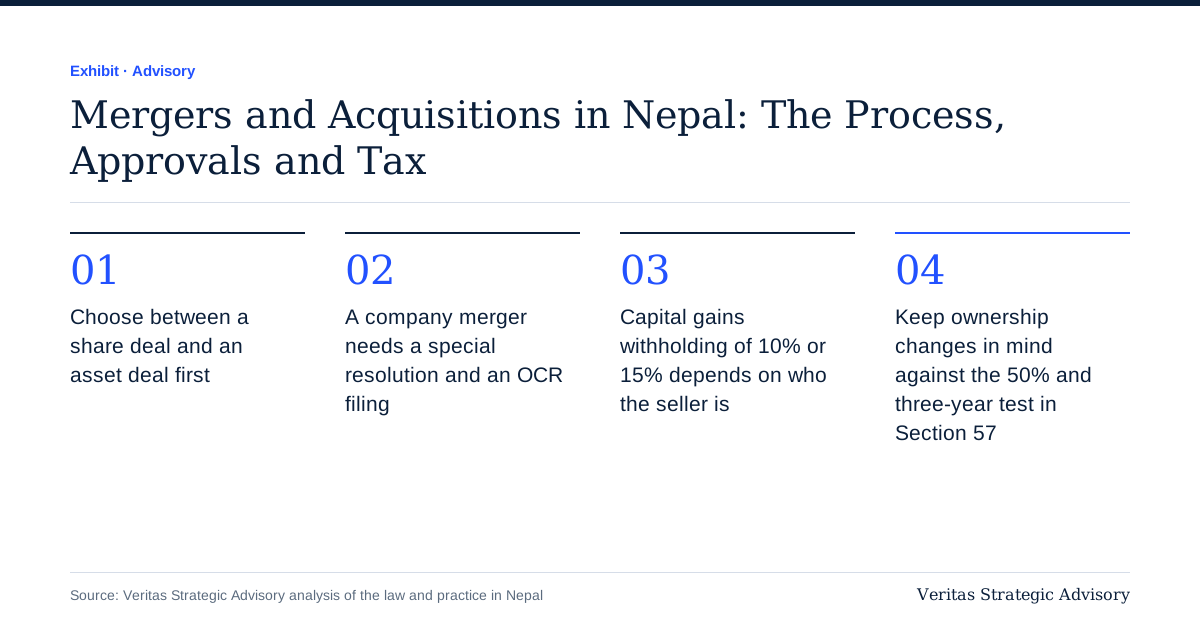
A share deal is simpler to run and keeps licences and contracts in place, but the buyer inherits past tax exposure. An asset deal lets the buyer pick what it wants, but each asset must be transferred, and the seller company is taxed on what it sells. Neither is better in the abstract. The right choice depends on the target's tax history, its licences and how clean its books are.
How does a merger work under the Companies Act, 2063?
For a merger of companies, the broad sequence is as follows.
Agree the terms. The boards agree a valuation, a share exchange ratio or cash consideration, and what happens to employees, contracts and loans.
Pass a special resolution. Section 177 of the Companies Act, 2063 requires the shareholders of the companies concerned to approve the merger by special resolution. A special resolution is a decision backed by at least 75% of the shareholders present at a properly convened general meeting. Check the Act's current text for the exact voting rule before calling the meeting.
Give the notices. Creditors, lenders and the public may need to be told, and some contracts require the counterparty's consent to a change of control or assignment.
Apply to the OCR. The merger documents are filed with the Office of the Company Registrar, which reviews them and records the result. The surviving company takes over the assets and liabilities of the merged company.
Update the registrations. PAN, VAT, bank mandates, licences, the shareholder register and the employee records must all follow.
Shareholders who disagree with a merger have rights under the Act, so the board should document the valuation that supports the share exchange. See what determines a company's valuation for how that number is usually built.
Which approvals might apply besides the OCR?
The Companies Act is only one layer. Depending on who the parties are, other approvals can apply:
Foreign buyers. An investment by a foreign party is governed by the Foreign Investment and Technology Transfer Act, 2075 and needs the relevant approval and recording. See FDI in Nepal: a practical guide for investors.
Banks, insurers and finance companies. These sit under their own regulators (Nepal Rastra Bank and the Insurance Authority) and have their own merger and acquisition rules.
Listed companies. A listed company must also deal with the Securities Board of Nepal (SEBON) and the stock exchange.
Competition rules. The Competition Promotion and Market Protection Act, 2063 can restrict a deal that creates a dominant market position. Sources differ on the exact market-share threshold, so it must be checked against the Act itself rather than relied on from memory.
Sector licences. Hydropower, telecom, education, health and similar businesses carry licences that may not pass to a new owner automatically.
A short regulatory map drawn up before price talks saves the most common failure in these deals: agreeing a price and then discovering that a needed approval is slow or uncertain.
What are the tax points in a share sale?
When shareholders sell shares in a company, the gain is taxed. For a resident individual selling unlisted shares the withholding rate is 10%, and for a resident entity it is 15%, under the capital gains provisions of the Income Tax Act, 2058. The gain is the sale price less the cost of the shares and allowable expenses. Withholding is normally deducted by the buyer, so the buyer must know it is responsible for deducting and paying it over to the IRD.
Here is an illustration only, using assumed figures. A resident individual holds all the shares of an unlisted private company. Paid-up capital and cost are NPR 20 million. A buyer agrees to pay NPR 120 million.
| Step | Amount (NPR) |
|---|---|
| Sale price | 120,000,000 |
| Cost of shares | 20,000,000 |
| Gain | 100,000,000 |
| Withholding at 10% | 10,000,000 |
| Seller receives | 110,000,000 |
If the seller were a company, the 15% rate would apply to the same gain and the withholding would be NPR 15 million. The numbers show why the identity of the seller matters, and why buyers should hold back or deduct the right amount at closing. Rates and rules should be confirmed against the current Finance Act at the time of the deal.
What is the Section 57 trap?
Section 57 of the Income Tax Act, 2058 applies when the underlying ownership of a company changes by 50% or more over three consecutive income years. The company is treated as having disposed of its assets and liabilities at market value, and certain tax attributes, such as carried-forward losses, can be lost.
For an acquirer this matters in two ways. First, buying a majority of a loss-making company for its tax losses will usually not work as planned. Second, even a genuine strategic purchase can trigger a deemed disposal if the ownership change crosses the line, so the tax cost should be in the price model from the start. Staged purchases, where a buyer takes 30% now and 30% next year, are still counted together inside the three-year window.
For a deeper reading of how this rule meets investment policy, see Section 57 and Nepal's deal climate.
What should a buyer check before signing?
A buyer's due diligence is where a deal is won or lost. A practical checklist:
Tax position. Filed returns, assessments, open notices and any disputes with the IRD.
VAT and TDS. Whether VAT has been charged, credited and refunded correctly, and whether TDS was deducted and deposited on time.
Related-party dealings. Loans, management fees and transfers between group companies or owner-managers.
Quality of earnings. Whether profit is backed by cash and whether the reported figures match bank and tax records.
Ownership and documents. Share register, board minutes, land titles, licences and key contracts.
Employee liabilities. Provident fund, gratuity, leave and any pending claims.
Debt and security. Loans, guarantees and charges over assets.
The deeper version of this list is in buying a business in Nepal: financial due diligence. Where a statutory audit is needed, our role is only to support the preparation and review of information for the licensed auditor and the parties.
What should a seller prepare?
Sellers get a better price when the business is easy to understand. Clean up the books for the last two to three years, reconcile VAT and TDS, settle old IRD questions, document related-party balances, and keep a clear record of how the owner's pay and expenses have been treated. If the business is a family company, the issues in selling a family business in Nepal will also apply.
How long does a deal take?
There is no standard timeline. A simple private share sale between two parties can close in a few weeks if the documents are in order. A merger needing a special resolution, creditor consents, regulator approvals and an OCR filing is more often a matter of months. The time is usually set by the slowest approval and by how quickly the target's records can be put in order, not by the legal drafting.
Frequently asked
What is the difference between a merger and an acquisition in Nepal?
An acquisition is one party buying control of another business, by shares or assets. A merger combines companies into one under the Companies Act, 2063 procedure, ending in an application to the Office of the Company Registrar.
Who pays the tax when shares are sold?
The seller pays capital gains tax on the gain. The buyer normally withholds it at 10% for a resident individual selling unlisted shares and 15% for a resident entity, and deposits it with the IRD.
Does a merger need a shareholder vote?
Yes. The Companies Act, 2063 requires a special resolution of the shareholders, generally a 75% majority of those present at a properly convened general meeting.
Can I buy a loss-making company to use its tax losses?
Usually not safely. If ownership changes by 50% or more within three years, Section 57 can treat the company as having sold its assets at market value and can restrict the losses.
Do foreign investors need extra approval?
Yes. Foreign investment is covered by the Foreign Investment and Technology Transfer Act, 2075, and the investment must be approved and recorded before it is treated as foreign direct investment.
Is an asset deal better than a share deal?
Not always. An asset deal avoids inherited liabilities but needs each asset and contract transferred. A share deal is simpler but brings the company's tax history with it.
How should the price be set?
Usually from a valuation based on cash flow, assets and comparable deals, with adjustments for debt and tax exposure. See the guide on what determines a company's valuation.
Next step
If you are weighing a purchase, a sale or a merger, we can help you test the structure, the tax cost and the approvals before you commit to a price. See our M&A advisory service or contact us.
General information only, not advice. Rules and rates change; confirm against the current Companies Act, Income Tax Act and Finance Act before acting.