
Getting the structure right early is disproportionately valuable relative to the effort it takes.
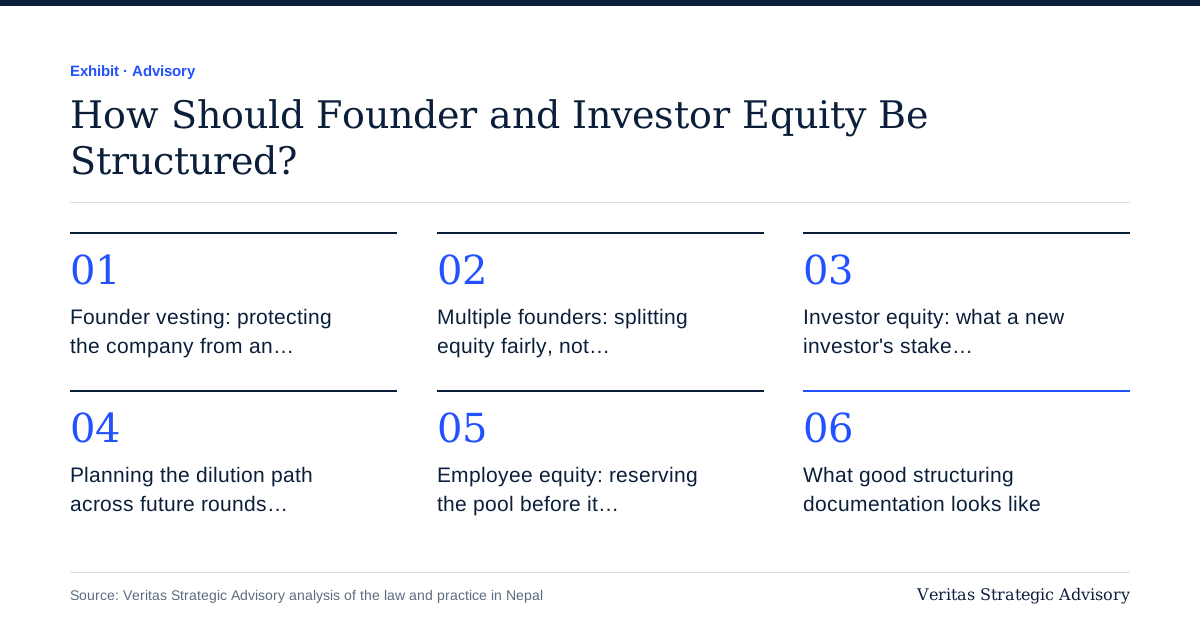
Founder vesting: protecting the company from an early departure
Vesting means a founder's equity is earned progressively over a period, typically several years, rather than granted outright and fully owned from day one. This protects the remaining founders and any investor from a scenario where a co-founder leaves early, months after formation, while retaining a large, fully-owned equity stake in a business they no longer contribute to. A standard structure includes a cliff, a minimum period before any equity vests at all, followed by gradual vesting over the remaining period. Founders frequently resist applying vesting to themselves, reasoning that they are the ones taking the risk and should not need to "earn" their own company's equity, but professional investors increasingly expect it as standard practice precisely because it protects everyone's incentives, including the founders who do stay and keep building.
Multiple founders: splitting equity fairly, not just equally
An equal split between co-founders feels fair on the surface and is, in practice, one of the more common sources of later conflict, particularly where contributions of capital, time, existing assets, or specialised expertise are genuinely unequal. A more durable approach values the actual contribution of each founder, capital invested, time committed, intellectual property or relationships brought in, and structures the split to reflect that, documented clearly enough that the reasoning survives being revisited years later under different circumstances.
Investor equity: what a new investor's stake actually carries with it
An investor's equity is rarely just a percentage ownership figure; it typically comes attached to specific rights that matter more than the headline percentage, covered fully in before bringing in an investor: what founders should know: liquidation preference, anti-dilution protection, board representation, and information or veto rights over specific decisions. Structuring these terms proportionately to the size and stage of the investment, rather than accepting standard boilerplate without scrutiny, is where much of the real negotiation should focus, not on the headline valuation alone.
Planning the dilution path across future rounds, not just this one
Every funding round dilutes existing shareholders, founders included, and a founder negotiating only the round in front of them, without modelling what a realistic sequence of future rounds does to their eventual ownership, frequently ends up more diluted than intended by the time the company reaches a meaningful exit. Before accepting a specific equity structure today, model at least one or two plausible future rounds and their dilution effect, so today's decision is made with a view of where it leads, not in isolation.
Employee equity: reserving the pool before it becomes expensive to create
Most growing companies eventually need an equity pool to attract and retain key employees. Reserving this pool at formation or at the first investment round, rather than creating it later by diluting only the founders after investors are already locked in at their existing percentage, is a structural decision that is easy to get right early and considerably harder, and more contentious, to correct later once other shareholders' stakes are already fixed.
Related-party and family shareholding: a specific Nepalese context
Many Nepalese private companies include family members as shareholders for reasons of trust, succession planning, or historical capital contribution, without always formalising the same governance discipline, board rights, transfer restrictions, drag-along and tag-along provisions, that would apply to an unrelated investor. This informality can become a genuine obstacle later, at the point of an outside investment or sale, when a professional investor requires clarity on every shareholder's rights and a family shareholder's informal understanding does not match what is legally documented. Formalising these arrangements properly, even among family, protects the business and the relationships within it.
What good structuring documentation looks like
A cap table that is accurate and current at all times, a shareholders' agreement that documents vesting, transfer restrictions, and any special rights clearly, and a clean, unambiguous record of every issuance and transfer since formation. This is precisely the documentation a prospective investor's due diligence will examine closely, and precisely the documentation, covered in what makes a business investment-ready, that is far cheaper to build correctly from the outset than to reconstruct under pressure once an investor conversation is already underway.
How Veritas supports equity structuring
We help founders structure vesting, founder splits, and investor terms proportionately to the stage and size of the business, and model the dilution path across realistic future rounds before a founder commits to today's structure. See our financial advisory and modelling service for how this fits into a broader fundraising or founding-structure engagement.
Frequently asked
Is vesting only relevant when there is an outside investor involved?
No; vesting between co-founders protects the business from an early departure regardless of whether outside investment has occurred, and is worth putting in place at formation even for a self-funded company with no immediate plan to raise capital.
Can an equity structure be corrected later if it was set up poorly at the start?
Some corrections are possible but are typically more complex, more expensive, and require the agreement of every affected shareholder, which is precisely why getting the structure right at formation or at the first investment round is disproportionately more valuable than the effort it takes at that stage.