- hours to respond
- 48
- core documents
- 5
- working days to answer follow-ups
- 2
Why the first response matters
An investor's first request is a test. They are checking whether you respond quickly, whether records exist, and whether figures agree. The pack you send answers those questions before they are asked.
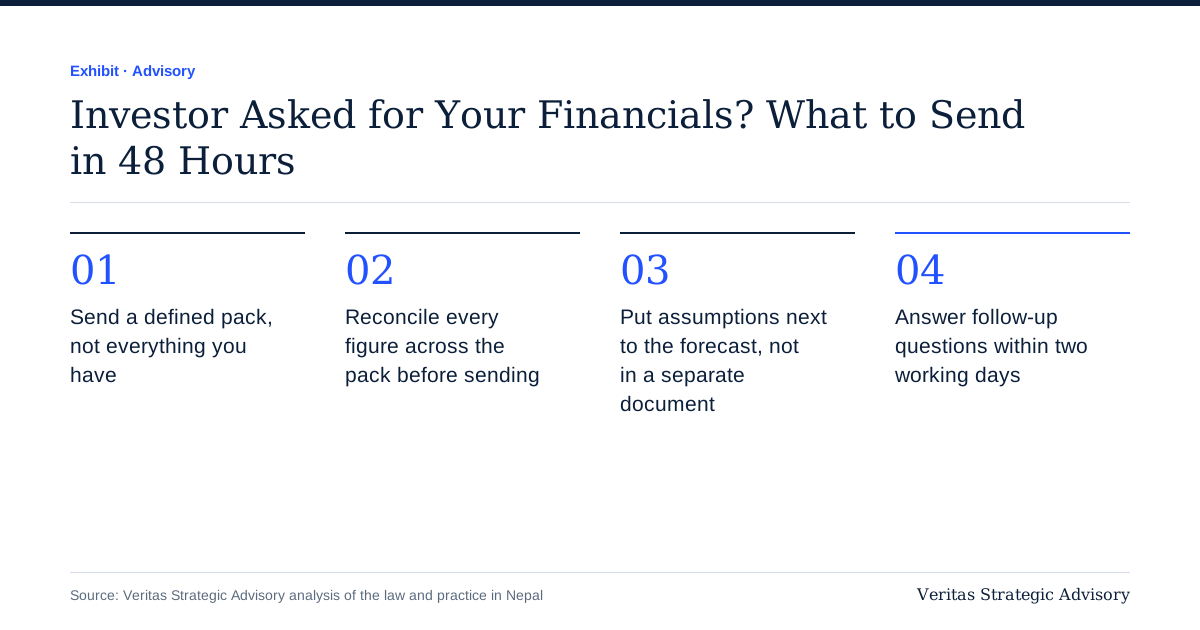
Do not send everything you have. Send a defined pack sized to the stage. An unstructured dump signals disorganisation, and the first meeting becomes a search for what you should have sent.
Hours 0 to 6: confirm the scope
Reply the same day. Confirm the scope in one line: which periods, which documents, and by when. If the request is unclear, ask one precise question.
Confirm an NDA covers the pack before sending anything confidential.
Hours 6 to 24: assemble the core pack
The core pack has five parts.
Three years of financial statements, prepared under the framework your business applies, with the auditor's report where one exists. Label any unaudited year clearly.
Twelve months of management accounts: profit and loss, balance sheet and cash flow. Monthly data shows how the business behaves between year-ends.
A three-year forecast built from unit economics, not top-down growth rates. Show revenue drivers, cost structure, working capital and the funding need.
The capitalisation table: every shareholder, holding, share class and special rights. An inaccurate cap table stops a deal.
A list of material contracts with key terms: customers, suppliers, leases and loans. Summarise each in a line and offer full copies on request.
Hours 24 to 48: reconcile before sending
This is the step most founders skip, and it matters most. Revenue in the statements should match the management accounts for the same period. Cash flow should explain the change in cash on the balance sheet. The forecast should start from the last actual year.
Where a difference exists, explain it in a short note. A difference you explain shows control. A difference the investor finds shows carelessness.
Put assumptions next to the forecast
Do not bury assumptions in an appendix. Place each key assumption beside the line it drives: growth rate, price increase, collection period, cost inflation, capacity limit.
Include a sensitivity table showing the forecast if the main assumptions move. Investors look for the downside case, and showing it yourself earns credibility.
What to send, and what to hold back
At an early stage, the pack is the summary and the model. Detailed contracts, payroll and bank statements can follow once the investor is serious. Holding detail back until requested is normal, provided you respond within the window you committed to.
Never send a figure you cannot defend. If it is an estimate, call it an estimate.
Answer follow-ups within two working days
The first questions come quickly. Answer each within two working days and keep an answer log, so the same question always gets the same answer. Inconsistent answers are among the fastest ways to lose an investor.
The one-page summary
Attach one page at the front: the business in two sentences, last year's revenue and profit, the cash position, the funding sought and its use, and the key risks. An investor who reads only that page should know enough to decide whether to continue.
Our financial advisory and modelling service builds this pack, the forecast and the cap table review before the request arrives. Related: before bringing in an investor, what founders should know and what makes a business investment ready.
What investors are really testing
Investors ask for financials for three reasons: to understand the business, to test the management, and to decide whether the numbers justify the price they are considering. The pack you send should serve all three. Understanding the business requires clarity. Testing management requires consistency and speed. Justifying the price requires figures that survive questioning.
Most early-stage requests come from investors who will not commit to a number until they have seen the detail. Their first pass is quick, perhaps an hour, and their decision to continue depends on whether the pack raises more questions than it answers. A well-organised pack answers the obvious questions and makes the non-obvious ones easy to ask.
Preparing the historical statements for scrutiny
Historical statements are the foundation, and investors test them harder than most founders expect. They will compare the revenue line with the cash line, check whether margins moved for a reason, and look for one-off items that flatter a year. Prepare your statements to answer these questions before they are asked.
Add a short schedule that explains the main movements: the largest changes in revenue, cost of sales, operating expenses and working capital, each with a brief reason. Identify any non-recurring item and show the figure both with and without it. An investor who finds an unexplained spike will assume the worst, so explain the spikes yourself.
Where the statements were prepared under a specific framework, state the framework and any significant policy choices. Changes in policy between years should be disclosed with their effect, because a change in method can make two years look different when the business has not changed.
The management accounts and what they reveal
Monthly management accounts show how the business behaves between year-ends, which is often more useful to an investor than the annual figures. They reveal seasonality, the speed at which revenue converts to cash, and whether management knows its own numbers monthly.
Present the monthly accounts in a consistent format, with the same line items every month. Add a commentary of two or three lines per quarter explaining the main movements. A management team that writes that commentary is demonstrating control, whether or not the business is performing well that quarter.
Reconcile the monthly accounts to the annual statements. The totals for the year should match. If they do not, explain the difference. Investors treat an unreconciled difference as a warning about the reliability of the whole finance function.
Building a forecast investors can test
A forecast is a set of assumptions expressed as numbers. Investors do not test the numbers first; they test the assumptions behind them. Begin with the drivers: how many customers, at what price, with what churn, and what capacity limits the business. Build the revenue forecast from these drivers, then the cost forecast from the cost behaviour of the business, not from a percentage of revenue.
State each assumption where it is used. Include the source of the assumption, whether historical data, a signed contract, a market reference or management judgement. An assumption based on judgement is still acceptable, but it should be labelled so that the investor can apply their own view.
Show the sensitivity of the outcome to the most important assumptions. A table showing the effect of a ten percent change in price, a delay in a major customer, or a higher cost of inputs gives the investor a range rather than a single answer. Investors trust a forecast that shows its own weaknesses more than one that presents only the optimistic case.
The cap table and the rights behind it
The capitalisation table is more than a list of percentages. It records who holds shares, in which class, on what terms, and with what rights. Investors will check whether the cap table matches the registered shareholding, whether any options or convertible instruments are outstanding, and whether any existing shareholder has a right that affects the new investment.
Prepare a summary that shows the fully diluted position, including any options or promised shares. Note any side agreements that affect voting, transfer or dividends. If there is a dispute or an unresolved transfer, disclose it at this stage, because a discovered issue damages trust far more than a disclosed one.
Contracts: what to summarise and what to hold
Material contracts matter because they show the security of the revenue. A list with a short summary of each contract, its counterparty, its term, its value and its termination rights is usually enough at the first stage. Customer concentration is the question most often asked here, so show the share of revenue from the largest customers and the terms of their contracts.
Hold back the full text of confidential contracts until the investor is serious. Say clearly that the full text is available and under what conditions. Withholding a contract is normal; withholding its existence is not.
The follow-up questions and how to answer them
After the pack, investors will ask questions. Some will be about numbers, some about the business, and some about the people. Answer each within two working days, and record the question and the answer in a shared log. When two people answer the same question differently, the investor notices. A single owner for investor questions, with a reviewer, prevents this.
If you do not know an answer, say so and give a date when you will. An honest timeline is far better than an invented answer that later proves wrong. Investors accept uncertainty; they do not accept inconsistency.
After the pack: what good looks like
A good outcome is a second meeting, a request for more detail on specific areas, or a clear statement of what the investor needs to proceed. Each of those signals genuine interest. A request that goes quiet after the pack usually means the pack raised more concerns than it resolved, and the best response is to ask directly what those concerns are.
Keep the pack current. The numbers will change, and an investor who receives an updated pack with a clear note of what changed trusts the process more than one who receives an old pack that no longer matches the business.
Do not bury assumptions in an appendix.
Frequently asked
Should I send the pack before a meeting?
Send the summary and core statements in advance and bring the rest to the meeting. Sending everything first can overwhelm a busy investor.
What if my accounts are not audited?
Say so clearly and explain the basis of preparation. Unaudited accounts can work if they are consistent and transparent, but they will be tested harder.
How much detail is too much?
If a document does not answer a question the investor has asked or is likely to ask now, hold it back. Every extra page is something to check.