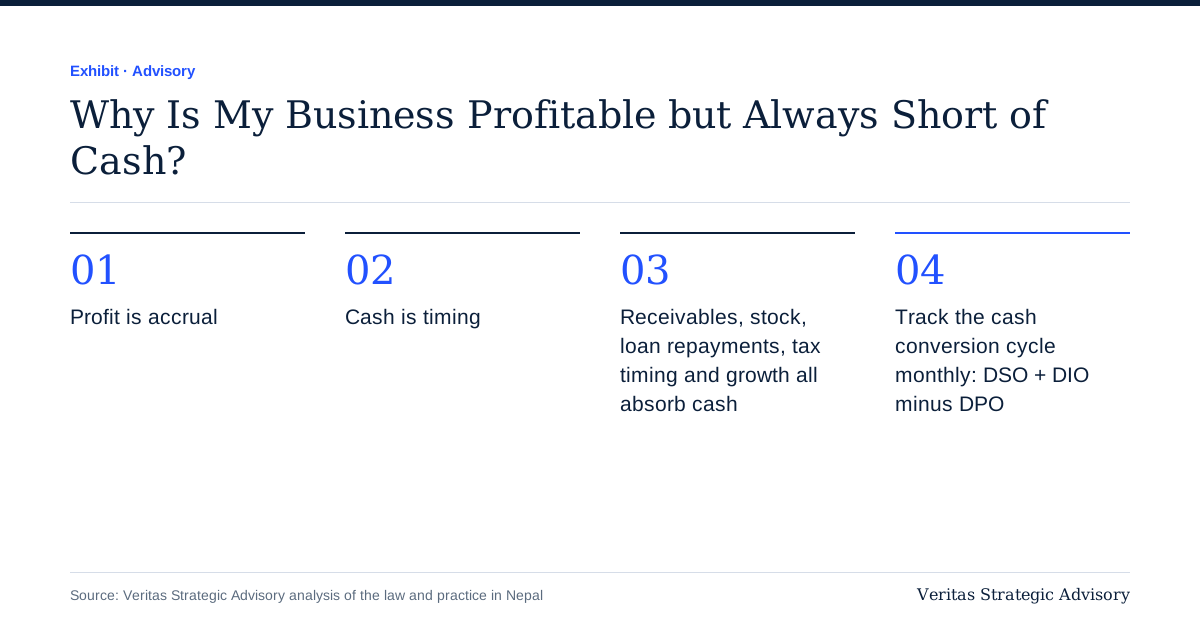
- common causes
- 5
- measures in the cash cycle
- 3
- rolling forecast
- 13 wks
- first statement to check
- 1
This is the single most common question we hear from business owners in Kathmandu, and it is rarely a sign of a bad business. It is almost always a sign of a business whose growth has outrun its working capital cycle, while the profit and loss statement keeps reporting good news.
Profit and cash are measuring two different things
Financial statements prepared on an accrual basis, as required for NFRS and NFRS for SMEs reporting, recognise revenue when it is earned and expenses when they are incurred, not when cash actually moves. A sale recorded this month may not be collected for 60 or 90 days. A profit and loss statement can show a healthy margin in a month where the bank balance falls, because profit and cash are simply not the same measurement.
The five most common causes
1. Receivables growing faster than sales. If customers are taking longer to pay, or credit terms have quietly loosened to win business, cash collection lags revenue recognition by a widening margin every month.
2. Inventory building up ahead of demand. Stock sitting on shelves is cash that has left the bank and not yet come back. A retailer or manufacturer that grows inventory faster than sales is financing that growth out of its own cash reserves, often without realising it.
3. Debt repayment and capital spending sit below the profit line. Loan principal repayments and equipment purchases do not appear as an expense on the profit and loss statement, but they are real cash outflows every month. A business can be profitable and still be committing a large share of its cash to repayments the P&L never shows.
4. Tax and VAT timing. VAT collected from customers is not the business's money, but it sits in the bank account until it is remitted. Similarly, advance tax instalments and year-end settlements under the Income Tax Act, 2058 fall due on a fixed schedule that does not track the timing of when cash was actually earned.
5. Growth itself consumes cash. This is the least intuitive and most important cause. A growing business needs more working capital, more inventory, more receivables outstanding, simply to support a larger volume of sales, even if margins and payment terms do not change at all. The faster the growth, the larger the cash gap, and profitable growth is often the exact circumstance that drains a bank account fastest.
How to find out which one applies to you
Start with the cash flow statement, not the profit and loss statement. The operating activities section reconciles net profit to actual operating cash by adjusting for the changes above. If operating cash flow is consistently lower than net profit, the gap itself tells you where to look: a large negative adjustment for receivables points to collections, a large negative adjustment for inventory points to stock, and so on.
A more precise diagnostic is the cash conversion cycle: the number of days between paying suppliers and collecting from customers. It combines three measures:
Days Sales Outstanding (DSO): average receivables ÷ (revenue ÷ 365)
Days Inventory Outstanding (DIO): average inventory ÷ (cost of goods sold ÷ 365)
Days Payable Outstanding (DPO): average payables ÷ (cost of goods sold ÷ 365)
Cash conversion cycle = DSO + DIO − DPO. A rising number, tracked month over month, is the earliest and clearest warning sign available, well before the bank balance shows it.
What to do about it
Tighten credit terms deliberately, rather than letting them drift, and track DSO monthly rather than only at year-end.
Set inventory reorder points against actual sales velocity, not against what was ordered last year.
Negotiate supplier terms as a working capital lever, not just a cost lever. Extending payables by even a week, without damaging supplier relationships, has a direct cash effect.
Forecast cash on a rolling basis. A rolling 13-week cash flow forecast catches a coming shortfall months before it becomes a crisis, because it is built from actual invoices and payment dates rather than average monthly figures.
Separate financing decisions from operating decisions. If growth needs more working capital, that is a financing question (a working capital facility, or equity), not a signal that the underlying business is unhealthy.
For a structured answer to how much working capital your specific business needs, see how much working capital does your business actually need. If you want a cash flow diagnostic done on your own numbers, see our financial strategy and performance capability or our virtual CFO service.