- steps to calculate it
- 4
- inputs: DSO, DIO, DPO
- 3
- day basis
- 365
Most owners either guess at their working capital requirement or borrow reactively once cash is already tight. Both approaches cost money: guessing too low creates repeated cash crunches, and guessing too high ties up capital that could be invested elsewhere in the business. The requirement can actually be calculated from the business's own operating cycle. Every figure in the worked example below is illustrative, built to show the arithmetic, and describes no real business or client.
What working capital is measuring
Working capital, in the simplest form, is current assets minus current liabilities: the cash tied up in receivables and inventory, net of what is owed to suppliers and other short-term creditors. But the more useful number for planning is not the balance sheet snapshot, it is the cash conversion cycle: the number of days that pass between paying cash out for inputs and collecting cash in from customers.
Cash conversion cycle = Days Sales Outstanding + Days Inventory Outstanding − Days Payable Outstanding
A business with a 60-day cash conversion cycle has, in effect, 60 days of its own operating costs permanently financed out of its own capital or borrowing, for as long as it operates at that volume of sales. The three inputs each have a plain meaning:
Debtor days (DSO): average receivables divided by credit sales, multiplied by 365. How long customers take to pay.
Stock days (DIO): average inventory divided by cost of goods sold, multiplied by 365. How long goods sit before they are sold.
Creditor days (DPO): average payables divided by cost of goods sold, multiplied by 365. How long you take to pay suppliers.
Use average or monthly balances rather than a single year-end figure, which is often unrepresentative.
Calculating the requirement in practice
Establish the cash conversion cycle from actual receivables, inventory and payables data, not industry rules of thumb.
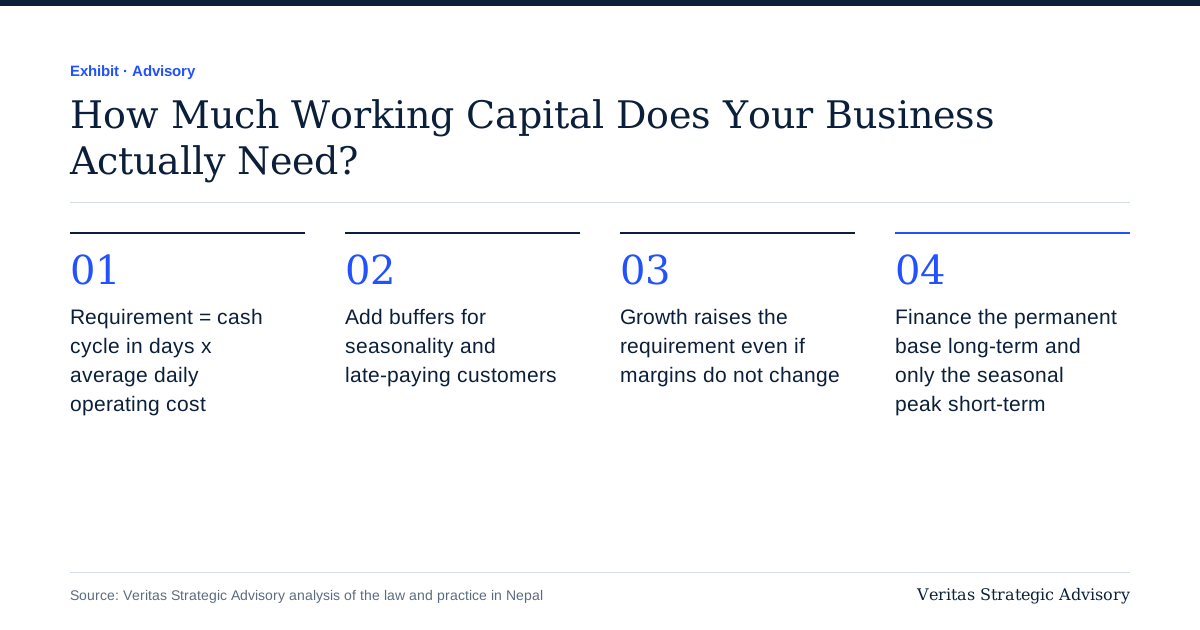
Multiply by average daily operating cost (cost of goods sold plus relevant cash operating expenses, divided by 365) to convert the cycle in days into a rupee requirement.
Add a buffer for seasonality. A business with a seasonal sales pattern, festival-season retail, agricultural inputs, tourism, needs working capital sized to its peak operating volume, not its annual average, because the cash is tied up during the peak regardless of what the yearly average looks like.
Add a buffer for payment-term risk. If a meaningful share of receivables consistently runs later than stated terms, the working capital requirement in practice is higher than the stated terms alone would suggest.
A worked example (illustrative numbers only)
Take a hypothetical trading and distribution business. All figures below are illustrative, not drawn from any real business.
Annual sales: NPR 120,000,000
Cost of goods sold: NPR 84,000,000
Cash operating expenses: NPR 18,000,000
Debtor days: 60
Stock days: 75
Creditor days: 45
Step 1: the cycle. 60 + 75 − 45 = 90 days. Cash goes out roughly three months before it comes back.
Step 2: daily operating cost. (84,000,000 + 18,000,000) ÷ 365 = about NPR 279,452 per day.
Step 3: the base requirement. 90 × 279,452 = about NPR 25.15 million. That is the permanent amount of money the business needs tied up in its operating cycle, even in an average month.
Cross-check against the balance sheet. The same days imply receivables of about NPR 19.73 million (60 days of sales), inventory of about NPR 17.26 million (75 days of cost of goods sold) and payables of about NPR 10.36 million (45 days of cost of goods sold). Net, that is about NPR 26.63 million. It is roughly 6% above the cost-based figure because receivables are carried at selling price, which includes margin, while the simplified method counts everything at cost. Treat the two as a range.
Step 4: late payers. Suppose one fifth of receivables habitually pays 30 days after the agreed terms. That adds 0.2 × 30 = 6 days of effective debtor time, so the cycle is really 96 days: 96 × 279,452 = about NPR 26.83 million, an extra NPR 1.68 million that stated terms would never show.
Step 5: seasonality. Suppose the festival-season quarter runs about 40% above average volume. The peak requirement is 26.83 × 1.4 = about NPR 37.56 million, so the seasonal layer is about NPR 10.73 million.
Step 6: the funding gap. Suppose the owners can fund NPR 12 million of working capital from their own capital and retained profit. Then:
| Layer | Illustrative amount (NPR million) |
|---|---|
| Permanent base including late-payer buffer | 26.83 |
| Funded by owners | 12.00 |
| Permanent funding gap | 14.83 |
| Seasonal layer above the base | 10.73 |
| Total external funding at the peak | 25.56 |
The check is simple: 37.56 at peak minus 12.00 owner-funded equals 25.56. Roughly NPR 14.83 million is a structural need present all year; only NPR 10.73 million is genuinely temporary.
What shortening the cycle is worth. Collecting ten days faster, 60 down to 50, releases about 10 × 279,452 = NPR 2.79 million of cash, without borrowing a rupee. That is often cheaper than any facility.
Why growth increases the requirement, even with no change in margin
This is the point most owners miss. If the cash conversion cycle and margins stay exactly the same, working capital requirement still rises in direct proportion to sales, because a larger volume of sales means a proportionally larger amount of receivables and inventory outstanding at any given time.
In the example, growing sales by a third with an unchanged 90-day cycle lifts the base requirement from NPR 25.15 million to about NPR 33.53 million. That is NPR 8.38 million more just to stand still, before funding any actual growth investment. This is the same mechanism explored in why a profitable business can still run short of cash: growth itself is a cash consumer, not a cash generator, in the short run.
Financing the requirement correctly
The most common and most damaging mistake is funding a permanent working capital requirement, the base level of receivables and inventory a business needs simply to operate at its normal volume, with short-term, renewable debt. That base requirement does not go away between renewal cycles; it is a structural feature of the business. Treating it as temporary creates repeated refinancing risk and real exposure if a lender tightens terms at renewal.
A more disciplined structure separates the two:
The permanent base level of working capital is financed with a facility, or capital structure, matched to its permanent nature: a longer-term working capital facility or equity, not a short-term overdraft renewed annually as if it were temporary.
The seasonal peak above that base is genuinely temporary, and is the appropriate use for a short-term or revolving facility that draws up and pays down within the year.
In the example, the NPR 14.83 million permanent gap suits equity, retained profit or a longer-tenor facility, while the NPR 10.73 million seasonal layer suits a revolving line paid down after the festival quarter.
How banks in Nepal tend to look at working capital
Terms differ from bank to bank and change over time, so confirm the current position with your lender. In practice, a credit officer usually looks at the same things this calculation does:
The cycle behind the request. Banks commonly test whether the amount asked for is consistent with sales, stock and receivables, rather than accepting a round number.
Quality of the current assets. Stock statements and receivables ageing are typically reviewed; old receivables and slow-moving stock are weak security for a revolving facility.
Consistent records. Accounts, tax filings and bank statements should tell the same story; mismatches are a common reason for a request to be trimmed or declined.
The right instrument. Overdraft, revolving lines and term loans serve different purposes. Our guide on why banks reject loan applications covers more.
An applicant who arrives with the cycle, the base-versus-peak split and a clean receivables ageing is easier to lend to than one who arrives with only a number.
Before taking a bank loan to cover a shortfall
Before signing, compare the cycle-based requirement with the facility size and repayment schedule offered, and check that the loan matches the right part of it, permanent base versus seasonal peak, rather than simply the number the bank offered. A mismatched facility either leaves the business short again within a year or costs more interest than the requirement justified.
For help building this calculation on your own numbers, and structuring the right financing against it, see our financial strategy and cash flow capability or our virtual CFO service.

If you would like your own cash cycle worked out and a financing structure matched to it, our team of chartered accountants can help.
*Prepared from published sources and standard practice, October 2026. The worked example is illustrative only. General guidance, not a substitute for advice on your own circumstances.*