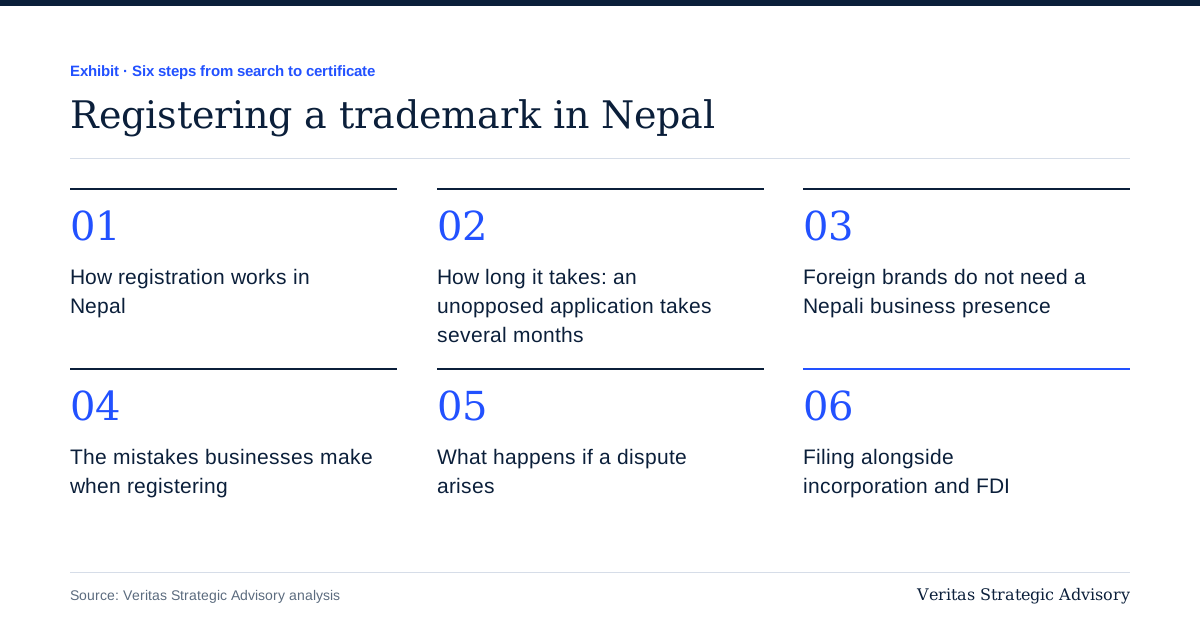

- steps from search to certificate
- 6
- year registration term, renewable
- 7
- title comes from registration
- 1st-to-file
Trademark protection in Nepal runs on a first-to-file basis, not first-to-use. Under the Patent, Design and Trademark Act, a person acquires title to a trademark through registration at the Department of Industry, not through having traded under the name first. This single fact drives most of what actually matters in the process.
Which law and which office apply
Trademarks are registered by the Department of Industry (Industrial Property Section), under the Ministry of Industry, Commerce and Supplies. The governing statute is the Patent, Design and Trademark Act, 2022 BS (1965), which the Department still lists as the Act on its website. Law-firm commentary points to Section 16 as the provision under which title to a mark is acquired on registration.
A replacement law is in progress. A draft Industrial Property Bill was registered in Parliament in 2025 and would replace the 1965 Act if passed, and press coverage in June 2026 still describes the Industrial Property Act as a draft. Reported proposals include protection against copies of well-known marks. We could not confirm enactment, and the Department's legal page still lists only the 1965 Act, so check which law applies on the day you file.
How does trademark registration work in Nepal?
Clearance search. Check the Department's records for conflicting or similar existing marks before filing. The Department offers a search service for a fee. We did not find a rule making a search mandatory, but it is the sensible first step.
Application filing. Submitted to the Department with the mark (word, logo or combination), the goods or services it covers, and applicant details.
Examination. The Department reviews the application, including whether it conflicts with earlier marks.
Publication. An accepted mark is published in the Department's Industrial Property Bulletin, which opens the window for third parties to oppose.
Opposition period. If no opposition is filed, or an opposition is resolved in the applicant's favour, the mark proceeds to registration.
Certificate of registration. Issued once fees are paid and the process is complete, giving the holder exclusive rights in the registered goods or services.
What the Department asks for. Its published checklist for a domestic applicant lists a completed application form, a copy of the business registration or operating permit with proof of VAT or PAN registration, four specimens of the mark (each no larger than 8 x 8 cm, clearly showing the business name, address and goods or services), the fee receipt, and a power of attorney if a representative files. Use the Department's current checklist, as requirements can change.
What does it cost and how long does registration last?
Fees change, so confirm them with the Department before you budget. One law-firm guide reports NPR 1,000 per class for the application, NPR 1,000 for a pre-filing search and NPR 5,000 for issuing the certificate, and notes that the schedule may be revised. We could not verify these amounts on the Department's own pages.
On duration, the sources we reviewed agree that registration lasts seven years from the date of registration and can be renewed for successive seven-year periods. The Department's checklist for renewal asks for the original certificate, proof that the business registration is current, and proof that the mark is in use. Law-firm commentary also notes that a mark can be cancelled for non-use, and one 2018 note reports a one-year period after registration. Because that period may differ under current rules, assume you must use the mark and keep evidence of use.
One law firm reports that Nepal is not a Madrid Protocol member, so a separate Nepal filing is needed.
How long does trademark registration take in Nepal?
We could not find an official processing time, so we do not quote one. What can be said is structural. The opposition window alone is a fixed block of time: one law firm, citing Section 18(1) of the Act, states that an opposition notice must be filed within 90 days of the Bulletin being made publicly available, with no provision for extension, while an older note describes the period as three months. Examination and publication sit on either side of it, so even an unopposed application is realistically a matter of months, not weeks. Opposed applications take longer, because the Department hears the dispute before deciding.
Do foreign brands need a Nepali presence to register a trademark?
Not necessarily a Nepali company, but a foreign applicant cannot simply file from abroad without local arrangements. The Department's checklist for foreign marks asks for everything a domestic filing needs, plus a certified copy of the valid home-country registration certificate, priority-date evidence if priority is claimed, and a power of attorney with a Nepal correspondence address. Law-firm guidance describes eligible foreign applicants as businesses with local representation. In practice that means appointing a Nepal-based representative, and it is worth confirming with the Department or counsel whether your own corporate documents will satisfy the business-registration and tax-registration items.
Because title follows registration, there is a real case for filing before launch rather than after. Our guide to the FDI process in Nepal covers the separate approval sequence for actually operating once the name is secured.
What mistakes do businesses make when registering a trademark?
Filing the wrong classification. Registration covers the goods or services classes you file in, and fees are charged per class. A business planning to expand into adjacent product lines should consider every class it actually intends to use, not just today's.
Registering a logo but not the word mark, or vice versa. These are different representations of a brand, and protecting only one can leave the other open to a third-party filing.
Treating a company name registration at OCR as trademark protection. The two are separate systems. Under the first-to-file rule, title comes from trademark registration, so a registered company name does not by itself give trademark rights.
Waiting for market entry to register. The gap between "we plan to launch here" and "we filed" is the window an opportunistic filer can use.
Ignoring the Bulletin. Marks are published in the Department's Industrial Property Bulletin, and the opposition window runs from that publication. A business that does not monitor it may only learn of a conflicting application after the window has closed.
What happens if a trademark dispute arises?
Before registration, the remedy is opposition: any person may file a notice after publication, the Department serves it on the applicant, the parties file their statements and evidence, a hearing is held, and the Director General decides. A party unhappy with the decision can appeal to the High Court. After registration, the routes are cancellation and infringement action at the Department and, where necessary, the courts.
Evidence of prior use, market recognition and the filing date can all be relevant. But under a first-to-file system a late-discovered conflict is harder to unwind than a timely opposition would have been, which is why the monitoring step above matters. Time limits are short, so take advice as soon as a conflict is noticed.
Frequently asked
Is Nepal first-to-file or first-to-use for trademarks?
First-to-file. Using a name in trade for years does not by itself protect it; title to a mark is acquired through registration, subject to opposition.
Can a foreign company register a trademark in Nepal without incorporating locally?
The sources we reviewed do not require a Nepali company, but they do require a certified home-country registration certificate, a power of attorney and a Nepal correspondence address. Confirm the current documents with the Department. Compare this with the separate company registration process needed to actually operate.
Does registering a company name at OCR also protect the brand as a trademark?
No. Company name registration and trademark registration are separate systems at different authorities, and one does not substitute for the other.
What is the biggest risk of waiting to register a trademark?
A competitor or opportunistic filer can register the same or a confusingly similar mark first, before the original user ever applies.

If you want to register a brand before you launch, our team of chartered accountants can coordinate the filing alongside company registration and investment approvals, working with trademark counsel where needed.
*Prepared from published sources, October 2026. General guidance only; confirm against the current text of the Act and with the Department of Industry before filing.*