

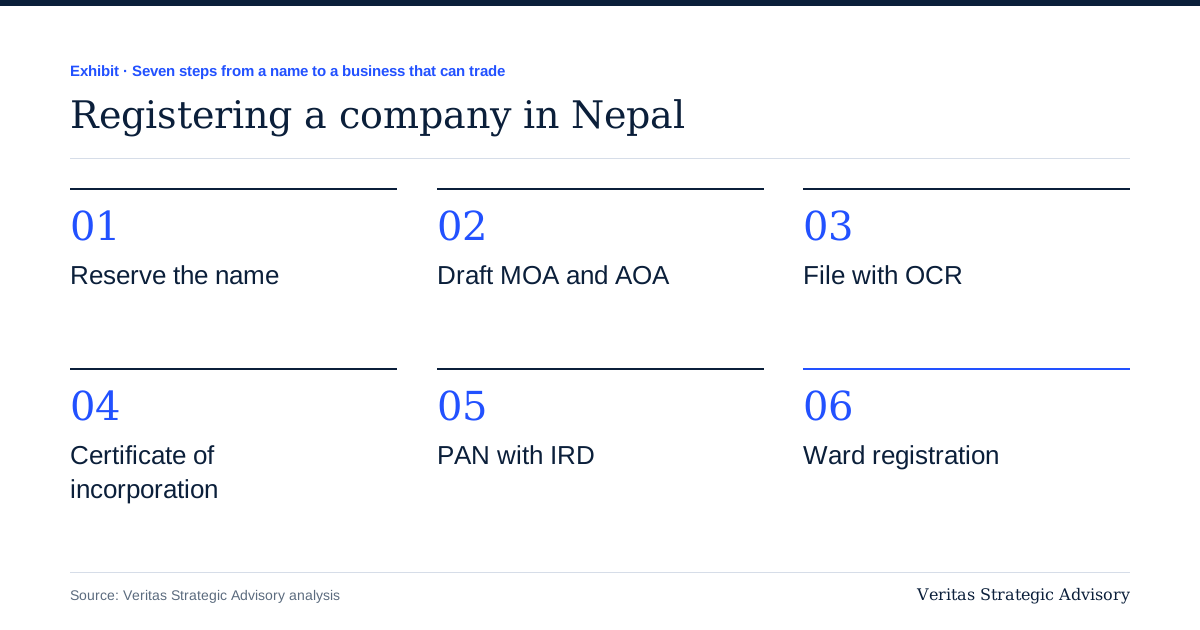
- steps to OCR incorporation
- 7
- documents most often missing
- 3
- weeks if papers are complete
- 1-3
Incorporating a company in Nepal is procedurally simple on paper and routinely slower in practice, usually because of avoidable documentation gaps rather than the process itself being complex.
Choosing the Structure
A private company (1–101 shareholders, no public share trading) covers the overwhelming majority of new businesses, foreign-invested or domestic. A public company (minimum 7 shareholders, able to raise capital publicly) is only relevant where public fundraising or a NEPSE listing is the actual plan — using a public structure by default adds governance overhead most businesses do not need.
Step by Step
Name reservation at OCR — propose 2–3 name options; OCR checks for conflicts with existing registered names and trademarks.
Draft the memorandum and articles of association — objects clause, share structure, and governance rules; for foreign-invested companies, this follows the DOI/IBN foreign investment approval (see our FDI approval guide).
File incorporation documents with OCR — MOA/AOA, director and shareholder details, registered address, and (for foreign investment) the DOI/IBN approval letter.
Receive the certificate of incorporation — the company now legally exists.
PAN registration with IRD — required before opening a bank account or issuing invoices; VAT registration follows once turnover crosses the threshold or the business opts in voluntarily.
Local ward registration — business registration at the ward office where operations are based.
Sector-specific licensing, where applicable — banking, insurance, education, health, and similar regulated sectors carry their own additional registration on top of the standard sequence.
Documents Commonly Missing on First Submission
Notarized identification for every director and shareholder, not just the majority holder
A registered address supported by a lease agreement or ownership document, not just a stated address
For foreign shareholders: notarized and, where required, apostilled corporate or personal documents
A share allocation that actually sums to 100% across all named shareholders — a surprisingly common drafting error
Timeline
Name reservation and incorporation itself typically clears within a week where documents are complete. PAN registration adds a few days. The realistic bottleneck is rarely OCR processing speed — it is documents returned for correction because something was missing or inconsistent on the first pass, which restarts the review rather than simply pausing it.
Three Decisions to Make Before You File
Authorised versus issued capital. The registration fee at OCR is set by authorised capital, so registering far more than the business needs raises the cost on day one. Issued capital can be increased later as the business grows.
Who owns what, in writing. Founders often agree shareholding informally and register it loosely. Record the exact split, and what happens if a founder leaves, before value is created. It is far cheaper than untangling it at the first investment.
Objectives wide enough for the next few years. The objectives in the memorandum limit what the company may do. Draft them for the business you plan to run, not only the one you are starting, so a new line of work does not require an amendment.
What It Costs
The government fee scales with authorised capital. On top of that come notarisation and document costs, any sector licence fees, and the professional fee for drafting and filing. We quote every component in writing before starting, and we will say plainly when a lower authorised capital would serve you better.
The First 90 Days After Registration
Open the bank account in the company's name, using the incorporation certificate, PAN and board resolution.
Register for VAT if your turnover or sector requires it, before you issue the first taxable invoice.
Set up payroll and TDS from the first salary paid, including SSF where it applies.
Open the books properly: chart of accounts, opening entries for capital introduced, and a filing calendar.
Issue share certificates and keep the share register current.
Hold the first board meeting and minute the key decisions, including authorised signatories and the appointment of the auditor.
The Compliance That Follows Every Year
Monthly: TDS deposits and returns, and VAT returns where registered.
Annually: the audit of the financial statements by your appointed auditor, the annual general meeting, the annual return to OCR, and the income tax return with IRD.
Whenever it changes: directors, shareholding, address or capital changes are notified to OCR within the prescribed time.
Mistakes We See Most Often
A registered address with no lease or owner's consent behind it, which stalls the application.
Authorised capital set high "to look serious", paid for in fees and never used.
Founder shareholding agreed verbally and registered in a way nobody actually intended.
No bookkeeping from day one, which turns the first year's audit and tax return into a rebuild.
Frequently Asked
Can a foreigner own 100% of a Nepali company?
In many sectors, yes, subject to foreign investment approval and the minimum investment rules. Some sectors are closed or restricted; see our FDI approval guide.
Do I need an office before registering?
You need a registered address supported by a lease or ownership document. Many small companies start with a modest leased space.
Can the company start trading on the day of incorporation?
Not in practice. PAN, a bank account and, where relevant, ward registration and sector licences come first.
How Veritas Can Help
We handle incorporation end to end alongside the accounting setup a new company needs from day one — opening books, first VAT/PAN filings, and payroll setup if hiring starts immediately. See our company registration service or talk to our team before you file the first draft.
How Veritas supports company registration
We handle incorporation end to end, from draft articles through OCR filing, PAN setup, opening the books, first VAT and TDS filings, and payroll configuration if you hire immediately. We also walk founders through shareholding structure and buy-sell documentation before value is created, when it is simple. If the shareholders are foreign, the route is different and starts with Department of Industry approval rather than OCR. For a technology or outsourcing business, see IT and BPO company registration in Nepal through FDI; for the general process, see the FDI approval guide.
Explore our company registration service or reach out to our team to discuss the best structure for your case.
*General information only, not advice. OCR processes, fee schedules, sector-specific licences and foreign investment rules change year to year; confirm the current position before filing.*