- causes of decline
- 5
- documents to reconcile
- 3
- file summary page that changes the review
- 1
Start with the reason, then the file
Banks rarely explain a rejection in detail. Ask for the reason in writing, or ask the relationship manager what would change the answer. Then read your file as a credit officer would: as questions about repayment, risk and documentation.
The principle to keep in mind: a bank lends against the ability to repay from cash flow, with security as the second line. A profitable business that cannot show repayment from cash will be declined.
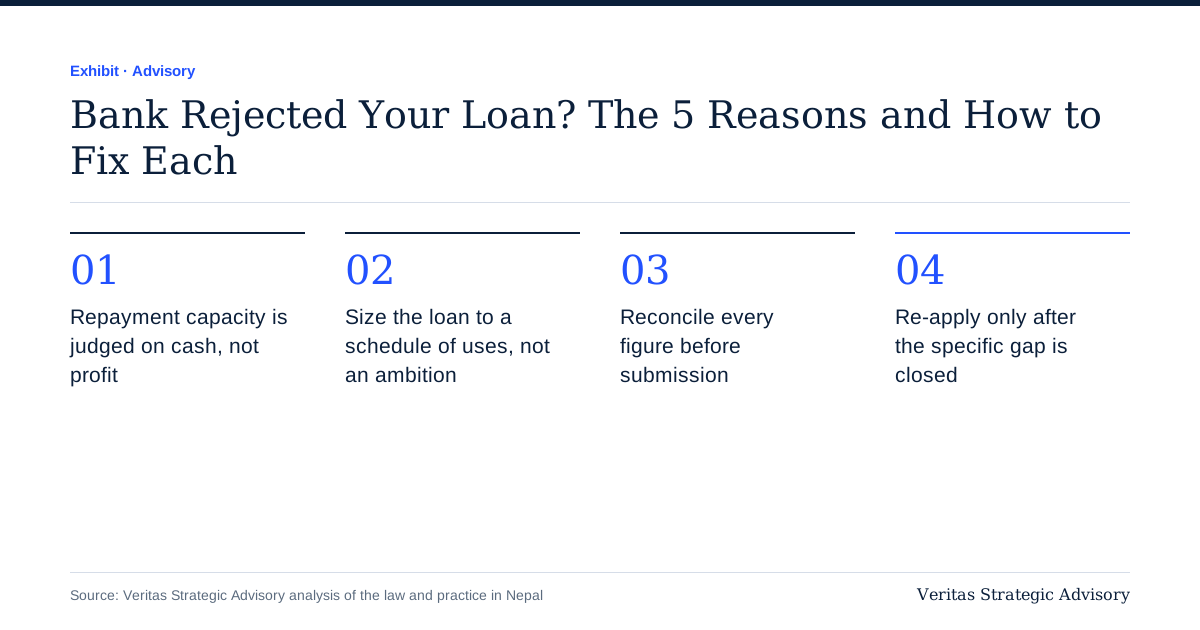
Reason 1: repayment capacity is not visible
This is the most common cause. The applicant shows strong sales and profit, but the bank cannot see how the loan will be repaid from cash.
The fix is a debt service calculation: annual operating cash flow before financing, against principal and interest due. A ratio comfortably above one, on a forecast the bank finds credible, answers the question directly.
Build the forecast from monthly cash, not average annual profit. Credit officers test timing. A forecast that ignores seasonality invites a decline.
Reason 2: the amount is tied to a wish, not a need
Applicants often request an amount chosen from ambition or from what they think will be approved. Banks look for a loan matched to a defined use. A request for general purposes is hard to approve.
Fix it with a sources and uses schedule: each use of funds, its amount and its timing, matched to a suitable form of finance. Permanent working capital needs a longer facility. Seasonal peaks need a shorter one. Equipment needs a term matched to its life.
Reason 3: documents are incomplete or inconsistent
Gaps cause more delay than weak economics. Common problems include unsigned statements, a tax clearance that does not match the return, a loan register that differs from the bank's records, and a company profile listing different shareholders from the registration.
Fix this with one checklist. Reconcile every figure across the statements, tax returns, bank statements and the project report before submission. Where a figure differs, add a short note explaining why. An unexplained difference reads as carelessness.
Reason 4: security is weaker than the applicant assumes
Security is often valued at the owner's figure rather than the bank's. Land may be encumbered, title may be disputed, or valuation may come in lower than expected.
Check before applying: current valuation, title, existing charges, and the lender's margin for each asset type. If security is insufficient, consider a guarantee structure or a smaller facility that the security supports.
Reason 5: the profile raises questions
Banks assess owners, sector and history. Limited track record, concentrated customers, a volatile sector or unclear governance can each reduce appetite, even when the numbers are sound.
Address these directly: show customer concentration and how you are reducing it, the owners' sector experience, and how decisions are made and who signs. Prepared answers shorten credit discussions.
How to re-apply
Re-apply only when you can point to the specific gap you closed. The same file gets the same result, and some banks restrict repeat applications for a period. Ask whether a waiting period applies.
Open the second application with a one-page summary: the request, the use of funds, the repayment ratio, the security, and what changed since the last decision. A credit officer who reads that page first gives the file a fuller review.
Use the rejection as a diagnostic
A decline shows which part of the file was weakest. Record the reason, fix it, and the next lender is often more receptive, because you have improved the file for them too.
Our bank loan documentation service prepares the project report, the debt service model and the document pack together. Related: before taking a bank loan, what to calculate and should you take a bank loan or bring in an investor.
Why banks look at the file differently than you do
A business owner reads a loan application as a story about growth and opportunity. A credit officer reads the same file as a set of risks to be tested and, where possible, reduced. Understanding that difference changes how you prepare everything.
The credit officer is asking four questions in order. Can the business repay? If it cannot, what will repay it? If that also fails, what can the bank recover? And finally, can the information be trusted? A file that answers the first question clearly, supports the second with evidence, documents the third and reconciles the fourth is usually approved, sometimes with conditions.
Most rejections come from a file that is strong in intent but weak in one of those four answers. The applicant assumed the bank would infer repayment from the business's reputation. The bank cannot approve on reputation. It approves on evidence that a reviewer can check.
Building the repayment case step by step
The repayment case is the centre of any application, so build it deliberately. Start with the last three years of actual cash flow from operations, not profit. Show how working capital moved, how much cash the business generated after its normal needs, and how much it spent on capital items. This historical picture is the foundation for the forecast.
Next, build the forecast on the same basis. Project monthly cash for the loan period, not an annual average. Include the seasonal pattern, the timing of collections from major customers, the payment cycle to suppliers, and the tax and statutory payments that fall due. Each assumption should be stated and justified, because the officer will test the ones that matter most.
Then calculate the debt service coverage ratio for each period. Show the cash available for debt service, the principal and interest due, and the ratio between them. Present the lowest ratio in the forecast as well as the average, because a bank lends against the weakest period, not the typical one.
Finally, show a stressed case. Reduce revenue by an amount you consider plausible, or delay a major collection, and recalculate. A business that still covers its debt in a moderate downside is far more fundable than one whose case depends on everything going to plan.
What the bank will want as security, and why
Security is the second line of defence. Banks value assets at a discount to market value, and they apply a margin that differs by asset type. Property usually attracts a different margin from equipment, and stock or receivables often carry the lowest weight. Your application should show each asset, its estimated realisable value and the lender's likely margin, so the bank can see the coverage without guessing.
Check the title and the existing charges before you offer any asset. An asset already charged to another lender reduces the security available to the bank, and an unclear title can delay a decision for months. Obtain the documents early.
Where the security is thin, a guarantee can strengthen the file. A guarantor with clear assets and a clean record can make a marginal case approvable, but the guarantor takes real obligations. They should read the guarantee terms and take independent advice before signing.
The project report and why it matters
For many facilities, the bank will expect a project report. This document explains the purpose of the loan, the business plan behind it, the market, the operations, the financial projections and the risks. A good project report reads as a business case, not a sales brochure. It should be honest about risks and specific about mitigation.
Keep the project report consistent with the financial statements and the forecast. Discrepancies are the most common reason a credit officer loses confidence in the whole file. Where a figure in the report differs from a figure in the forecast, either correct it or explain the difference in a footnote.
Include the main assumptions in the report itself, not only in the model. Officers often read the report first and the model second, and an assumption they cannot find in the report will be treated as untested.
Negotiating after an approval, and before one
A decline is not always final. Many banks will discuss the reasons, and some will consider a revised structure. Ask whether a smaller facility, a different term, a partial guarantee or a staged drawdown would be acceptable. These alternatives can convert a refusal into an approval without changing the business.
Once a loan is approved, read the covenants carefully before accepting. Covenants limit what you can do without the bank's consent, such as taking on more debt, paying dividends or changing ownership. Check the covenant levels against your forecast. A covenant set too tight for the business's normal seasonality can trigger a technical breach in a good year.
Keeping the relationship strong after the loan
A bank relationship is built over years, and the file you create for one loan becomes the baseline for the next. Deliver the required statements on time, report covenant positions before the bank asks, and tell the relationship manager about material changes early. A bank that hears bad news from you first treats it as a management issue. A bank that hears it from the monthly statements treats it as a surprise.
Review the facility each year against the business's actual performance. If the business has grown beyond the loan's structure, raise the next facility before it becomes urgent. Borrowing from a position of strength is cheaper and less stressful than borrowing in a crisis.
A checklist for the day you submit
Before submission, confirm that every figure reconciles across the statements, returns, bank statements and report. Confirm the forecast starts from the last actual year. Confirm each security document is current and its title is clear. Confirm the guarantor, if any, has read and understood the terms. Confirm the one-page summary states the request, the use, the repayment ratio, the security and what changed since any earlier decision.
A file that passes this check is far more likely to reach a decision on its merits, and that is the outcome that matters most.
Frequently asked
Will a rejection hurt my credit record?
A decline is not usually recorded as negative, but ask how requests are logged. Several applications in a short period can look unfavourable.
Can a guarantee replace weak security?
Sometimes. A stronger guarantor can improve the assessment, but the guarantor takes on real obligations, so they must understand what they sign.
Is a smaller loan easier to get?
Often, when it matches a clear use and clear repayment capacity. An approved smaller facility also builds the track record for a larger one.