In the short run, for a business adding volume quickly, the opposite is often true, and understanding exactly why is the difference between reacting to a real financing need correctly and mistaking healthy, well-run growth for a business in decline.
The mechanism, stated precisely
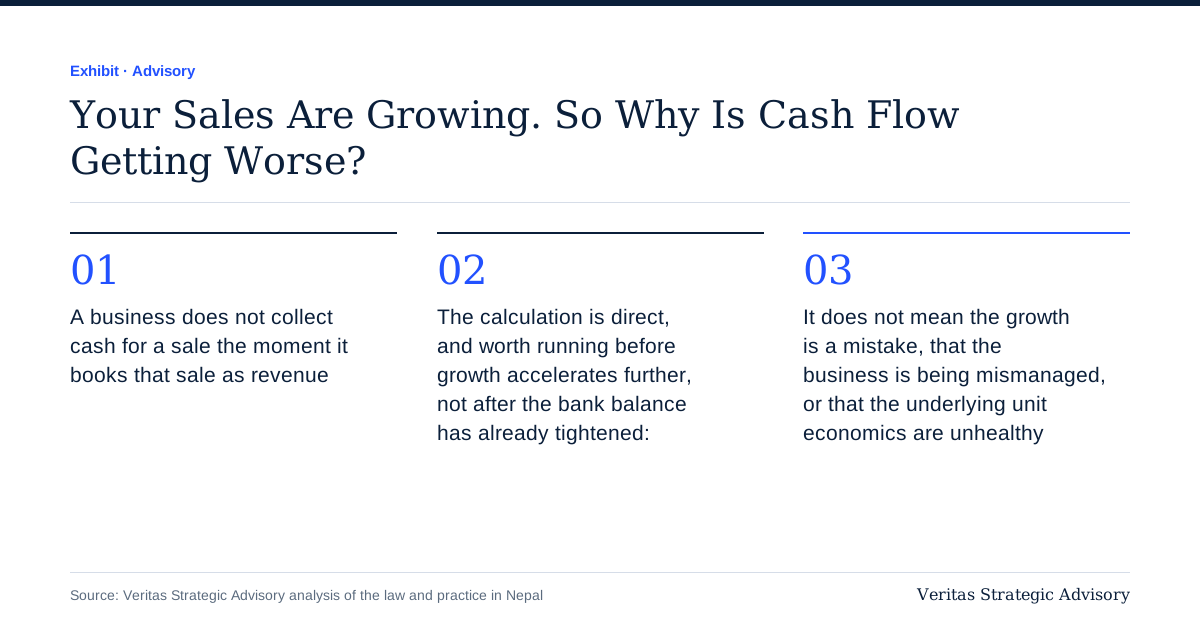
A business does not collect cash for a sale the moment it books that sale as revenue. Between the moment a sale happens and the moment cash from that sale sits in the bank, the business has already paid for the inputs: raw materials or stock, labour, and operating costs. That gap, the operating cycle, is financed out of the business's own working capital.
Here is the part that catches most owners by surprise: if the length of that cycle and the margin on each sale stay exactly the same, the total amount of cash tied up in the cycle still rises in direct proportion to the volume of sales, because a larger number of sales in flight at any given time means a proportionally larger amount of inventory and receivables outstanding at that moment, even though nothing about how the business operates has changed at all. A business growing sales by 40% in a year, with an unchanged 60-day cash conversion cycle and unchanged margins, needs roughly 40% more working capital just to carry that larger volume, before a single rupee of that growth has actually been "banked" as improved cash position. This is why growth, done well and done fast, is one of the most common causes of a cash crisis in an otherwise perfectly healthy company, a point we develop further in why is my business profitable but always short of cash.
Quantifying the effect on your own numbers
The calculation is direct, and worth running before growth accelerates further, not after the bank balance has already tightened:
Incremental working capital need ≈ (revenue growth %) × (current working capital tied up in the operating cycle)
If your business currently carries, say, NPR 1 crore in combined receivables and inventory net of payables, and you are planning or already experiencing 30% revenue growth, the operating cycle alone requires roughly an additional NPR 30 lakh in working capital, independent of any capital spending, new hires, or marketing investment the growth itself might also require. This is frequently a larger number than founders expect, because it is easy to mentally credit growth entirely to the profit and loss statement and forget that the same growth has a mirrored, and immediate, claim on the balance sheet.
Three specific ways growth accelerates the gap further
1. New customers often get looser terms than established ones, at first. Winning volume during a growth phase frequently means extending credit terms more generously to new accounts than the business's historical average, which lengthens Days Sales Outstanding at exactly the moment sales volume is also rising, compounding the cash effect from both directions at once.
2. Inventory is bought ahead of confirmed demand. Scaling a business, particularly in retail, distribution, or manufacturing, usually means placing larger purchase orders in anticipation of continued growth, which means cash leaves the business before the corresponding sales, and sometimes before it is fully certain the anticipated demand will materialise as forecast.
3. Fixed costs step up in advance of revenue catching up. A new hire, a new location, or new equipment to support higher volume is typically paid for before the additional revenue it enables has fully ramped, creating a temporary cash drag layered on top of the working capital effect already described.
What this does not mean
It does not mean the growth is a mistake, that the business is being mismanaged, or that the underlying unit economics are unhealthy. A business with genuinely strong, profitable unit economics and a growing cash gap has a financing problem to solve, not an operating problem to fix. Conflating the two is itself a common and costly error: cutting back on legitimate, profitable growth to protect short-term cash, when the correct response is to finance the growth properly, can cost the business far more in lost opportunity than the financing itself would have cost.
How to finance the gap correctly
Separate the base, permanent working capital requirement from the incremental, growth-driven requirement, and match each to financing of an appropriate term, a facility structured for the level the business operates at today, expanded deliberately as growth is confirmed, rather than financed reactively through short-term debt renewed under pressure each time it runs tight. Our companion piece on how much working capital does your business actually need sets out the calculation in full.
Forecast the cash effect of growth before committing to it, not after the purchase orders are already placed and the new hires already made, so that financing can be arranged in advance rather than negotiated from a position of urgency.
Track the cash conversion cycle monthly during a growth phase specifically, since this is the single number most likely to move meaningfully while a growth phase is underway, and the earliest indicator of whether the growth is being financed on acceptable terms or is quietly eroding the balance sheet's flexibility.
Revisit pricing and terms for new volume specifically. If new customer growth is coming disproportionately on looser payment terms than the existing base, that is a negotiable, controllable lever, not a fixed cost of growing.
How Veritas supports a business through this phase
We build the cash flow forecast that separates operating performance from the working capital effect of growth specifically, and structure financing conversations with lenders around the real, calculated need rather than a reactive request once cash is already tight. See our financial strategy and cash flow capability or our virtual CFO service for how this is run as an ongoing discipline through a growth phase, not a one-time fix.
Frequently asked
Will this problem resolve itself once growth slows down?
Largely, yes: once revenue growth stabilises, the working capital requirement stabilises with it, and cash generation typically improves, assuming the underlying unit economics were sound throughout. The risk is entirely in the transition period, where the financing gap has to be bridged correctly.
Is this different from a business that is simply losing money?
Yes, and the distinction matters enormously for how a lender or investor should read the situation. A profitable, growing business with a temporary cash gap driven by its own working capital cycle is a fundamentally different, and far more financeable, situation than a business burning cash because its underlying economics do not work; the forecast and the cash conversion cycle trend are what separate the two cases credibly.