

Scale is the ability to grow that activity substantially without a proportional increase in the problems, errors, and owner involvement required to run it. A business can grow for years without ever becoming genuinely scalable, and pushing hard for volume before that readiness exists tends to multiply operational strain rather than multiply profit.
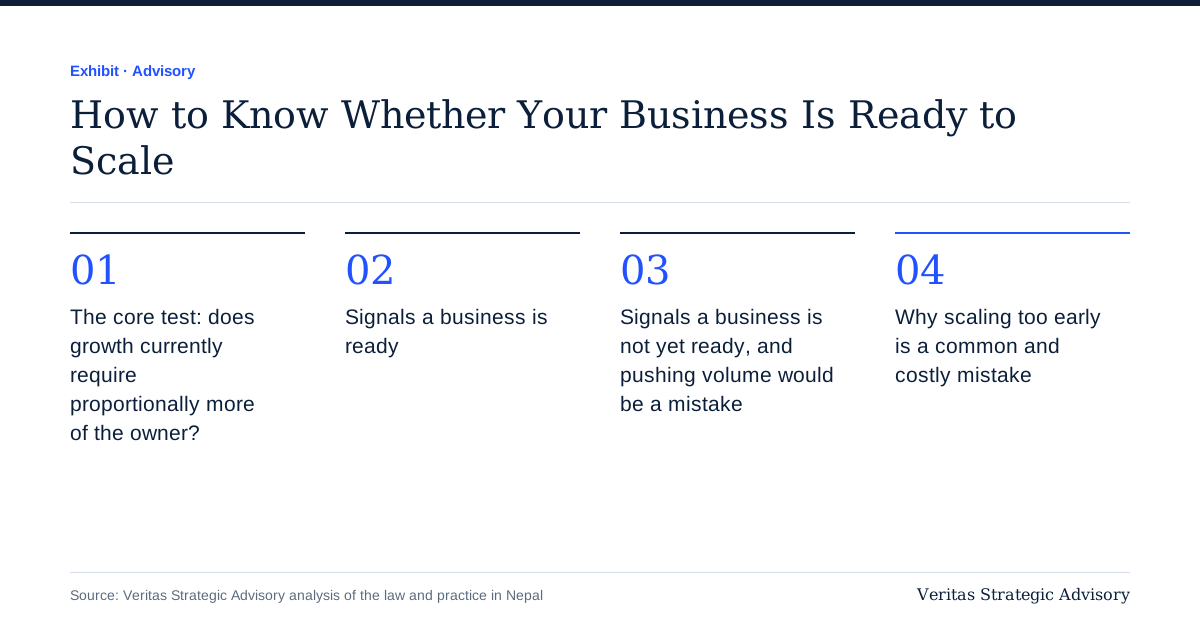
The core test: does growth currently require proportionally more of the owner?
If doubling revenue today would require the owner to personally work roughly twice as many hours, make roughly twice as many individual decisions, and personally supervise roughly twice as much of the day-to-day operation, the business is not yet built to scale, no matter how strong its growth trajectory looks on a revenue chart. Genuine scalability means growth can be absorbed by systems, documented processes, and a management layer that does not require the owner's direct, individual involvement in every incremental unit of activity.
Signals a business is ready
Documented, repeatable processes, not tribal knowledge. Core operations, fulfilment, quality control, customer service, are written down and can be executed consistently by someone other than the person who originally figured them out. A business where a key process only works because one specific employee knows how to do it a certain way is carrying a hidden scale ceiling.
A management layer that can make decisions without the owner. At least some meaningful categories of decision, pricing within a defined range, standard customer issues, routine purchasing, can be made by someone other than the owner, using clear guidelines rather than requiring the owner's personal sign-off every time.
Financial systems that can absorb more volume without breaking down. Monthly closing, invoicing, and collections processes that are already reasonably efficient at current volume, rather than barely functioning and dependent on manual heroics each month, since those manual workarounds do not scale linearly and often break down entirely well before volume doubles.
Working capital and financing already planned for growth, not discovered during it. As covered in your sales are growing, so why is cash flow getting worse, growth consumes working capital in direct proportion to volume; a business ready to scale has already modelled this effect and arranged financing in advance, rather than discovering the cash strain only once growth is already underway.
Quality and customer experience that holds up under load. A business whose product or service quality visibly degrades under the strain of higher volume, longer wait times, more errors, more customer complaints, is signalling a capacity constraint that adding more customers will only expose more severely, not resolve.
Signals a business is not yet ready, and pushing volume would be a mistake
The owner is still the single point of failure for most meaningful decisions.
Core processes exist only as informal habits, not written procedures that a new hire could follow.
Financial reporting lags badly enough that management cannot see a problem until well after it has already compounded.
The business has not stress-tested what happens to quality, cash, or staff workload at meaningfully higher volume.
Key supplier or logistics relationships are already near their own capacity limits at current volume.
Why scaling too early is a common and costly mistake
A business that pushes aggressively for volume before these systems and this management layer exist typically experiences a specific, painful pattern: initial growth looks like validation, then quality slips, cash gets tight in a way that feels sudden even though it was mathematically predictable, the owner's hours become unsustainable, and the business either retreats from the growth it just won or burns out the people trying to sustain it. This pattern is avoidable, and the avoidance is almost always the same: build the systems and the management layer first, deliberately, even at the cost of slower near-term growth, so that scale, when it comes, is absorbed rather than survived.
How this connects to eventual investment or sale
The same readiness signals that determine whether a business can scale safely are, not coincidentally, close to the same signals an investor examines when assessing investment-readiness, covered fully in what makes a business investment-ready. A business that has built genuine scalability has, in effect, already done much of the preparation an eventual fundraise or sale would require.
How Veritas helps assess and build this readiness
We run a structured operational and financial readiness review against the signals above, identify the specific gaps holding a business back from safe scale, and help build the systems, reporting, and management structure needed to close them before a growth push, rather than during one. See our virtual CFO and outsourced finance function service for how this fits into a broader engagement.
Frequently asked
Can a very small business, with just a handful of employees, be genuinely scalable?
Yes; scalability is about how the business operates, documented processes, decisions that do not all route through one person, rather than its current size. Some very small businesses are more genuinely scalable than much larger ones still run entirely through the founder's personal involvement.
Is it possible to build scalability while continuing to grow, rather than pausing growth to build it first?
In most cases, yes, but it requires deliberate attention: documenting a process while it is still being used, building a management layer incrementally as volume increases, rather than assuming systems will somehow catch up on their own once growth has already outpaced them.
The owner is still the single point of failure for most meaningful decisions.