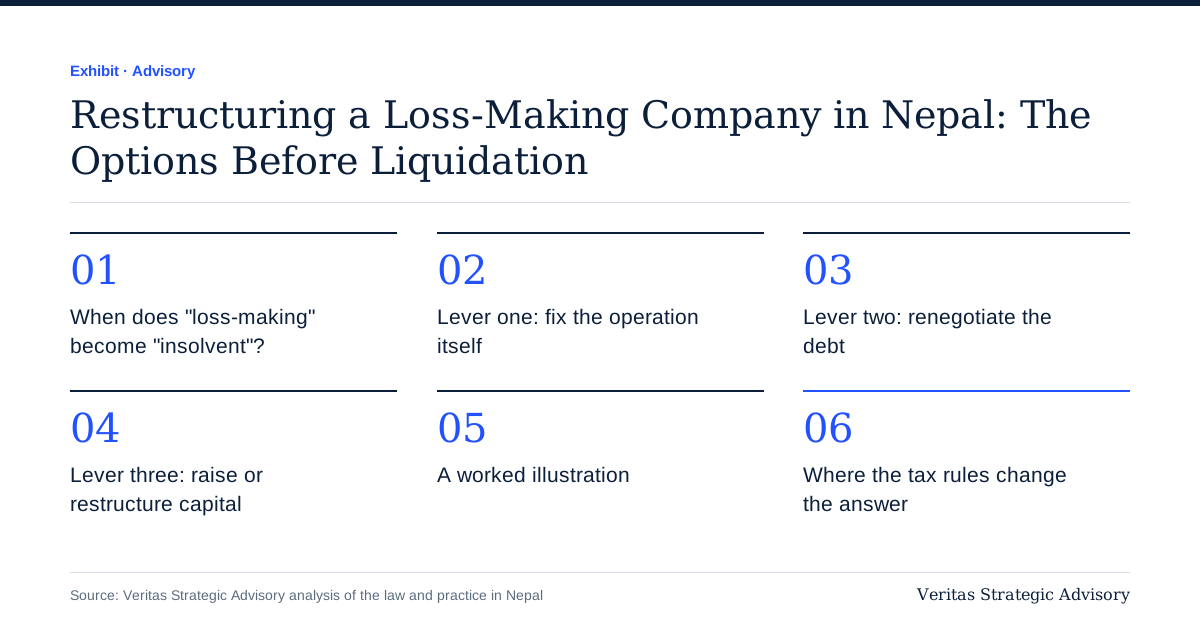
- normal loss carry-forward (12 for hydro, infra, petroleum)
- 7 yrs
- ownership change that can trigger Section 57
- 50%
- main restructuring levers before a formal scheme
- 3
- liquidation routes: voluntary or insolvency
- 2
Losing money for a year does not put a Nepali company on a legal clock. Becoming insolvent does. The distinction matters because several of the better options for a struggling business, including a simple reduction of share capital, are only available before that line is crossed. The business owner who waits until creditors are already filing claims has fewer choices left than the one who acts while the company is merely loss-making.
This guide sets out the options in the order a business normally works through them: operational and debt fixes first, capital restructuring next, the formal Insolvency Act scheme after that, and liquidation only when the others have failed or been rejected. It also flags where the tax rules change the calculation, because a restructuring that looks right in cash terms can still create a tax problem if it is not sequenced correctly.
When does "loss-making" become "insolvent"?
A company can report a loss for several years and still be solvent, in the sense that it can pay its debts as they fall due. The Insolvency Act, 2063 is concerned with the point past that: it defines "financial difficulty" as a situation where a company may become insolvent soon unless it is restructured, and treats a company as insolvent broadly where its liabilities exceed its assets or it cannot pay its debts as they fall due. The practical test an owner should apply is simpler than the legal one: can the business still meet payroll, statutory dues and the next instalment to its lenders from its own operations, or only by borrowing further or delaying payments it has already promised? The second answer is the signal to start restructuring, not to wait for a creditor to force the question.
Lever one: fix the operation itself
The cheapest and fastest lever is operational, and it should be exhausted before anything involving capital or courts. In practice this means:
Cutting or renegotiating fixed costs: rent, management contracts, non-critical headcount, and any service agreements priced for a different revenue level.
Discontinuing or selling the loss-making division or product line if the business has more than one, rather than letting it consume cash generated by the parts that work.
Tightening working capital: faster collection, slower but still compliant payment of suppliers, and a hard look at inventory that has stopped turning.
Getting a real monthly management account in front of the owner, not an annual figure seen months late. A business cannot restructure what it cannot see; see our note on what a monthly management report should include for the minimum that should be on the owner's desk every month.
Operational fixes buy time and improve the numbers that lenders and investors will look at in the next two levers. They rarely solve a genuine solvency problem on their own.
Lever two: renegotiate the debt
If operational fixes are not enough, the next conversation is with lenders, not with a court. Nepali banks and finance companies can restructure or reschedule a borrower's facility, extend tenure, offer a grace period on principal, or convert part of a facility into a different instrument, within the directives Nepal Rastra Bank issues to banks and financial institutions from time to time. This conversation works best when the business brings a credible plan and current numbers to it, not when it is already behind on payments and asking for forgiveness. A lender that believes the business can service a restructured facility has every incentive to agree; a lender that believes it is lending into a company already heading to liquidation does not.
Debt restructuring with a bank is a private, commercial negotiation. It does not by itself require a court filing or a creditors' meeting under the Insolvency Act, and it is usually the fastest way to relieve pressure on cash flow without touching ownership.
Lever three: raise or restructure capital
Where the problem is not just cash flow but an eroded balance sheet, the company has to look at its capital structure.
Bring in new equity. A rights issue to existing shareholders, or a fresh investment from a new partner, injects cash without adding debt service. For a company that could attract foreign investment, this also raises the approvals under the Foreign Investment and Technology Transfer Act, 2075; see our guide on FDI in Nepal for that process.
Convert debt to equity. Where a lender or a related party is willing, swapping debt for shares reduces the company's debt service immediately. This changes who owns the company, which is the point at which the tax rules below start to matter.
Reduce share capital against accumulated losses. Section 57 of the Companies Act, 2063 allows a company to reduce its share capital by special resolution, followed by an application to the Court for confirmation under Section 58, with public notice so creditors can object before the Court confirms it. This is a useful way to clean up a balance sheet carrying years of accumulated losses against paid-up capital. It has one hard limit worth flagging early: a company that has already become insolvent under the prevailing law cannot reduce its capital under this section. That is the clearest legal reason to start the restructuring conversation while the company is loss-making, not after it has crossed into insolvency.
Merge with a stronger company. Where the business has value but not enough standalone capital, merging into a better-capitalised company under the Companies Act, 2063 special-resolution process can preserve the operation even if the original ownership structure does not survive intact. See our guide on mergers and acquisitions in Nepal for how that process runs and what a buyer will look for in a target that has been loss-making.
A worked illustration
The numbers below are an illustration only, using assumed figures, to show how the levers interact.
A trading company has paid-up capital of NPR 30 million and accumulated losses of NPR 18 million, leaving net worth of NPR 12 million. It owes NPR 25 million to its bank and NPR 8 million to trade creditors, and operating cash flow currently covers interest but not principal.
| Step | Effect |
|---|---|
| Operational cuts save NPR 3m/year | Restores a small operating surplus, but principal is still due |
| Bank reschedules NPR 25m over a longer term | Monthly debt service drops to a level operating cash can cover |
| Capital reduction of NPR 18m against the loss | Balance sheet shows paid-up capital NPR 12m, zero accumulated loss |
| Fresh equity of NPR 10m from an incoming partner | Net worth rises to NPR 22m, funding working capital |
None of these four steps alone would have fixed the company. Together, and done in this order, while the company was still solvent, they avoid both liquidation and a Section 57 ownership-change problem, because the incoming partner's stake can be sized to stay under the 50% threshold discussed below.
Where the tax rules change the answer
Two provisions of the Income Tax Act, 2058 decide whether a restructuring preserves or destroys the value of the company's past losses.
Carried-forward losses expire. Section 20 allows a loss from business or investment to be carried forward and deducted for seven income years. Certain long-horizon projects, specifically the building and transfer of public infrastructure, the construction and operation of a hydropower project, and petroleum operations, get a twelve-year window instead. A company sitting on losses it plans to use against future profit should restructure with that clock in mind: a scheme that takes three years to turn the business around has already used three of the seven years.
A big ownership change can wipe the losses out. Section 57 of the Income Tax Act, 2058 applies when the underlying ownership of a company changes by 50% or more over three consecutive income years, treating the company as having disposed of its assets and liabilities at market value and restricting the use of its carried-forward losses. This is exactly the provision a debt-to-equity swap or a rescue investment can trip, if the new investor ends up with a majority stake. See Section 57 and Nepal's deal climate for how that rule is applied, and size any new investor's stake with it in view before the deal is signed, not after.
Lever four: the formal scheme under the Insolvency Act, 2063
Where private negotiation with lenders and shareholders cannot reach an agreement, the Insolvency Act, 2063 provides a court-supervised restructuring route, set out mainly in its Chapter 4. The company itself, or its creditors, shareholders or debenture-holders, may apply to the Appellate Court. Once the matter is before the Court, an inquiry official is appointed, who calls and chairs a meeting of creditors, with voting rights set in proportion to each creditor's claim. The creditors vote on a restructuring programme; if they adopt one, or instead resolve to reject it and liquidate the company, that outcome is submitted to the Court, and once the Court approves it, the programme or the liquidation is implemented.
This route exists precisely for the situation where a company cannot get every lender to agree privately: a formal vote binds dissenting creditors to the outcome the majority and the Court accept. It is slower and more public than a private renegotiation, and the Act has been criticised in practice for not setting firm timelines, so a restructuring filed under it can run longer than the business can comfortably survive. It is the tool for when private negotiation has failed, not the first call.
When liquidation is the right answer, not a failure
Liquidation is not always the wrong outcome. A business whose core market has genuinely disappeared, or whose cash burn restructuring cannot plausibly reverse, is better wound up in an orderly way than kept alive on fresh debt that only grows the eventual loss. Nepal gives two main routes:
Voluntary winding up under the Companies Act, 2063 (Chapter 10), available to the company itself where it can still pay its debts: a members' voluntary liquidation with a declaration of solvency if the company is solvent, or a creditors' voluntary liquidation, where the creditors control the appointment of the liquidator, if it is not. An application is filed with the Office of the Company Registrar.
Liquidation under the Insolvency Act, 2063, following the restructuring process above where creditors reject a scheme, or where the company is already insolvent and a creditor, shareholder or the company itself applies directly. A liquidator realises the assets and distributes the proceeds according to the statutory priority of claims: liquidation costs first, then secured creditors, employee dues, and government tax dues, among others.
The choice between the two routes, and the timing of the decision to stop restructuring and start winding up, is itself a decision worth taking deliberately rather than by default, because it changes who controls the process and how much of the remaining value is preserved for shareholders.
A short checklist before choosing a path
Get a current monthly management account; do not decide on a stale annual figure.
Test whether the business can service its debt from operations alone, after realistic cost cuts.
Approach the lender with a plan before a payment is missed, not after.
Model any new investor's stake against the 50% Section 57 threshold before agreeing terms.
Check whether the company is still solvent before relying on a capital reduction under Section 57 of the Companies Act.
If private negotiation stalls, weigh the Insolvency Act restructuring scheme against a voluntary winding up, with legal advice on both.
Keep the carried-forward loss clock, seven years for most businesses, in view throughout.
How Veritas supports a restructuring
We build the cash-flow model that tells you which of these levers is realistic, prepare the numbers a bank or an incoming investor will want to see, and structure a capital change or ownership transfer so it does not trip Section 57 or waste the company's carried-forward losses. Where the matter needs formal legal filing under the Insolvency Act or the Companies Act, we work alongside legal counsel on the financial side of the case. See financial strategy for how this work fits together, or contact us to talk through a specific situation.
Frequently asked
Is a loss-making company automatically insolvent?
No. Insolvency is about whether the company can pay its debts as they fall due and whether its liabilities exceed its assets, not simply whether it reported a loss. A company can be loss-making for years and still be solvent.
Can I still reduce my company's share capital once we are behind on payments?
Possibly, but check solvency first. Section 57 of the Companies Act, 2063 bars a company that has already become insolvent under the prevailing law from reducing its capital under that section, so this option narrows the longer the company waits.
What happens to our tax losses if we bring in a rescue investor?
It depends on the size of the stake. If the ownership change reaches 50% or more within three consecutive income years, Section 57 of the Income Tax Act, 2058 can treat the company as having disposed of its assets at market value and restrict the carried-forward losses, so the investment should be sized and timed with that test in mind.
Do we need to go to court to restructure our debt with a bank?
No. Renegotiating a facility with a bank or finance company is a private commercial matter between the borrower and the lender. Court involvement under the Insolvency Act is for the formal scheme that binds all creditors, including ones who disagree.
How long do we have to use our carried-forward losses?
Seven income years for most businesses under Section 20 of the Income Tax Act, 2058, extended to twelve years for specified infrastructure, hydropower and petroleum projects. A restructuring that takes several years to complete uses up that window while it runs.
Who can start a formal restructuring case under the Insolvency Act?
The company itself, or its creditors, shareholders or debenture-holders, may apply to the Appellate Court.
General information only, not advice. Restructuring and insolvency outcomes depend heavily on the specific facts, the company's governing documents and current law; confirm the applicable provisions and get legal advice before acting.