
A monthly management report exists for a different purpose entirely: to give management a current, decision-useful view of the business often enough that a problem or an opportunity can actually be acted on while it still matters. Many businesses that believe they have "monthly reporting" in place are, in practice, receiving a monthly trial balance or a partial profit and loss statement, which is not the same thing and does not serve the same function.
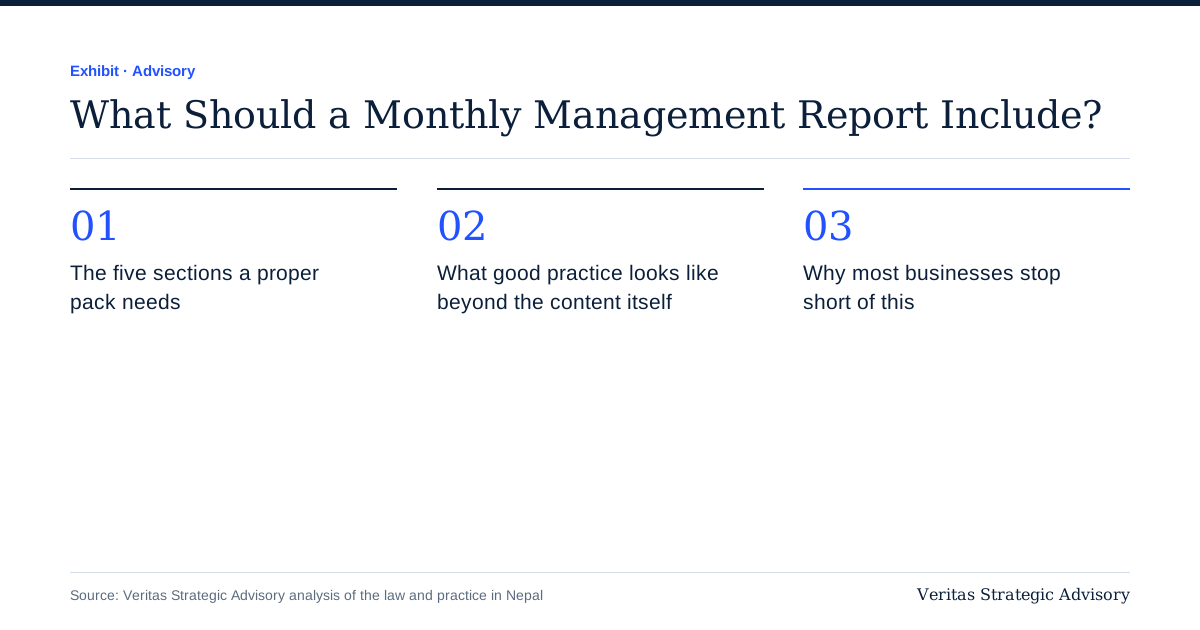
The five sections a proper pack needs
1. Profit and loss, with commentary, not just numbers. A profit and loss statement for the month and year to date, compared against budget or forecast and against the same period last year, is the starting point, but the number alone answers only "what happened." A short written commentary, two or three sentences explaining the drivers behind any material variance, is what turns the same numbers into something management can act on without needing to ask a follow-up question first.
2. Cash position and a forward cash flow forecast. The closing cash position for the month matters far less on its own than the forward view: a rolling forecast, typically 13 weeks for near-term visibility and a longer 12-month view for planning, built from actual invoices and payment dates rather than an average monthly assumption. This is the section most likely to give management genuine advance warning of a coming shortfall, and it is the section most commonly missing from what businesses mistakenly call "monthly reporting."
3. Receivables and payables ageing. A breakdown of what is owed to the business and by whom, and what the business owes and to whom, aged into buckets, current, 30, 60, 90-plus days, surfaces a deteriorating collection pattern or a growing supplier obligation well before it shows up as a cash problem in the summary numbers. Tracked monthly, this is also the earliest practical warning sign of the widening cash conversion cycle described in why is my business profitable but always short of cash.
4. A small set of operational KPIs specific to the business. Generic financial ratios matter less here than the two or three operational drivers that actually move this specific business's results, units sold, average order value, occupancy, utilisation, conversion rate, whichever measures are the true leading indicators for the business in question, tracked consistently month over month rather than recalculated differently each time.
5. A short written summary from whoever prepares the pack. A page of numbers, however well organised, still requires the reader to do the analytical work of deciding what matters. A brief narrative, three to five points, on what changed, why, and what it means for a decision management is currently facing, is what makes the difference between a report that gets skimmed and filed, and one that actually drives a decision in the room.
What good practice looks like beyond the content itself
A consistent format, month to month. Comparability is lost the moment the layout, categories, or metrics shift between reporting periods; a stable template, refined occasionally and deliberately rather than redesigned every month, is what allows trends to actually be seen.
Delivered on a fixed schedule. A report that arrives on the fifth business day one month and the eighteenth the next is far less useful for planning than one delivered reliably on the same day every time, since timeliness itself is part of what makes the information decision-useful.
Built for the reader, not for the preparer. A pack designed around how the accounting system happens to categorise data, rather than around the questions management actually needs answered, forces the reader to do translation work every month that a properly designed report would have already done for them.
Distinguishing actual results from forecast clearly. Blending actuals and projections without a clear visual or structural distinction is one of the most common ways a management report quietly loses the reader's trust once a projected figure fails to materialise as shown.
Why most businesses stop short of this
Producing a genuine management pack, as opposed to exporting a standard profit and loss statement from accounting software, requires someone to build the cash forecast, calculate the ageing, select and maintain the right KPIs, and write the commentary, every single month, on schedule. This is exactly the recurring, forward-looking work that distinguishes a CFO function from a bookkeeping function, a distinction we set out fully in CFO vs accountant: what is the difference. A business that has excellent bookkeeping can still have no one producing this pack, simply because bookkeeping and management reporting are different disciplines requiring different time and skill, even when they draw on the same underlying data.
How Veritas builds this
We design the pack around the specific decisions a client's management is actually facing, not a generic template, and deliver it on a fixed monthly schedule with the commentary built in, not left for management to interpret unassisted. See our virtual CFO and outsourced finance function service for how this fits into a broader recurring engagement.
Frequently asked
Is a monthly management report necessary for a small business, or only a larger one?
The specific KPIs and level of detail should scale to the size of the business, but the core discipline, a forward cash view and a clear read on receivables, matters just as much, arguably more, for a smaller business with thinner cash reserves and less room to absorb a surprise.
How long should it take to produce this every month?
For a business with clean, consistently closed books, a well-designed template, and a stable set of KPIs, production time drops substantially after the first two or three cycles, since most of the effort in the early months goes into building the format and the forecast model rather than repeating the same manual work each time.