- of employees in KPMG's 47-country study hide their use of AI at work
- 57%
- of firms in MIT's 2025 research had staff using personal AI tools, against 40% with an official subscription
- 90%+
- risk families cover most of the exposure: accuracy, confidentiality and dependence
- 3
In 2023 engineers at one of the world's largest electronics companies pasted confidential source code and meeting notes into a public chatbot to get help with their work. Nobody intended harm. The company restricted the tool across its workforce within weeks. The episode became a standard reference because of how ordinary it was: capable people, a helpful tool, no rule, and information outside the company's control before any manager knew the tool was in use.
Something similar is happening now in offices across Nepal. An accounts officer pastes a debtor list into a chat tool to draft reminder letters. A manager uploads a tender document to summarise it. An HR assistant asks a tool to rank CVs. A junior at a professional firm pastes a client's trial balance to "check the ratios". None of them asked permission, because nobody told them they needed to.
That is why AI risk is a governance question before it is a technology question. This is the twelfth article in our series on artificial intelligence for business in Nepal. It follows the question every board should ask, which dealt with value, and deals here with risk.
Why this belongs to the board
Four reasons.
Use precedes policy. Research from MIT in 2025 found staff at more than 90 per cent of the companies studied using personal AI tools for work, while only 40 per cent of those companies had bought an official subscription. KPMG and the University of Melbourne found 57 per cent of employees concealing their AI use. The board's choice is not whether the company uses AI. It is whether that use is visible and governed.
The risks are corporate, not technical. A leak of client data, a wrong figure in a bank submission or a discriminatory hiring decision is a legal, financial and reputational event. It lands on directors.
Accountability cannot be delegated to a tool. Under the Companies Act 2063, directors owe duties of care and are responsible for the company's accounts and compliance. Nepal Rastra Bank's AI Guidelines say in terms, as reported, that the board and senior management of a licensed institution remain "ultimately accountable" for AI systems. The principle holds for every company.
The decisions involve trade-offs only a board can make. How much risk to accept for how much productivity, which uses are off limits, how dependent to become on a foreign vendor: these are matters of risk appetite.
Three families of risk
A long list of AI risks is easy to compile and hard to use. For a board, three families cover most of the ground.
1. Accuracy: the output is wrong
Generative AI produces plausible text and numbers, not verified ones. It fabricates references, misreads documents, miscalculates and gives different answers to the same question. Predictive models degrade when conditions change and inherit the biases of their training data.
The business consequences:
wrong figures in management reports, lender submissions or tax returns;
wrong advice or information given to customers, for which the company is answerable (a Canadian tribunal held an airline liable in 2024 for its chatbot's incorrect statement);
unfair decisions on hiring, credit or pricing, made by a model nobody can explain;
professional work containing invented facts, as in the report for which a global firm refunded part of its fee in 2025;
quiet erosion of quality as unchecked output accumulates.
The governing control is review proportionate to consequence, which we set out in controls over AI-generated numbers.
2. Confidentiality: information goes where it should not
Whatever is typed or uploaded into an external tool leaves the company. Depending on the tool and its settings, it may be stored, reviewed by the provider's staff, used to train future models, or exposed in a breach. Free consumer versions generally offer the weakest protections.
What is at stake in a Nepali company:
Personal information: payroll, employee files, customer identity documents, patient records, borrower data. Protected under the Individual Privacy Act 2075.
Client information held in confidence: for accountants, lawyers, banks and consultants, a professional and contractual obligation.
Commercial secrets: pricing, costs, supplier terms, tender bids, formulations, source code.
Price-sensitive information in listed companies, with securities law consequences.
Credentials: passwords, banking details and system access pasted for convenience.
Further exposures arise from tools that connect to email, drives and accounting systems: a tool with broad access can retrieve and reveal more than the user intended, and can be manipulated by instructions hidden in a document it reads.
There is an intellectual property side too. Content produced by AI may reproduce protected material, and ownership of machine-generated work is unsettled in most legal systems, Nepal's included.
3. Dependence: the company cannot do without it
This family is the least discussed and, over time, possibly the most serious.
Vendor dependence. Almost every AI tool used in Nepal is supplied from abroad, priced in dollars and governed by foreign terms. Prices rise, products are withdrawn, features change, terms are rewritten. Payment requires foreign exchange under Nepal Rastra Bank's rules. A process rebuilt around one vendor's tool is hostage to that vendor.
Model change. Providers update models without notice. A prompt or workflow that worked last month may behave differently today.
Skill loss. If staff stop performing a task, they lose the ability to perform it and to judge whether the machine did it well. In finance, law and engineering this erodes the base on which review depends (the apprenticeship problem).
Concentration. If a whole sector relies on the same few models, an outage or a systematic error affects everyone at once.
Connectivity and power. A cloud tool is unavailable when the internet is down. Critical processes need a manual fallback.
Lock-in of data. Information, prompts and workflows built in one tool may not transfer to another.
Around the three families sit conduct risks that deserve a mention: deepfake voice and video used to impersonate executives and authorise payments, AI-written phishing in fluent Nepali and English, and staff presenting machine work as their own.
The legal position in Nepal
Nepal has no AI statute as of late 2026. That does not mean AI is unregulated. Existing law applies to what companies do with it.
| Source | What it requires or implies |
|---|---|
| Constitution, Article 28 | Right to privacy of person, residence, property, documents, data and correspondence |
| Individual Privacy Act 2075 and Regulation 2077 | Personal information collected and used with consent and for the stated purpose. Unauthorised disclosure is an offence |
| Electronic Transactions Act 2063 | Legal recognition of electronic records. Offences relating to unauthorised access and disclosure of confidential electronic information |
| Companies Act 2063 | Directors' duties. Responsibility for books and accounts |
| Contract Act and client agreements | Confidentiality and data-handling obligations to clients, especially foreign ones |
| Professional rules (ICAN, Bar Council, medical council) | Confidentiality, competence and due care |
| Bank and Financial Institutions Act and NRB directives | Customer confidentiality, outsourcing and IT risk rules for licensed institutions |
| NRB AI Guidelines (December 2025) | For banks, financial institutions and payment operators: risk classification, governance, board accountability, transparency to customers, human oversight |
| Labour Act 2074 | Fair treatment in employment, relevant to AI-assisted hiring and monitoring |
| Securities law | Handling of price-sensitive information in listed companies |
| National AI Policy 2082 | Not binding. Signals an AI Regulation Council and risk-based legislation to come |
Three gaps should be understood. Nepal has no comprehensive data protection law, no dedicated data protection authority and no general duty to notify data breaches. A proposed information technology and cybersecurity law lapsed, as reported, with the dissolution of the House in September 2025. A board should not read these gaps as freedom. Law is coming, clients impose their own requirements by contract, and the reputational cost of a leak does not depend on a statute.
Foreign law that reaches Nepali companies
Companies that serve foreign clients or handle foreign residents' data, including IT exporters, outsourcing firms and those in global delivery, are bound through contract and sometimes directly by foreign regimes: the European Union's GDPR and AI Act, the United Kingdom's data protection law, sectoral rules in the United States, India's Digital Personal Data Protection Act. Client contracts increasingly contain clauses on whether and how AI may be used on their data. For these companies, AI governance is a condition of keeping the client (IT exporters and foreign currency earnings).
What good governance looks like
Proportion is the guiding idea. A bank needs a formal framework. A fifty-person trading company needs a page and a habit. The elements are the same.
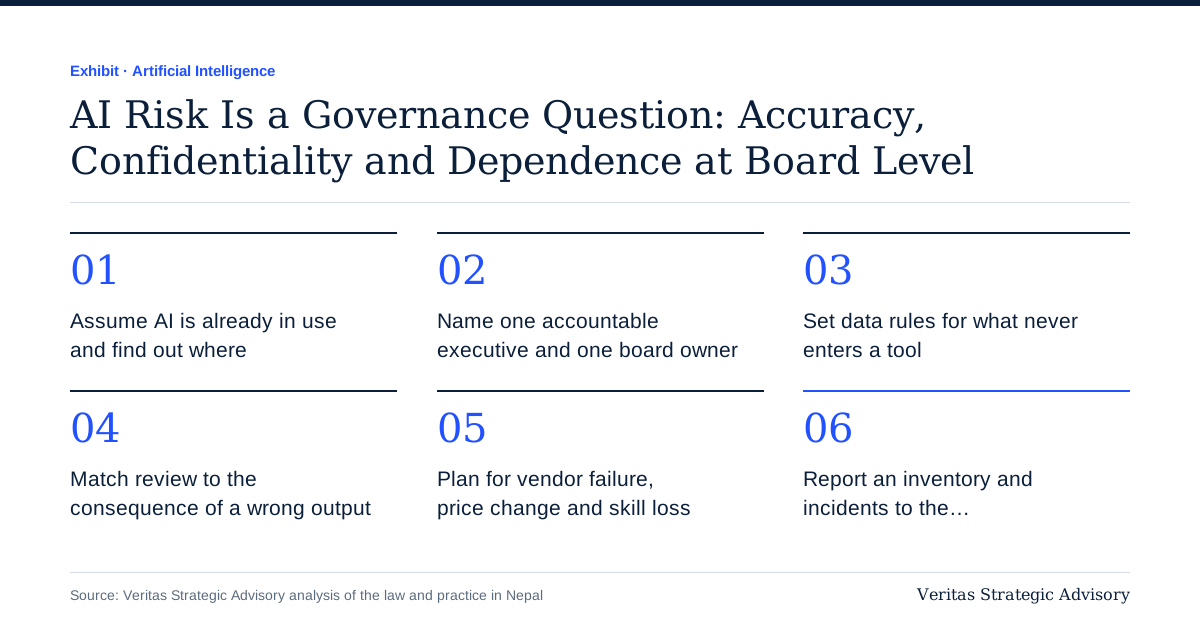
1. Ownership
One executive is accountable for AI use: in a mid-sized company, usually the head of finance, operations or IT. At board level, one director or the audit committee takes oversight. In banks and financial institutions, the central bank's guideline, as reported, calls for an AI steering committee drawn from business, risk, IT, legal, audit and human resources.
2. Inventory
A list of where AI is used: the tool, the task, the data involved, the owner and a risk tier. Start by asking staff, without blame. Update it quarterly. Include AI features embedded in software the company already uses, which are often switched on by an update.
3. Risk tiers
Classify each use by consequence. A simple scheme:
| Tier | Description | Examples | Requirement |
|---|---|---|---|
| Low | Internal, no confidential data, no reliance on facts | Drafting general text, brainstorming, formula help | Follow the policy |
| Moderate | Internal analysis or drafting with company data | Summarising internal documents, first-draft reports | Approved tool, user verification |
| High | Affects financial reporting, customers or employees | Coding transactions, customer chatbots, CV screening | Approved tool, independent review, owner, monitoring |
| Critical or prohibited | Legal effect, regulated decisions, sensitive personal data | Tax filings, credit decisions, medical information, client-confidential data in public tools | Senior approval and full verification, or not permitted |
4. Data rules
The most important single page. State what may never be entered into a tool that is not specifically approved for it:
personal information of employees, customers or patients;
client-identifiable information;
passwords, banking credentials and access keys;
unpublished financial results and price-sensitive information;
tender bids, pricing and contracts under confidentiality;
source code and proprietary formulations.
And state what is permitted: public information, anonymised data, the user's own drafting.
5. Approved tools
Choose a small number of tools, on business terms that exclude training on the company's data and give control over retention. Provide them to staff. This is the most effective way to end the use of personal accounts: people use unofficial tools mainly because no official one is offered.
6. Human oversight
For each high-tier use, name who reviews, how, and what evidence is kept. No output goes outside the company, into the books or into a decision about a person without it.
7. Vendor terms
Before adopting a tool, check: where data is processed and stored, whether it is used for training, retention and deletion, security certifications, what happens on termination, liability and indemnity, and price terms. Most vendors exclude liability for the accuracy of output. Plan on that basis.
8. Training
Every user learns three things: what the tools get wrong, what must not be entered, and how to check output. An hour is enough to start.
9. Incidents
A simple route for reporting a suspected leak, a serious error or a fraud attempt, without fear of punishment for honest reporting. A log, a response and a lesson recorded.
10. Review
Quarterly report to the board. Annual review of the policy.
A one-page policy
For most companies outside the regulated financial sector, the following headings on a single page will do.
Purpose. We encourage useful, careful use of AI tools.
Approved tools. The list, and who to ask for additions.
Never enter. The prohibited data categories.
Always check. Output is a draft. The user is responsible for its accuracy. Figures are tied to source and references verified.
Disclose. Tell your reviewer when AI was used in work for approval.
High-stakes uses. The list of uses that need prior approval.
Customers and employees. No decision about a person is made by AI alone.
Payments. No payment or change of bank details is authorised on a voice or video instruction without call-back verification.
Incidents. Report to the named person immediately.
Owner and review date.
A policy people can remember is worth more than a manual nobody reads.
Questions for the board
A director with no technical background can govern well by asking these.
Where are we using AI today, including tools staff have adopted themselves?
Who is accountable for it?
What information are we prohibited from entering, and how do staff know?
Which uses could cause loss, a legal breach or embarrassment if the output were wrong, and who reviews those?
Which vendors do we depend on, on what terms, and what would we do if one were unavailable tomorrow?
What do our client contracts and regulators require, and do we comply?
Have we had any incidents or near misses?
Are our people keeping the skills needed to check the machine?
Could someone impersonate our chief executive by voice to our accounts team, and what would stop a payment?
What have we decided not to do with AI, and why?
Sector notes
Banks, financial institutions and payment companies. The central bank's guideline is the governing text. Boards should confirm that systems are classified by risk, a steering committee exists, customers are told when AI is used in decisions that affect them, and an annual report is made as required.
IT and outsourcing companies. Client contracts and foreign law drive requirements. Certification to recognised standards, a clear position on AI use on client data and evidence of controls are becoming conditions of sale.
Professional firms. Client confidentiality and due care. Public tools are unsuitable for client data. Review of every deliverable.
Hospitals and clinics. Patient information is among the most sensitive personal data. Clinical use of AI needs professional oversight and caution.
Schools and colleges. Student data, and policy on AI use in teaching and assessment.
Trading and manufacturing. Lower inherent risk. Focus on commercial secrets, payment fraud and accuracy of financial information.
From ground level to policy level
On the ground, governance succeeds or fails on whether an employee feels able to ask "may I use this tool for this?" and gets an answer the same day. A culture of prohibition produces concealment. A culture of guided permission produces visibility.
At company level, the board sets appetite and receives the inventory.
At sector level, regulators are moving at different speeds. Nepal Rastra Bank has acted. The Securities Board, the Insurance Authority, the Telecommunications Authority and professional councils have yet to issue comparable guidance, and regulated firms in those sectors should expect it.
At national level, the National AI Policy 2082 provides for an AI Regulation Council and a National AI Centre and anticipates risk-based legislation. The policy questions that matter most to business are these: a modern data protection law with a competent authority, which would give companies clear rules and foreign clients confidence; clarity on cross-border data flows, on which Nepal's IT exports depend; proportionate obligations that do not burden small firms with the compliance apparatus of a bank; and alignment with the standards Nepal's trading partners use, so that a Nepali company can meet one set of expectations instead of several.
The role of consulting and advisory firms
AI governance has become a significant line of business for the large professional firms. Each has a branded framework for responsible or trusted AI, offers readiness assessments, policy design and model risk management, and is developing assurance over AI systems. Their frameworks draw on common public sources, chiefly the NIST AI Risk Management Framework, ISO/IEC 42001 and the OECD AI Principles, and a company can go to those sources directly at no cost.
These firms also manage the same risks internally, at scale, and their published policies on confidential data and review are instructive. So are their lapses.
What a mid-sized Nepali company needs from an adviser is narrower: help in finding where AI is used, a policy fitted to the business, controls over the uses that touch money and personal data, a review of vendor terms, and training for staff. It does not need a hundred-page framework.
Our own role lies in the control and finance side of this. We review and design internal controls, including those over AI-assisted processes (internal audit), assess risks around financial reporting and data used in it (data analytics and reporting), and help boards set proportionate policy. We are not lawyers or cybersecurity specialists, and on questions of data protection law, contracts and technical security we recommend that clients take advice from those who are.
The next 90 days
Days 1 to 30. Survey staff on the tools they use and for what. Build the inventory. Name the accountable executive and board owner. Issue the "never enter" rule immediately, even before the full policy.
Days 31 to 60. Adopt the one-page policy. Choose approved tools on business terms and provide them. Classify uses by tier and write the review requirement for high-tier uses. Introduce call-back verification for payment instructions. Run a one-hour training session.
Days 61 to 90. Review vendor terms and client contract clauses on AI. Test one high-tier control. Present the first quarterly report to the board: inventory, tiers, incidents, dependencies and decisions required.
Frequently asked questions
Does Nepal have an AI law?
Not as of late 2026. There is a National AI Policy 2082, which is not binding, and Nepal Rastra Bank's guidelines for licensed financial and payment institutions. General law on privacy, electronic transactions, companies and contracts applies to AI use.
Should we ban AI tools?
A ban is seldom effective and forgoes real benefits. The evidence suggests staff use the tools regardless. Provide approved tools with clear rules.
Is it legal to put customer or employee data into an AI tool?
Personal information must be handled with consent and for its stated purpose under the Individual Privacy Act 2075. Entering it into an external tool without a proper basis and safeguards risks breaching the Act and any contractual duty. Take legal advice for specific cases.
Who is liable if AI output causes loss?
The company that used it, and potentially its directors and the professionals who relied on it. Vendors' terms generally disclaim responsibility for accuracy.
Do small companies need an AI policy?
Yes, one page. The risk of an employee pasting a client list or bank details into a public tool does not depend on company size.
Are paid versions of AI tools safe for confidential data?
Business versions usually offer better terms on training and retention. Read the terms, check settings, and still exclude the most sensitive categories unless specifically assessed.
What should the board see regularly?
An inventory of uses by risk tier, incidents and near misses, key vendor dependencies and any regulatory or client requirements.
How do we protect against deepfake fraud?
Require verification by a call to a known number for any payment instruction or change of bank details, whatever the apparent source. Train accounts staff that voice and video can be faked.
*This article is general guidance, not legal or professional advice. Descriptions of laws and regulatory guidelines are summaries based on published sources and should be confirmed against the original texts and with legal counsel.*