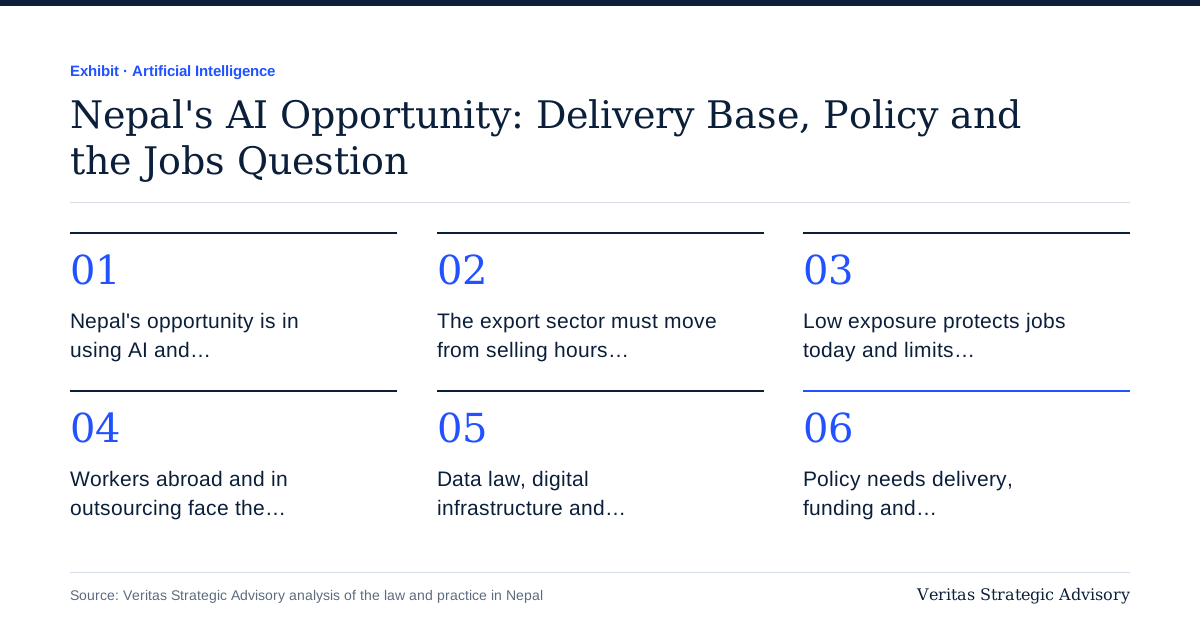

- of jobs worldwide are exposed to AI by the IMF's estimate, against 26% in low-income countries
- 40%
- is the industry's estimate of Nepal's IT service exports in 2025
- USD 1bn
- of 193 was Nepal's place in a 2023 index of government AI readiness
- 150th
Two claims about Nepal and artificial intelligence are heard in Kathmandu, often from the same platform. The first is that Nepal, with its young population, its engineers and its surplus hydropower, can become an AI hub. The second is that AI will destroy the outsourcing jobs that have been the country's one modern export success and will leave its graduates with nothing to do.
Both are overstated, and both contain something true. This final article in our series on artificial intelligence for business in Nepal tries to set out, with what evidence exists, where the opportunity really lies, what the risks are, what policy has done and what it should do. The earlier fifteen articles dealt with the firm. This one deals with the country, because a firm's prospects depend on it.
Much of what follows is judgement. Data on Nepal's digital economy is thin, estimates differ widely, and forecasts about AI have a poor record everywhere. We mark figures as estimates where they are.
Where Nepal starts
An economy with low exposure. The World Bank's South Asia Development Update of October 2025 found Nepal to have the lowest exposure to AI in the region. More than 60 per cent of workers are in farming and manual occupations that AI does not perform. Across South Asia about 7 per cent of jobs were classed as highly exposed without offsetting complementarity, against about 15 per cent in other emerging markets. The IMF's global estimate is that about 40 per cent of jobs are exposed, falling to 26 per cent in low-income countries. The ILO finds one worker in four globally in an occupation with some exposure to generative AI, and 11 per cent in low-income countries.
Low readiness. The same structure that limits exposure limits benefit. Oxford Insights ranked Nepal 150th of 193 governments for AI readiness in its 2023 index. Internet access is wide through mobile phones and uneven in quality. Firms are small. Public systems are fragmented.
A services export base. Against that background stands one clear success. A study by the Institute for Integrated Development Studies estimated IT service exports at about USD 515 million in 2022, and the industry puts the figure near USD 1 billion for 2025. These are estimates, and official balance of payments data records less, partly because much freelance income arrives informally. Tens of thousands of people, on any estimate, work for foreign clients from Nepal as employees of export companies or as freelancers.
A labour-exporting country. Remittances are around a quarter of GDP. Several million Nepalis work abroad, most in the Gulf, Malaysia and India, in construction, security, hospitality, manufacturing and domestic work, with a growing number in Japan, Korea, Europe and Australia, and students who stay on as workers.
Energy. Installed hydropower capacity has passed 3,000 megawatts, with a wet-season surplus exported to India and now Bangladesh, and dry-season imports.
Policy in motion. A National AI Policy was approved by Cabinet in August 2025. A National AI Centre was launched in November 2025. Nepal Rastra Bank issued AI Guidelines for the financial sector in December 2025. The 2083/84 budget announced a sovereign AI compute centre and an AI-driven tax assessment system.
That is the starting position: a low-exposure, low-readiness economy with a promising services export sector, a large workforce abroad, seasonal surplus power and a government that has begun to act.
Three opportunities, in order of realism
1. Adoption across the existing economy
The least glamorous opportunity is the largest. Nepal's productivity is low in almost every sector. Applying AI and, more basically, the digital discipline that precedes it, to banks, traders, hotels, hospitals, factories and government offices would raise output with the people and capital the country already has. We set out the sector picture in AI across Nepal's sectors and the firm-level case in where the value is.
General-purpose tools matter here more than is usually recognised. A capable assistant for drafting, translation, analysis and coding, available for the price of a subscription, is a form of expertise that small firms in a small country could never previously afford. A ten-person exporter can now produce documentation, marketing and analysis of a quality that once required specialists. Language is a real limit, since the tools are weaker in Nepali and much weaker in Nepal's other languages, but it is narrowing.
The constraint on adoption is not technology. It is data, skills, management attention and the ability to pay for foreign services.
2. Export services: from hours to outcomes
Nepal's IT and outsourcing sector sells, in large part, time: developers, testers, data processors, accountants and support agents billed by the hour or month to clients in the United States, Europe, Australia and elsewhere, at rates below those of the client's home market.
AI changes that business in three ways.
It compresses routine work. Code generation, test writing, data entry, document processing, first-line support and basic bookkeeping are being automated or accelerated. The World Bank reported global job postings in customer service and software development down by about a fifth as generative AI spread. A client who needed ten people may need six.
It lowers the scale needed to compete. A small, skilled team with good tools can deliver what once required a large one. That favours a country of small firms, provided they are skilled.
It creates new work. Preparing and labelling data, evaluating model output, integrating AI into business processes, monitoring automated operations, handling exceptions and providing the human review that regulation and prudence require. The South Asia update found a wage premium of about 30 per cent for AI skills in India and Sri Lanka, not yet visible in Nepal.
For Nepal's exporters the strategic conclusion is uncomfortable and clear. The model of billing hours for routine work has a shrinking future. The opportunity is to sell outcomes: a finance function run to a standard, a tested software release, a processed claim, with AI inside the delivery and people accountable for the result. That requires domain knowledge, quality systems, security certification and the confidence to price by value.
Finance and accounting outsourcing is a case in point. Bookkeeping entry for foreign small businesses is being automated by their accounting software. What remains valuable is review, month-end close, reporting, tax preparation support and advisory, delivered by qualified people using the automation (global delivery, the CFO's office in 2030).
What exporters need from the state is modest and specific: predictable tax treatment (foreign currency earnings of IT exporters), easy receipt and payment of foreign currency, reliable connectivity, a data protection law that foreign clients recognise, and straightforward entry for foreign investors and clients (IT and BPO registration with FDI).
3. Compute and the hydropower argument
The proposal that Nepal should turn surplus hydropower into AI computing services has entered the budget, with a Sovereign AI Compute Centre announced for Syuchatar in Kathmandu and subsidised compute for start-ups.
The argument has logic. Data centres are large, steady consumers of electricity. Nepal has renewable power that is cheap in the wet season and a cool climate at altitude. Exporting computation would capture more value than exporting electricity.
The difficulties are equally real and are less often stated.
Power is seasonal. Data centres need firm supply every hour of the year. Nepal imports power in the dry season, and reliability and voltage quality are uneven. Firm supply implies storage projects or imports.
Connectivity. Nepal is landlocked and reaches the global internet through India and China. Latency, capacity and redundancy matter greatly for some workloads and less for others, such as model training.
Capital and chips. Advanced processors are expensive, in short supply, subject to export controls, and obsolete within a few years. A facility is a recurring commitment, not a single investment.
Demand. Who will buy the compute? Domestic demand is small. International customers choose on reliability, legal certainty, connectivity and price, in competition with established hubs.
Risk. Seismic risk, political stability and the legal framework for data all weigh on investors.
Jobs. Data centres employ few people once built.
None of this makes the idea wrong. It suggests sequence and scale: a modest national facility serving government, universities and start-ups with data that should stay in the country; private data centres attracted by firm power contracts, clear law and connectivity; and the larger ambition tested by whether private capital will commit, not by public announcement. Bhutan's experience with hydropower-fed computing next door, with both its returns and its volatility, deserves study.
What Nepal should not attempt
Building frontier models. The cost runs to billions of dollars and the field is led by a handful of companies and states. The sensible ambition is to adapt open models to Nepali needs: language resources for Nepali and other national languages, speech recognition, and applications in agriculture, health, education and public services. That is achievable, valuable, and the proper work of the National AI Centre and universities.
The jobs question
At home
For most Nepali workers the honest answer is that AI will change little soon. A farmer, a mason, a driver, a shopkeeper and a garment worker do work that AI does not do. Exposure is a matter of what tasks a job contains, and exposure is not the same as loss: the ILO stresses that most exposed jobs will be changed, not removed, and the World Bank classed about 70 per cent of exposed roles in South Asia as complementary to AI.
The domestic groups who will feel it are the educated, urban and office-based:
Outsourcing and IT employees, discussed above.
Clerical and administrative staff in banks, companies and offices, as data entry, reconciliation and routine correspondence are automated.
Entry-level professionals. The junior accountant, lawyer, developer and analyst whose first years were spent on the routine tasks AI now does. This is the apprenticeship problem: if beginners are not needed for routine work, how do they become experienced?
Call centre and support staff.
Translators, content writers and designers working to commodity briefs.
This matters beyond its numbers. These are the jobs that Nepal's graduates want, and the scarcity of them is a principal reason so many leave. An economy that produces graduates and then automates graduate-entry work will export more of its young people, unless it creates new work as fast.
Abroad
The less discussed exposure is among Nepalis working overseas. Most are in manual occupations that are not exposed to generative AI. Some are exposed to automation of other kinds: warehouse and factory work, security, retail checkout, driving in the longer run. Destination countries are investing heavily in automation precisely to reduce dependence on migrant labour. The effect will be gradual and uneven. For an economy in which remittances are a quarter of GDP, even a slow decline in demand for low-skilled migrant labour over a decade is a macroeconomic risk that deserves a place in planning. The response is the same as for every other reason to worry about dependence on remittances: skills that command higher wages abroad, and jobs worth staying for at home.
The balance
Nepal does not face mass technological unemployment. It faces something subtler: the risk that the narrow ladder by which educated young people enter modern work is shortened at the bottom, while the gains from AI accrue to countries and firms that adopt it. Low exposure is protection in the short run and a symptom of low productivity in the long run.
Skills
Every national strategy says "skills". The useful questions are which and how.
Foundations first. Literacy, numeracy and English remain the base. AI tools reward those who can frame a question and judge an answer.
Data literacy for everyone in an office. Reading a table, questioning a number, using a spreadsheet properly. This is scarce and matters more than coding.
AI use as a working skill. How to instruct a tool, verify its output and protect confidential information. An hour's training changes practice (AI risk as a governance question).
Depth for a few. Data engineers, machine learning engineers and researchers, needed in hundreds and thousands, not hundreds of thousands. Nepal trains good engineers and loses many. Retention depends on interesting work and pay, which depend on the export sector's success.
Domain plus technology. The most valuable people combine knowledge of a field, accounting, medicine, agriculture, hydrology, law, with the ability to apply tools to it.
Curricula. University and professional syllabuses change slowly. The Institute of Chartered Accountants of Nepal, engineering and medical councils and universities each need to decide what AI changes in their field.
The diaspora. Nepalis working in technology abroad are an underused asset for teaching, mentoring, investment and client introductions.
What policy has done
The National AI Policy 2082. Approved in August 2025, it sets out principles, provides for an AI Regulation Council chaired by the minister for communication and information technology, a National AI Centre, centres of excellence at national and provincial level, national datasets and a risk-based law to follow. It is a statement of intent. It is not binding, carries no dedicated budget in itself, and its targets are general.
The National AI Centre, launched in November 2025, is the intended institutional home.
Financial sector guidelines. The central bank's December 2025 guidelines are the most concrete regulation so far, and a reasonable model of proportionate, risk-based rules (how lenders will read your business).
Budget 2083/84. A sovereign compute centre, subsidised compute for start-ups, AI in tax administration, further opening of IT services to foreign investment and provision for remote work for foreign companies (what the budget means for business).
Tax treatment of IT exports. Concessions on export income have been changed in successive budgets and, as reported, reduced. Whatever the right rate, frequent change is itself a cost to a sector that signs multi-year contracts.
What is missing. A modern data protection law and authority. The information technology and cybersecurity bill lapsed, as reported, with the dissolution of the House in September 2025. Rules for cross-border data transfer. Clear arrangements for businesses to pay for foreign cloud and software services without friction. Published data on the digital economy.
A practical agenda
For government
Pass a data protection law and establish an authority. It protects citizens, and it is the single most valuable step for the export sector, because foreign clients require it.
Build digital public infrastructure before compute. Interoperable identity, registries for companies, land and vehicles that can be queried, consent-based sharing of financial data, and government services that work online. These raise productivity in every sector.
Open public data. Weather, hydrology, prices, maps, statistics and legislation in machine-readable form.
Make tax and foreign exchange rules for exporters predictable, and announce them for several years.
Ease payment for foreign digital services within prudential limits, so that a firm can subscribe to the tools its competitors abroad use.
Invest in Nepali language resources as a public good: text and speech datasets for Nepali and other national languages.
Use AI in government where it helps citizens, with human review and a right to explanation: tax, health insurance claims, social security, grievance handling.
Regulate by risk and by sector, building on the central bank's approach, without imposing on a twenty-person firm the obligations suited to a bank.
Test the compute proposal commercially. Firm power, connectivity and anchor customers before scale.
Fund, measure and publish. A policy without a budget, an owner and published indicators is an aspiration.
For companies
Put the basics in place: clean data, a short policy, approved tools (the question every board should ask).
Choose one use with a measurable payback and prove it.
Train every office employee in careful use.
Protect the apprenticeship: keep juniors doing enough real work, under review, to become seniors.
If you export services, begin the move from hours to outcomes now, and obtain the certifications clients ask for.
Work through your sector association on shared standards and shared tools.
For individuals
Learn to use the tools well and to check them.
Deepen a domain. General skill is what AI supplies cheaply.
Keep English and numeracy sharp.
Build a record of work that can be shown: projects, not only certificates.
Expect to retrain several times.
Three scenarios for 2035
Forecasts in this field deserve little trust. Scenarios are more useful for thinking.
Drift. Policy remains on paper. Data protection law is delayed. Firms use consumer tools informally. The outsourcing sector loses routine work faster than it gains new work. Graduates leave in greater numbers. Remittances hold up for a time and mask the problem. Nepal remains a consumer of foreign AI services, paying in dollars it earns from exporting labour.
Catch-up. The legal basics are passed. Digital public infrastructure improves. Banks, larger firms and the tax system adopt AI competently. The export sector moves partly up the value chain and grows more slowly in headcount than in revenue. Productivity rises modestly across services. Migration continues at a somewhat lower rate.
Leap. In addition, export services double and redouble on AI-enabled delivery, a few Nepali product companies succeed internationally, firm power and connectivity attract private data centres, and public services become digital by default. Skilled Nepalis return or work from Nepal for global employers.
Which of these occurs will be decided less by technology than by the familiar determinants of Nepal's performance: political stability, the capacity of the state to implement, the quality of education, and whether rules are predictable.
From ground level to policy level
On the ground, the opportunity is a young accountant in Biratnagar who learns to use an AI assistant carefully and becomes capable of work for a client in Sydney. The risk is the same person finding no entry-level post because the routine work has gone.
At firm level, it is the choice between selling hours and selling outcomes.
At national level, it is the choice between prestige and plumbing. A compute centre is visible and can be inaugurated. A data protection authority, a working company registry and a payment rule are invisible and matter more.
The role of consulting and advisory firms
International institutions and firms shape this agenda in every developing country. The World Bank, the IMF, the ILO, the Asian Development Bank and UN agencies supply research, technical assistance and finance, and their analyses are the main evidence base on Nepal. Global consulting firms advise governments on national AI strategies and digital public infrastructure and publish the estimates of economic potential that appear in policy speeches. Technology companies provide platforms, training programmes and, sometimes, the policy ideas that favour their products.
Their contribution is real. Two cautions apply. Strategies written for other countries are easily transplanted without the institutions that made them work. And headline figures for economic potential are produced by models with assumptions that seldom survive contact with a country where most firms keep their records in a ledger book.
Domestic firms, including professional advisers, have a different and humbler part: helping individual companies do the unglamorous preparation, giving policymakers evidence from the ground through professional bodies and business associations, and helping foreign clients and investors work with Nepali teams.
Our part in that is specific. We help companies set up and operate in Nepal (company registration, FDI in Nepal), provide finance and accounting delivery for firms abroad (global delivery, outsourced finance and virtual CFO), and advise on tax and structure for exporters (tax advisory). We are users of AI in our own work, with review by qualified people, and we are not technology vendors or policy lobbyists.
The next 90 days
Days 1 to 30. For a company: decide which of the three opportunities applies to you, adoption, export services or neither yet. Read the National AI Policy summary and, if you are in finance, the central bank's guideline. For an exporter: list the services you sell by the hour and estimate how much of each AI can now do.
Days 31 to 60. Train staff in careful use. Start one adoption project with a measure. Exporters: pilot AI-assisted delivery on one account with the client's agreement, and draft an outcome-based price for one service.
Days 61 to 90. Review results. Set a skills plan for the year. Raise two specific policy needs through your association. Exporters: begin the certification your clients most often ask for.
Frequently asked questions
Can Nepal become an AI hub?
As a base for AI-enabled services delivered to the world, plausibly, building on the existing IT export sector. As a centre for building frontier models, no. As a location for data centres, possibly at modest scale if firm power, connectivity and legal certainty are provided.
Will AI take jobs in Nepal?
Few in the near term, because most work is manual. The pressure falls on outsourcing, clerical and entry-level professional work, which is where graduates look for jobs.
Does Nepal have an AI law?
No. It has a National AI Policy approved in 2025, which is not binding, and central bank guidelines for financial institutions. A risk-based law is anticipated.
What is the Sovereign AI Compute Centre?
A facility announced in the 2083/84 budget at Syuchatar, Kathmandu, intended to provide computing capacity, with subsidised access for start-ups. Details of scale, funding and timing should be confirmed from official sources.
How will AI affect Nepali workers abroad?
Most are in manual jobs with little exposure to generative AI. Automation in destination countries may reduce demand for some low-skilled work gradually. Higher skills are the protection.
What should an IT company in Nepal do?
Adopt AI in delivery, move toward outcome-based pricing, build services around AI integration and review, obtain security certifications and train continually.
What is the most important policy step?
In our view, a data protection law with a competent authority, followed by digital public infrastructure and predictable rules for exporters.
What should a student study?
A substantive field, combined with data and AI skills, strong English and the habit of verification. Narrow routine skills are the most exposed.
*This article is general commentary, not professional advice. Economic figures are estimates from the sources cited and differ between sources. Descriptions of policy and budget measures are summaries based on published reports and should be confirmed against official texts.*