- of organisations surveyed by McKinsey in 2025 use AI in at least one function
- 88%
- report any effect on operating profit, most of them below 5%
- 39%
- of employees in a 47-country KPMG study say they hide their AI use at work
- 57%
Artificial intelligence has reached Nepali boardrooms in an awkward way. Directors hear about it from their children, from a vendor presentation, from a bank's annual report and from a line in the budget speech. Staff are already using free chat tools to draft letters, summarise contracts and write formulas, often without telling anyone. Meanwhile the formal agenda still treats AI as an information technology item, to be discussed after the audit report and before any other business.
That placement is the first mistake. AI is not primarily a technology purchase. It is a change in how a company makes decisions and does routine knowledge work: who gets credit, what is reordered, which invoice is paid, which customer is called, which transaction is questioned. Those are management and governance matters, and under the Companies Act 2063 the directors answer for how the company is run. This article sets out the questions a board in Nepal should be asking, what a good answer looks like, and what to do in the next 90 days.
It is the opening piece of our series on artificial intelligence for business in Nepal. The later articles go deeper on value, readiness, finance, tax, lending, risk and policy.
Why this belongs on the board agenda now
Three things have changed in the past two years.
Adoption is nearly universal, value is not. McKinsey's 2025 global survey of almost 2,000 respondents in 105 countries found that 88 per cent of organisations use AI in at least one business function, up from 78 per cent a year earlier. Only 39 per cent reported any effect on operating profit at the enterprise level, and most of those put it below 5 per cent. BCG's research the same year sorted companies into three groups: about 5 per cent that are getting value at scale, 35 per cent that are starting to, and 60 per cent that report no material value despite the spending. A study from MIT's NANDA initiative, based on a smaller and self-reported sample, put the share of organisations with no measurable return from generative AI at 95 per cent. The exact figures differ. The pattern does not: nearly everyone is using the tools and a small minority is earning from them.
For a board, that pattern matters more than any forecast of what AI could do. It says the technology is available to everyone at roughly the same price, so the tool cannot be the advantage. What separates the 5 per cent is management: choosing the right problems, changing the process around the tool, and holding someone accountable for the result. Those are board-level choices.
The regulators have moved. Nepal Rastra Bank issued Artificial Intelligence Guidelines in December 2025 for banks and financial institutions of classes A to D, the infrastructure bank and payment system operators and providers. As reported, the guidelines make the board and senior management ultimately accountable for AI use, require the board to set the institution's AI risk tolerance, require each AI system to be classified as high-risk or not before deployment, and require customers to be told when AI is used in decisions that affect them. That applies directly to licensed institutions. Indirectly it applies to every borrower, because the way a bank assesses a file is changing (how lenders will read your business).
The government approved the National AI Policy 2082 in August 2025. It is a policy, not a statute, but it signals where regulation is heading: a risk-based approach, an AI regulatory council, a national AI centre and later legislation. The federal budget for 2083/84 announced an AI-driven e-assessment system for risk-based tax investigation and audit, alongside a sovereign AI compute centre. A company whose invoices already flow to the Inland Revenue Department through the Central Billing Monitoring System should assume that its data will be read by a machine before it is read by an officer (the data-driven tax authority).
Staff have not waited. The KPMG and University of Melbourne study of 48,000 people in 47 countries found that two thirds use AI regularly, 57 per cent of employees hide that use from their employer, and 56 per cent say they have made mistakes at work because of it. There is no comparable survey for Nepal, but anyone who has sat with a young accounts team in Kathmandu knows the pattern holds. Free tools are on personal phones. Customer lists, payroll sheets and draft contracts are being pasted into them. The board is already exposed to the risks of AI. The only open question is whether it is also getting the benefit.
The wrong question and the right one
"Should we use AI?" produces a yes or no, and then a purchase. It leads to a chatbot on the website because a competitor has one, or a set of licences that nobody measures.
The right question has four parts:
Which decisions and tasks in this company would be done better, faster or cheaper with prediction, document reading or drafting by a machine?
On what data, and is that data complete and correct enough to rely on?
At what cost and for what gain, measured in rupees and in the time of named people?
Who answers for the result, including when the machine is wrong?
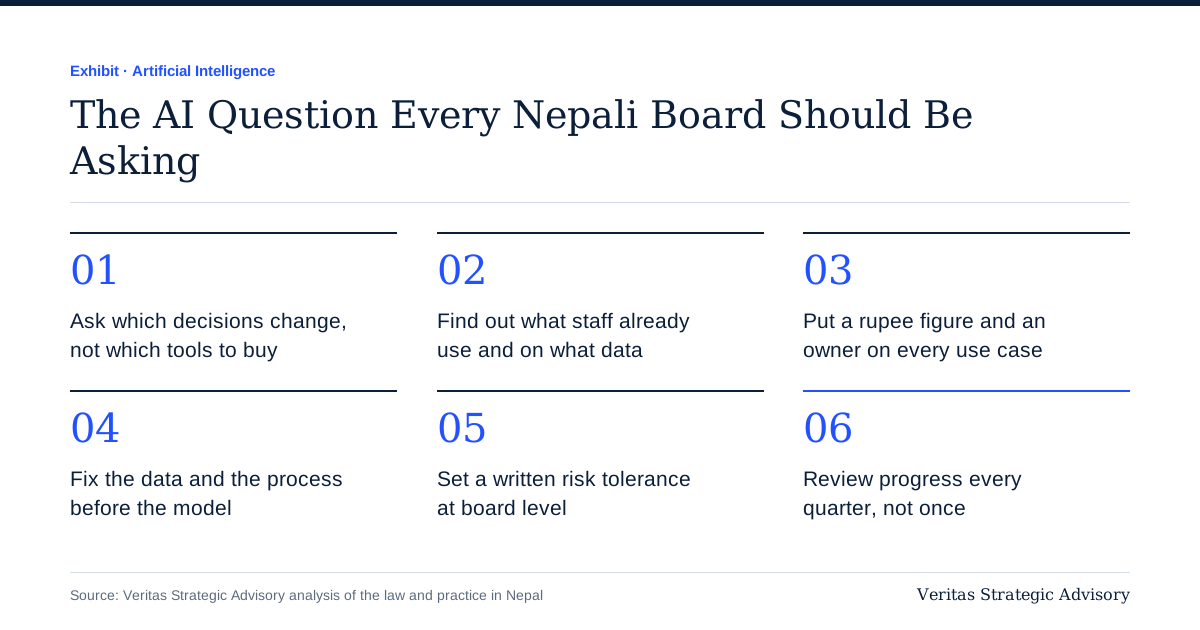
Everything else on the board's list is a refinement of those four. The eight questions below unpack them in the order a board should take them.
Question 1: Where do we make and lose money, and which of those points turn on prediction or paperwork?
AI is good at three things that matter in business: predicting a number or a category from past data (demand, default, delay), reading and extracting from documents (invoices, bank statements, contracts, customs declarations), and producing a first draft in language (a letter, a summary, a variance note). It is poor at judgement where the facts are thin, at anything that needs accountability, and at tasks where the cost of a confident error is high and nobody checks.
So the first exercise is not about technology. Management should lay out the company's value drivers and loss points in ordinary terms. For a distributor in Nepal that might be: stock-outs in the top 200 items before Dashain, receivables beyond 90 days, landed cost surprises on letters of credit, and returns. For a hospital: bed occupancy, pharmacy leakage, insurer claim rejections and consultant billing. For a hotel: rate setting by season and channel commissions.
Then ask of each: is the bottleneck a prediction, a document, a draft or something else? Where the answer is "something else", for example a supplier who will not extend credit or a road that closes in the monsoon, AI has nothing to offer and the board should say so.
A good answer is a list of five to ten points, each with a rough annual rupee value at stake. A poor answer is a list of tools.
We work through the sizing method in where the value is.
Question 2: What is already in use, by whom, and on what data?
Most boards assume the answer is "nothing yet". It almost never is. Ask management for an inventory within four weeks:
which AI tools are being used in each department, including free ones and features embedded in accounting, email and office software;
what kind of information goes into them (customer data, employee data, pricing, tax positions, bank details);
whether the accounts are personal or company accounts, and what the provider's terms say about using inputs to train models;
which outputs are sent outside the company, and whether a person reviews them first.
This is not a hunt for offenders. Staff who have found a way to do in ten minutes what used to take two hours have shown the company where the value is. The purpose is to bring that use into the open, move it to accounts the company controls, and set a short list of things that must never be pasted into a public tool.
The legal backdrop is the Individual Privacy Act 2075, which requires consent and limits the use of personal information to the purpose for which it was collected. Nepal has no general data protection authority and no general breach-notification regime yet, which makes the practical risk reputational and contractual more than regulatory. That will not last, and foreign clients of Nepali IT and outsourcing firms already impose stricter terms by contract.
A good answer is a one-page inventory and a one-page acceptable use policy. A poor answer is "we have blocked it", which usually means it has moved to mobile data.
Question 3: Can we trust our own data?
Every serious study of AI results reaches the same conclusion from a different direction. BCG's rule of thumb is 10-20-70: about 10 per cent of the effort and value in an AI programme lies in the algorithm, 20 per cent in technology and data, and 70 per cent in people and processes. A model trained or prompted on wrong data produces wrong answers with perfect grammar.
For a typical mid-sized Nepali company the data position looks like this. The accounting system holds the vouchers, but item masters are duplicated, customer names are spelled three ways, and cost centres were set up for the audit and not for management. Sales data sits in the billing software, stock in a separate system or in Excel, and payroll in another file. Dates are a mix of Bikram Sambat and Gregorian. A share of purchases is recorded late, when the bill arrives, and a share of sales is adjusted at year end.
None of that prevents a company from using AI for drafting and summarising. All of it prevents the company from using AI for the valuable things: forecasting, anomaly detection, pricing and credit control. The board should ask for a plain assessment of the five or six data sets that matter, rated on completeness, accuracy, timeliness and ownership. We set out a readiness test and what it costs to fix in data before algorithms.
A good answer names an owner for each data set and a date by which it will be reliable. A poor answer is "the software vendor says their system has AI built in".
Question 4: What is the business case, in rupees?
AI spending should be held to the same standard as a new machine or a new branch. That means a baseline, an expected gain, a cost and a payback period.
The discipline is to state the gain as one of four things: revenue that would not otherwise be earned, cost that will actually leave the profit and loss account, working capital released, or a loss avoided. "Hours saved" is not a gain until the board knows what happens to those hours. If five people each save six hours a week and nothing else changes, the company has gained nothing it can bank. If the same saving lets the month-end close move from day 20 to day 7, and management decides on better information, that is a gain, though one that must be argued, not assumed.
The cost side is usually understated. Licences are the small part. The larger parts are cleaning data, changing the process, training people, and the management time to make it stick. In a small market there is a further question: whether to build anything at all. For most Nepali companies the answer is to buy what is already embedded in mainstream software, configure a little, and build almost nothing. We give a decision rule in build, buy or wait.
A good answer is a short table of use cases with an owner, a baseline, a target, a cost and a review date. A poor answer is a budget line called "digital transformation".
Question 5: Who is accountable?
Accountability for AI fails in a predictable way. The technology team owns the tool, the business team owns the process, the vendor owns the model, and nobody owns the outcome. When a collections model stops calling the right customers, or a chatbot quotes a price that does not exist, each party can show it did its part.
The board should insist on three things:
One executive sponsor for the programme as a whole, senior enough to change processes across departments. In most Nepali companies that is the managing director or the finance head, not the IT manager.
A named business owner for each use case, whose performance measure includes the result.
A clear line on who signs. A machine may draft the VAT reconciliation, the customer letter or the credit memo. A person with authority reviews and signs it, and remains responsible. This is not a formality. Courts abroad have already held companies to what their automated systems told customers, and professionals have been sanctioned for filing documents containing material an AI tool invented.
Nepal Rastra Bank's guidelines give licensed institutions a template that other companies can borrow at smaller scale: a steering committee drawn from business, risk, technology, legal, audit and human resources, and at least one senior person who understands technology risk. A 200-person company does not need a committee of six. It does need the same functions represented by two or three people who meet monthly.
Question 6: What could go wrong, and how much of it will we accept?
AI adds a small number of specific risks to those a company already carries.
| Risk | What it looks like in practice | First control |
|---|---|---|
| Accuracy | A confident, fluent, wrong answer on a tax rate, a contract clause or a figure | Human review before anything leaves the company or enters the books |
| Confidentiality | Customer, payroll or pricing data pasted into a public tool | Company accounts, a banned-data list, vendor terms checked |
| Dependence | A process nobody can run by hand when the tool or the internet fails, or when the vendor changes price | A documented manual fallback and an exit plan |
| Bias and fairness | A scoring model that systematically disadvantages a group of customers or applicants | Test outcomes by group before and after deployment |
| Fraud | Cloned voices and forged documents used to authorise payments | Call-back verification on a known number for any change of bank details |
| Regulatory | Use that breaches privacy law, a sector rule or a client contract | Legal review of each use case touching personal data |
The board's task is to set a tolerance: which uses are permitted freely (drafting internal notes), which need review (anything sent to a customer, regulator or bank), and which are prohibited for now (automated decisions on credit, hiring or dismissal without human sign-off). That tolerance should be written down in one page and reviewed each year. We set out a fuller framework in AI risk is a governance question and the specific controls over figures in who reviews the machine.
Question 7: What do those who judge us expect?
A company is assessed by people outside it: the tax office, the bank, the auditor, large customers and, for some, a foreign parent or investor. Each of them is changing how it reads the company.
The tax office. The Inland Revenue Department's published strategy describes automated selection of audit cases using risk indicators and weightings, data matching with customs, and near real-time invoice data from the Central Billing Monitoring System. The 2083/84 budget names an AI-driven e-assessment system. The practical meaning: mismatches between VAT returns, income tax returns, customs data and counterparties' filings will be found by pattern, not by chance. A board should want to know that those reconciliations are done internally every month (how the IRD selects companies for audit).
The bank. Credit assessment is moving toward scoring from data: bank statement behaviour, credit bureau history, tax filings and, in time, payment data. A borrower whose accounts, VAT returns and bank statements tell three different stories will be scored accordingly.
Customers and partners. Foreign clients of Nepali service exporters increasingly ask, in contracts and questionnaires, how the supplier uses AI and how it protects their data. An honest, documented answer is becoming a condition of the work.
A good answer shows that management knows what each outside party can see and has tested its own data against it first.
Question 8: What happens to our people?
This is the question boards avoid and staff think about most. The honest position, on the evidence so far, is that AI changes tasks faster than it removes jobs. The World Bank's 2025 South Asia update found Nepal to have the lowest exposure to AI in the region, because more than 60 per cent of workers are in farming and manual work. Within a company's office functions the picture is different: data entry, first drafts, reconciliations and routine customer replies are exactly the tasks that are exposed.
A Nepali company faces a particular version of this. Skilled accountants, analysts and engineers are scarce, and many leave for work abroad. AI that removes routine work lets a small team handle more volume and gives able juniors more interesting work, which is a reason to stay. But it also removes the training ground. A junior who never prepares a bank reconciliation by hand may not learn to spot what is wrong with one.
The board should ask management for a view on three things: which roles change in the next two years, how people will be trained (in the tools, and in the judgement needed to check them), and what the company will tell staff. Silence is read as a threat. A plain statement that the aim is to grow without adding routine headcount, and to retrain those whose tasks change, is both more honest and more useful.
What this looks like in a Nepali boardroom
Most companies in Nepal are closely held. The board is the promoter family, perhaps a nominee of a lender or investor, and in larger companies one or two independent directors. Meetings are infrequent and dominated by financing, tax and family matters. There is rarely a technology or risk committee.
That structure has an advantage. Decisions are fast. The MIT study found that mid-sized firms moved from pilot to implementation in about 90 days, against nine months or more for large enterprises. A promoter who decides that the close will move to day 7, and that the tools and data needed for that will be put in place, can make it happen in a quarter.
It also has a weakness. Enthusiasm at the top is not challenged. A promoter who returns from a conference convinced that the company needs its own model will not hear from a risk committee that the data cannot support it. The eight questions are a way to build that challenge into a small board without adding structure. Put them on the agenda twice a year. Ask management to answer in writing. Give one director, ideally the one most sceptical, the task of reading the answers closely.
From the ground to the policy level
It helps to see the same subject at three heights.
On the ground, in the accounts room, AI today means a junior using a chat tool to write an Excel formula, an accountant photographing a bill so that software reads the amount and the PAN, and a manager asking for a summary of a 40-page loan agreement. These uses are real, cheap and mostly unrecorded. Their value is in hours. Their risk is in what gets pasted in and what is believed without checking.
At company level, AI means a small number of processes rebuilt around the tools: invoice processing that needs a person only for exceptions, a cash forecast that updates weekly from the ledgers and bank feeds, a collections list ranked by likelihood of delay, stock orders driven by a demand forecast. This is where the money is, and where the work is mostly data and process, not software.
At the level of the economy, AI is a question of regulation, infrastructure and jobs: whether Nepal passes a modern data protection law, whether the compute centre and the hydropower-to-data-centre idea become real, whether the tax and banking systems use data fairly, and whether the IT export sector moves up from labour arbitrage to higher-value work. A board cannot control these, but it should watch them, because they set the rules it will operate under (Nepal's AI opportunity).
The role of consulting and advisory firms
The large international firms have shaped much of how boards think about AI, and it is worth being clear about what they do and do not offer.
Their research is the most useful public evidence available. The annual surveys by McKinsey, BCG, KPMG, Deloitte, PwC and EY, and the more critical work from MIT, RAND and Stanford, are where the figures in this article come from. A Nepali director can read the summaries free of charge and will be better informed than most vendors' sales teams. The caveats: the samples are dominated by large companies in rich economies, the answers are self-reported, and the firms sell the services the research points toward.
Their own behaviour is informative too. The big professional firms announced multi-billion dollar AI investments in 2023 and have built internal assistants for their staff. They have also shown the risks in public: in 2025 one of the Big Four refunded part of the fee on an Australian government report after apparent AI-generated errors, including a fabricated quotation and citations, were found in it. The lesson is not that the firms are careless. It is that review discipline fails under time pressure even in organisations that write the guidance on it.
What an adviser can properly contribute to a mid-sized company in Nepal is narrower and more practical than strategy slides:
an independent view of where the value is, from someone who is not selling a tool;
an honest assessment of the data and the finance processes the tools will sit on;
the redesign of a process (the close, collections, purchasing) so that the technology has something to improve;
controls and review procedures, so that the board can rely on what comes out;
a translation of regulatory developments, in tax, banking and privacy, into what the company should do.
What a board should be wary of: an adviser who starts with the tool, who cannot show how the gain will be measured, who proposes building what can be bought, or who offers certainty about a technology that is changing every quarter. A useful test is to ask the adviser what they would tell the company not to do.
Our own position is that of a finance and advisory practice. We work on the foundations AI depends on: clean books, management reporting and analytics, process automation, controls and finance leadership. We do not build models, and we say so when a company needs someone who does.
A one-page board paper
Ask management to bring this page to the next meeting. If it cannot be filled in, that is the finding.
| Item | Management's answer |
|---|---|
| Top five value or loss points, with annual rupee value | |
| AI tools in use today, by department, with data types | |
| The three use cases proposed for the next 12 months | |
| For each: owner, baseline, target, cost, payback | |
| State of the data each use case depends on | |
| What is prohibited, what needs review, what is free | |
| Who signs outputs sent to the IRD, banks and customers | |
| Training planned, and which roles will change | |
| Date of the next review |
The next 90 days
Days 1 to 30: see what is there. Commission the inventory of current use. Issue a one-page acceptable use rule: company accounts only, no customer or payroll data in public tools, human review of anything sent outside. Ask the finance head to list the five most valuable problems in the business with a rupee figure against each.
Days 31 to 60: choose and prepare. Pick two use cases, one that saves time in the finance function (invoice capture, bank reconciliation, report drafting) and one that touches money directly (collections ranking, stock forecasting, a rolling cash forecast). Name the owners. Assess the data each needs and start fixing it. Write the baseline down before anything changes.
Days 61 to 90: run and measure. Run both for a full month alongside the old process. Compare. Decide whether to scale, change or stop. Report to the board with numbers, including what did not work. Set the tolerance statement and the review calendar for the year.
A board that does this will be ahead of most of its peers, not because it has better technology, but because it has asked better questions.
Frequently asked questions
Does a small or mid-sized company in Nepal really need an AI strategy?
It needs a one-page answer to four things: which tasks and decisions will change, on what data, at what cost and gain, and who is accountable. That is a strategy. A long document is not required and usually does not help.
Is it legal for our staff to use tools like ChatGPT with company data?
There is no law in Nepal that bans the tools. The Individual Privacy Act 2075 restricts how personal information is collected and used, and client contracts often restrict where their data can go. The safe course is company-controlled accounts, a list of data that must not be entered, and a check of the provider's terms on retention and training.
Who on the board should own this?
The whole board owns the tolerance and the review. One director should be asked to lead the questioning, and one executive, usually the managing director or finance head, should sponsor the programme. It should not sit with IT alone.
How much should we budget?
Start with the cost of the two chosen use cases, not a percentage of revenue. For most mid-sized companies the first year's spending is dominated by data clean-up, process change and training, with software licences a minor part.
Do the Nepal Rastra Bank AI guidelines apply to us?
They apply to licensed banks and financial institutions and to payment operators and providers. Other companies are not bound, but the structure they describe (risk classification, board accountability, disclosure to customers, human oversight) is a sound model to adapt.
Will AI replace our accountants?
It will take over much of the data entry, matching and first drafting. It does not take responsibility, and it does not know your business. The roles that grow are review, analysis and explanation to management. See the CFO's office in 2030.
What is the single most common mistake?
Starting with a tool and looking for a use. The companies that get results start with a costly problem, fix the process and the data around it, and only then choose the tool.
How often should the board revisit this?
Twice a year for the full set of questions, and every quarter for progress on the chosen use cases. The technology changes too quickly for an annual review to be enough.
*This article is general guidance, not legal, tax or investment advice. Regulatory details are summarised from published sources and press reports as of November 2026 and should be confirmed against the original documents before acting on them.*