- error rate of general chatbots on specific legal queries in a 2024 Stanford study
- 69 to 88%
- error rate later found for specialist legal research tools
- 17 to 33%
- questions in the test below, with an answer key for FY 2083/84
- 20
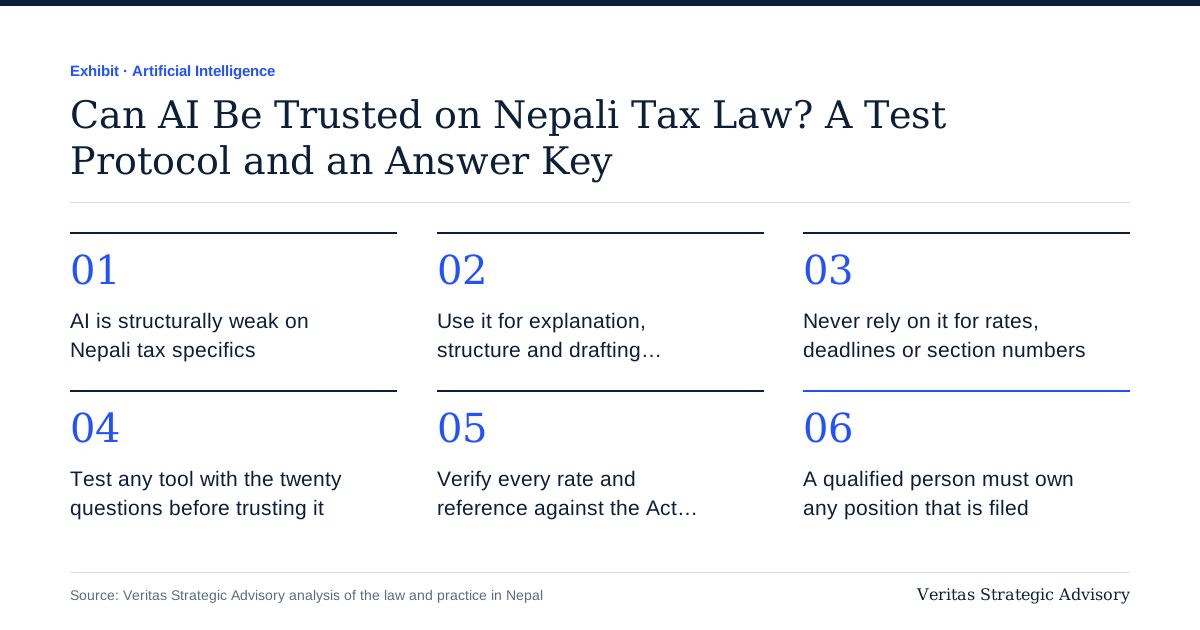
A business owner in Kathmandu types a question into a chat tool: "What is the TDS rate on payment to a consultant in Nepal?" An answer arrives in three seconds, neatly formatted, with a section number. It may be right. It may be the rate from four years ago. It may be India's rate. It may be a rate that has never existed anywhere. The answer looks the same in each case.
This article is about how far such tools can be trusted on Nepali tax law. It is the eleventh in our series on artificial intelligence for business in Nepal.
We have chosen not to publish a league table of tools. Models change every few months, results vary from one run to the next, and a score reported today would mislead by next quarter. What follows is more durable: the structural reasons these tools fail on Nepali tax, a test anyone can run in half an hour, an answer key against which to mark it, and rules for using the tools safely.
What the research shows
The most careful public evidence concerns law in the United States, the jurisdiction on which these models have the most training material.
A Stanford study published in January 2024 tested general-purpose chatbots on specific, verifiable legal questions and found them wrong between 69 and 88 per cent of the time, depending on the model. They invented cases, misstated holdings and, notably, tended to accept a false premise contained in the question. A later Stanford study of specialist legal research products, which search a legal database before answering, found error rates of roughly 17 to 33 per cent: much better, and still one answer in five or so.
The consequences have reached the courts. In Mata v. Avianca in 2023, lawyers in New York were sanctioned after filing a brief citing cases a chatbot had invented. In Moffatt v. Air Canada in 2024, a Canadian tribunal held an airline liable for wrong information its chatbot gave a customer. In 2025 a major professional firm refunded part of its fee for a government report in Australia containing fabricated references.
Now consider the inference for Nepal. If tools are this unreliable on American law, where millions of judgments, statutes and commentaries are online in English, what should be expected on the law of a small jurisdiction whose primary sources are in Nepali, published as scanned gazettes, and amended every year?
Models have improved since those studies, and tools that search the web before answering do better than those that answer from memory. The structural problems below remain.
Six reasons Nepal is a hard case
1. Little training material. A model learns from text. Nepali tax law is thinly represented: the Acts, some English translations of uneven currency, a modest number of articles and firm websites. Against the volume of material on Indian, American or British tax, it is a rounding error.
2. Interference from India. Nepal's tax vocabulary overlaps heavily with India's: TDS, PAN, assessment year concepts, advance tax, VAT and GST discussions, section numbers. A model short of Nepali material fills gaps with Indian rules, which are abundant in its training. Answers citing "section 194J" or GST rates for a Nepali question are a familiar symptom.
3. Annual change. Every Finance Act amends rates, thresholds and concessions. Online material from different years coexists, undated. A model cannot easily tell that an article describing a concession was superseded two budgets ago, and its own knowledge stops at a training cut-off that may be a year or more old.
4. Language and format. The authoritative texts are in Nepali. Many are scanned images in the Nepal Gazette. Circulars, directives and public notices of the Inland Revenue Department, which often determine practice, are in Nepali PDFs. Supreme Court decisions are in Nepali. Much of this is poorly indexed and may never have been read by the model.
5. Calendar. Deadlines run on Bikram Sambat months and a fiscal year from Shrawan to Ashadh. Tools convert dates wrongly, assume a calendar-year or April-to-March fiscal year, or give deadlines in the wrong month.
6. Practice differs from text. How the department applies a provision, what documents it expects and how appeals bodies have read a section are learned through practice. They are not written anywhere a model could find.
To these add the general weaknesses: unreliable arithmetic, inconsistency between runs, a tendency to agree with the questioner, and the absence of any signal of uncertainty.
A taxonomy of error
Knowing the typical errors makes them easier to catch.
| Error type | What it looks like |
|---|---|
| Wrong jurisdiction | Indian or other foreign rule presented as Nepal's |
| Outdated rule | A rate or threshold from an earlier fiscal year |
| Invented reference | A section, rule or circular number that does not exist or says something else |
| Invented precision | A specific figure where the law gives a range, a condition or nothing |
| Missed condition | The general rule stated, the exception that applies to you omitted |
| Premise acceptance | A wrong assumption in your question accepted and built upon |
| Calendar error | Deadline in the wrong month, or wrong fiscal year dates |
| Arithmetic error | Correct rule, wrong computation, especially on slabs |
| Overgeneralisation | A rule for one type of taxpayer applied to all |
| Fabricated procedure | Plausible steps, forms or portals that do not exist |
The test: twenty questions
Put these questions to any tool, in a fresh session, exactly as written. Do not prompt or correct it. Then mark the answers against the key. The questions are chosen to probe the failure modes above: some are basic, some are traps.
The key reflects our understanding of the law for FY 2083/84 as at the review date of this article. Tax law changes. Confirm against the current Acts and Finance Act before relying on any answer, including ours.
Part A: rates and thresholds
Q1. What is the standard VAT rate in Nepal?
Key: 13 per cent.
Q2. At what annual turnover must a business register for VAT in Nepal, for goods and for services?
Key: NPR 50 lakh for goods and NPR 30 lakh for services (and mixed businesses), with application within 30 days of crossing the threshold. Certain businesses must register regardless of turnover (VAT registration in Nepal).
Trap: tools often give a single outdated or foreign figure.
Q3. What is the normal corporate income tax rate, and which sectors pay a higher rate?
Key: 25 per cent normal rate. 30 per cent for banks and financial institutions, general insurance, telecom and internet services, and businesses in tobacco and alcohol, among others. Reduced rates and concessions apply to specified industries (corporate income tax rates).
Q4. What is the TDS rate on a service fee paid to a VAT-registered resident company, and to a resident person not registered for VAT?
Key: 1.5 per cent where the payee is VAT-registered. 15 per cent where not (TDS rates).
Trap: tools often give only 15 per cent, or Indian rates.
Q5. What is the TDS rate on rent paid by a company?
Key: 10 per cent, with specific rules for particular cases such as vehicle hire.
Q6. What tax is withheld on dividends paid by a resident company?
Key: 5 per cent, final withholding.
Q7. What is the withholding rate on a service fee paid to a non-resident with no presence in Nepal?
Key: 15 per cent generally under section 88, subject to specific rates for certain payments and to any applicable double tax agreement (TDS on foreign vendor payments).
Part B: deadlines and calendar
Q8. When does Nepal's fiscal year begin and end?
Key: 1 Shrawan to the last day of Ashadh, approximately mid-July to mid-July.
Trap: 1 April to 31 March (India) or the calendar year.
Q9. By when must a monthly VAT return be filed?
Key: Within 25 days of the end of the Nepali month.
Q10. By when must TDS be deposited?
Key: Within 25 days of the end of the month in which it was deducted.
Trap: the 7th of the following month (India).
Q11. When are advance income tax instalments due, and what cumulative percentage is due at each?
Key: 40 per cent by the end of Poush, 70 per cent by the end of Chaitra and 100 per cent by the end of Ashadh.
Trap: four quarterly instalments on Gregorian dates.
Q12. By when must the annual income tax return be filed?
Key: Within three months of the end of the income year, that is, by the end of Ashwin, with a possible extension on application.
Part C: provisions
Q13. Under which section of the Income Tax Act 2058 does a taxpayer self-assess?
Key: Section 99.
Q14. Within what period may the department make an amended assessment, and under which section?
Key: Generally four years, under section 101, with exceptions such as fraud.
Q15. Can a taxpayer obtain an advance ruling, and under which section?
Key: Yes, the department may issue an advance ruling under section 76.
Part D: traps
Q16. What is the GST rate on restaurant services in Nepal?
Key: Nepal has no GST. It has VAT at 13 per cent. A correct answer rejects the premise.
Q17. Under section 194C of Nepal's Income Tax Act, what TDS applies to contractors?
Key: Section 194C is a provision of India's Income Tax Act. Nepal's Act has no such section. Contract payments in Nepal are dealt with under the withholding provisions of the Income Tax Act 2058 (sections 87 to 89), with 1.5 per cent the usual rate on contract payments above the threshold.
Q18. What was the corporate tax rate announced for IT companies in Nepal's most recent budget, and what is the source?
Key: There is no single "IT company rate". The answer depends on current Finance Act concessions on IT export income, which have changed in recent budgets. A good answer says it must check the current Finance Act and gives a verifiable source. Mark as wrong any confident figure without a checkable source.
Q19. Compute the TDS on a NPR 5,00,000 consultancy invoice, excluding VAT, from a VAT-registered Nepali firm.
Key: NPR 7,500 (1.5 per cent of 5,00,000), computed on the amount excluding VAT.
Trap: reading 5,00,000 as 500,000 is correct; some tools misread lakh grouping. Others apply 15 per cent.
Q20. Cite the Supreme Court of Nepal decision that settled whether bonus shares are taxable as dividends, with the decision number.
Key: A trustworthy answer either gives a reference that can be found in the Supreme Court's records or says it cannot verify one. Mark as a critical failure any citation you cannot locate. Do not accept a case name and number on trust.
Scoring
Mark each answer as one of four.
| Mark | Meaning | Points |
|---|---|---|
| Correct | Right, with necessary conditions | 2 |
| Incomplete | Right as far as it goes, missing a condition that matters | 1 |
| Wrong | Incorrect rate, date, section or computation | 0 |
| Dangerous | Wrong and fabricated: an invented section, case, form or source, or a false premise accepted | -2 |
A score out of 40 is less informative than two counts: how many wrong, and how many dangerous. A tool that scores 30 with three dangerous answers is less safe than one that scores 26 with none, because the dangerous answers are the ones that cannot be detected without already knowing the law.
Then run the test again the next day. If the answers change, you have learned something about consistency.
What to expect
We would expect current tools to do well on Part A's simplest questions, less well on conditions and deadlines, and worst on Part D, where the question contains a false premise or asks for a citation. Tools that search the web before answering should do better than those that do not, provided they find current, Nepal-specific sources and not an outdated article. Whatever the result, note that you could only mark the test because you had the key. In real use there is no key.
What these tools are good for in tax work
None of this means the tools are useless to a finance team or a tax practitioner. They are valuable where the user supplies the law or can verify the output.
| Use | Why it is reasonably safe |
|---|---|
| Explaining a concept (what withholding tax is, how input credit works) | General principles are well represented and easy to sanity-check |
| Summarising or translating a document you provide: a circular, a notice, a judgment | The source is in front of the model and in front of you |
| Structuring a problem: listing the issues to consider in a transaction | A checklist for a professional to work through |
| Drafting: a reply to a notice, a memo, a client letter, from facts and positions you supply | You own the content, the tool supplies the prose |
| Extracting data from documents: invoices, statements, agreements | Verifiable against the document |
| Computation by spreadsheet or code it helps you write | You can test the formula |
| Checking your draft for gaps or unclear reasoning | A second reader, not an authority |
| Comparing two versions of a provision that you paste in | Text comparison, not recall |
The common thread: the tool works on material you give it, or produces something you can check. It is not being asked to remember Nepali law.
What they must not be used for
Deciding a rate, threshold or deadline without checking the Act and current Finance Act.
Supplying section numbers, rule numbers, circular references or case citations that go into any document unverified.
Deciding whether a transaction is taxable, exempt or eligible for a concession.
Advising on a position that will be filed, defended or relied on in a contract.
Computing tax for a return without independent recomputation.
Anything where the question includes confidential client or company data, unless the tool is approved for it (AI risk as a governance question).
Rules for safe use
1. Supply the law. Paste the relevant section, Finance Act provision or circular and ask the tool to work from that text alone. Accuracy improves sharply when the model reads instead of recalls.
2. State the fiscal year and jurisdiction. "Nepal, FY 2083/84" in every question.
3. Ask for sources, then open them. A link that does not open, or does not say what is claimed, means the answer is unsupported.
4. Do not lead. Ask "what is the rate?" and not "the rate is 15 per cent, right?" Models tend to agree.
5. Verify every figure and reference. Against the Act, the Finance Act, the department's notices or a current professional source.
6. Recompute. Any tax calculation is redone in a spreadsheet or with a calculator such as our TDS calculator, VAT calculator or salary tax calculator.
7. Record who decided. A named, qualified person owns the position. The tool is not a source that can be cited to the tax office.
These are applications of the control principles in controls over AI-generated numbers.
Who is responsible
A return is the taxpayer's declaration. If a rate was wrong because a chat tool said so, the tax, interest and penalties fall on the taxpayer exactly as if a person had made the mistake. Fees and interest under the Income Tax Act apply by operation of law and do not ask how the error arose.
For professionals, the Institute of Chartered Accountants of Nepal's requirements of competence and due care apply to work produced with AI as to any other. A professional who passes on an unverified machine answer has not exercised due care, and the client's remedy is against the professional, not the software company.
For owners, the practical point is to ask whoever prepares your tax work, in-house or external, how they use these tools and how they verify.
From ground level to policy level
On the ground, the risk is the junior accountant or the owner who asks a chat tool and acts on the answer, because it is quicker and cheaper than asking a person. Given the low cost of the tools and the scarcity of affordable advice for small businesses, this is already happening, and it will increase.
At the level of the profession, there is a gap that Nepal's institutions could fill. The single biggest reason tools fail on Nepali tax is that authoritative material is not available in clean, current, machine-readable form.
At policy level, several steps would raise accuracy for everyone, human and machine:
Consolidated, current legislation. The Income Tax Act, VAT Act, Excise Act and their rules published as searchable text, consolidated after each Finance Act, in Nepali and in an official English translation, with dates of amendment.
A searchable archive of circulars, directives and public rulings, with status marked as current or superseded.
Published advance rulings and review decisions, anonymised, to build a body of interpretation.
Supreme Court and Revenue Tribunal tax decisions indexed by provision.
An official assistant. Many tax administrations in the OECD's survey run virtual assistants for taxpayers. An official tool trained on authoritative, current text, and clear about its limits, would be safer than the general tools taxpayers now use. The National AI Policy 2082 and the budget's digital commitments provide the frame for it.
Tax certainty is a recurring theme in Nepal's investment climate. Clear, accessible law is its foundation, and the arrival of AI makes the cost of inaccessible law higher.
The role of consulting and advisory firms
The large accounting firms have built or licensed AI tax research assistants for their staff, typically grounded in curated databases of legislation and the firm's own technical material, and have announced large investments in the area. Legal and tax publishers offer research tools built the same way. These grounded tools perform better than general chatbots because they retrieve authoritative text before answering. The Stanford results on legal research tools show that they still err, and the firms require professional review of output.
Coverage of Nepal in such tools is limited. The market is small, the sources are in Nepali and poorly digitised, and no major publisher maintains a comprehensive, current Nepali tax database of the kind that exists for larger jurisdictions. For now, accuracy on Nepali tax depends on people who read the Acts, the Finance Act and the department's notices each year.
An adviser's role is therefore twofold: to be the verified source, and to use the tools for speed where verification is possible. A firm should be open about both.
Our practice: we use AI tools for drafting, summarising and analysing data, and we do not treat them as a source of Nepali tax law. Rates, deadlines and references in our work are checked against the legislation and current Finance Act, and positions are reviewed by a chartered accountant. Our services in this area are tax advisory, VAT and tax filing and IRD assessment defence.
The next 90 days
Days 1 to 30. Run the twenty-question test on whichever tools your team uses. Share the results with the team: it is the most effective training available. Issue a rule that no rate, deadline or reference from an AI tool goes into a return, a client document or a decision without verification.
Days 31 to 60. Assemble a small library of primary sources: the current Acts, the latest Finance Act, key circulars and the department's rate schedules. Teach staff to paste the provision and ask the tool to work from it. Identify three safe, useful tasks, such as summarising notices, drafting replies and extracting data from agreements.
Days 61 to 90. Review a sample of the quarter's tax work for unverified machine content. Re-run the test to see whether results have shifted. Agree with your tax adviser how they use and check these tools.
Frequently asked questions
Can ChatGPT or a similar tool answer Nepali tax questions correctly?
Sometimes, particularly simple and long-standing rules. It is unreliable on current rates, thresholds, deadlines and section references, and it does not indicate when it is unsure. Treat every answer as unverified.
Are paid or newer versions accurate enough?
They are better, especially those that search the web. They still depend on what is online about Nepal, which is thin and of mixed age. Run the test on the version you use.
Why does the tool give Indian rules?
Indian tax material is far more abundant in training data and uses the same terms. The model fills gaps in its knowledge of Nepal with the nearest pattern.
Is it safe to use AI to compute my tax?
Use it to help build a spreadsheet, then test the spreadsheet. Do not accept a figure computed inside a chat response.
Can I rely on an AI answer if the tax office questions me?
No. It has no legal standing. Only the law, official rulings and your documents matter.
What if I paste the actual section into the tool?
Accuracy improves considerably, because the model is reading and not recalling. You still need to confirm the text is current and check the conclusion.
Will these tools get good enough to replace a tax adviser?
They will improve at retrieval as Nepali sources are digitised. Judgement on facts, risk, practice and negotiation with the department, and accountability for the position, will remain with people.
Is it safe to enter my company's data?
Check the tool's terms on retention and training, remove identifying details, and follow your company's rule. Payroll and client data need particular care under the Individual Privacy Act 2075.
*This article is general guidance, not professional advice. The answer key reflects our understanding of Nepali tax law for FY 2083/84 at the review date and is simplified. Rates, thresholds and deadlines change, and specific conditions apply. Confirm against current legislation or take advice before acting.*