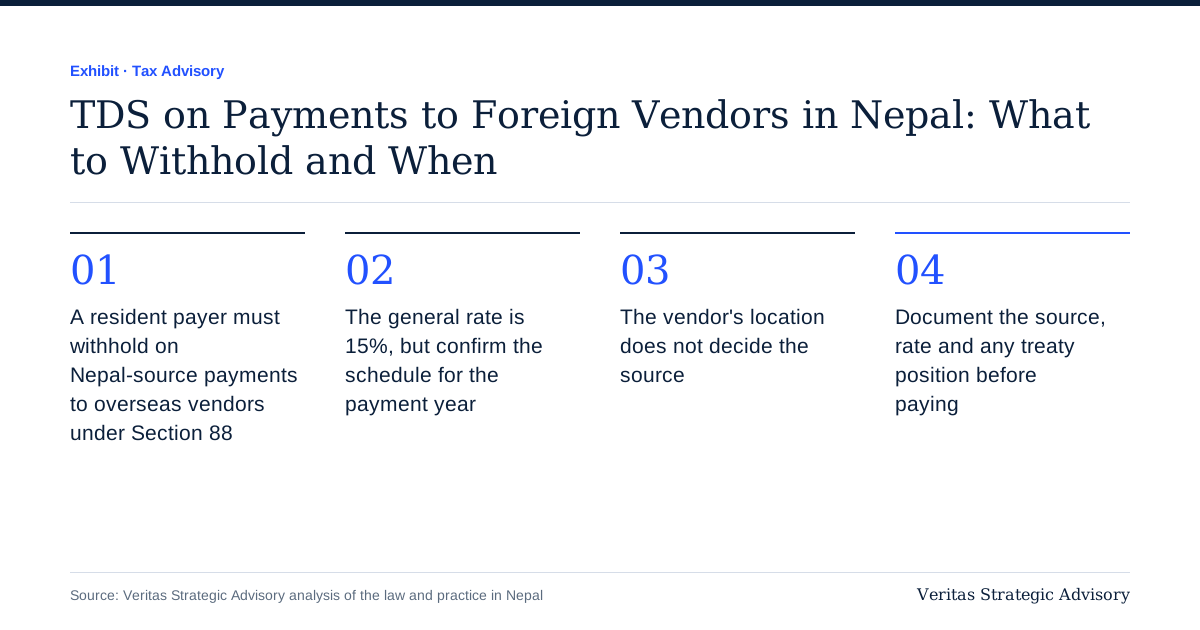
- general withholding rate under Sec 88
- 15%
- Income Tax Act 2058 provision
- Sec 88
- checks before each payment
- 4
- payer carries the withholding duty
- 1
Paying a foreign vendor feels like a transaction between two companies. For the tax office it is a payment made inside Nepal, and the Nepali payer stands between the vendor and the Inland Revenue Department. That is the point most businesses miss. The overseas consultant does not file the withholding in Nepal. You do, and if you did not withhold, the tax can be recovered from you.
This guide covers the usual case: a Nepali company or other resident payer sends money abroad for a consultancy, software licence, royalty, technical fee or similar service. It is general information, not advice on a specific invoice. The rate and treatment depend on the exact nature of the payment and on the year in which it is made.
Does withholding apply when the vendor is outside Nepal?
Section 88 of the Income Tax Act, 2058 deals with withholding on payments made by a resident person. Its opening rule is that, when a resident person makes a payment of interest, natural resources, rent, royalty, service charge, commission, sales bonus, retirement payment or other consideration having a source in Nepal, the person must withhold tax. The text is published on Nepal Laws, Section 88.
Two words in that rule carry the weight. The first is the payer: the obligation sits with the Nepali resident making the payment, not with the foreign vendor. The second is source: the question is whether the income has a source in Nepal, not whether the vendor happens to be located abroad. A foreign consultant who performs work for a Nepali company in Nepal, or a licensor whose intellectual property is used in Nepal, is a common example where the source test is met.
This is why the vendor's address on the invoice does not settle the question. You need to know what is being paid for and where the value is delivered or used.
Which rate applies?
The general rate in Section 88 is 15% of the total payment. That is the figure to start from for most payments to overseas service and royalty providers. Withholding on payments to non-residents is also dealt with in Section 89, which carries its own rates, for example a lower rate on certain contract payments. Which provision and rate apply depends on the type of payment and the vendor's status, so confirm both before paying.
Section 88 and the wider withholding provisions also set different rates for some payment types, and the rate schedule is updated through the annual Finance Act. Do not assume that the general rate is always the final answer. Before paying, confirm the rate for that payment type in the schedule that applies to the year of payment. Our TDS rates guide for FY 2083/84 sets out the main Nepali rate table and the errors that most often cost money, and our TDS rate calculator works out the rate and section reference for a specific payment in under a minute.
Four checks before any overseas payment
1. What exactly is being paid for? Write down the nature of the payment in plain words: consultancy, software subscription, royalty, technical fee, reimbursement, or a pure purchase of goods. A mixed invoice, such as a service fee bundled with travel costs, must be split. The split matters because each component can carry a different treatment.
2. Does the income have a source in Nepal? If the service is performed outside Nepal and the benefit is used only outside Nepal, the source test may not be met. If the work is done for a Nepali business, or the right being licensed is used in Nepal, it usually is. Keep the statement of work and the place of performance on file.
3. Which rate applies on the payment date? Match the payment type to the rate in the schedule for the year. Note the date and the rate you applied in your working papers, not just in the bank remittance.
4. Is there a treaty position, and can you document it? Where Nepal has a double taxation agreement with the vendor's country, the treaty may change the rate or the taxing right. The treaty position must be documented at the time of payment: the vendor's residence certificate, the article relied on, and the reasoning. A treaty argument raised only after a notice is far harder to win.
Payment types that need extra care
| Payment | Question to ask | Evidence to keep |
|---|---|---|
| Overseas consultancy or advisory fee | Is the work performed in Nepal or for a Nepali benefit? | Engagement letter, work location, deliverables |
| Software subscription or SaaS | Is it a service fee, a licence payment, or a royalty? | Contract, licence terms, invoices showing the split |
| Royalty or licence for a brand or technology | Is the right used in Nepal? | Licence agreement, usage scope, payment schedule |
| Technical or management fee to a parent or group company | Is the arrangement at arm's length? | Intercompany agreement, transfer pricing file |
| Reimbursed travel or expenses | Is the recharge part of the service fee? | Itemised invoice, receipts, the basis of recharge |
The last two rows connect to transfer pricing. A group charge that looks like a reimbursement but carries a mark-up is a service fee. Our transfer pricing explainer covers how the tax office tests these arrangements.
Timing: do not leave withholding until the year-end
A common error is to pay an overseas invoice in full, record it in the books, and assume the withholding can be sorted out at year-end. Withholding is tied to the payment itself, so a payment made without withholding is an under-deduction for that period, whatever the vendor later declares in its own country. Build the withholding step into the payment approval, not into the audit file.
The same discipline applies to advance payments and deposits. A prepayment is still a payment. Check whether withholding is due at that point and do not wait for the final invoice.
Mistakes that turn a routine payment into a demand
Paying the gross invoice when the contract says "net of tax". If the contract requires the vendor to receive a fixed net amount, the tax is still computed on the gross payment. Negotiate the gross-up clearly in writing, or the difference becomes an internal cost you did not budget for.
Treating a licence as a plain service. A licence for technology or brand use may be a royalty in substance, even when the invoice calls it a subscription. The label on the invoice does not decide the treatment.
Using a treaty without the paperwork. A treaty rate applied with no residence certificate or documented article is weak support. Collect the paperwork before the payment, not after the notice.
Losing the working papers. The tax office will ask for the contract, the invoice, the proof of payment and the rate applied. If any of these is missing, a correct decision can still look like a wrong one.
Ignoring the deposit and return cycle. Withheld tax is only half the job. It must be deposited and reported in the return for the period. A withheld amount that sits in the bank account and never reaches the tax office is a penalty waiting to happen.
What to keep on file for each overseas payment
The contract or statement of work, with the place of performance clearly stated
The invoice showing the split between service, licence and reimbursement
Your written note of the payment type, the source conclusion and the rate applied
The treaty certificate and article, where a treaty rate was claimed
The proof of payment and the withholding deposit reference
The entry in your withholding register for the period
Keep these for the full period the tax office can review. A payment made today may be examined years later, when the people who approved it have moved on.
Frequently asked
Do I withhold tax if the vendor is a foreign company with no office in Nepal?
It depends on the source of the income, not on the vendor's office. If the payment is for a service performed in Nepal, or for a right used in Nepal, withholding is usually required. Document the place of performance and the use of the right before you pay.
Is 15% always the rate for overseas payments?
No. 15% is the general rate under Section 88 for the listed payment types. Other rates apply to some payment types, and the rate schedule changes through the annual Finance Act. Confirm the rate for the specific payment and the year.
Can a double taxation treaty reduce the withholding?
It can, if the treaty covers the income and the vendor qualifies as a resident of the treaty country. You need a residence certificate and a documented treaty article, prepared at the time of payment.
Does the vendor pay tax in its own country, so I do not need to withhold?
No. The Nepali payer's withholding duty under Section 88 applies regardless of what the vendor reports abroad. The two obligations are separate.
What if I already paid without withholding?
Speak to an advisor quickly. Work out what was due, whether a treaty position is available, and how to correct the position before the tax office raises it. Early, documented correction is far better than waiting for a notice.
Does this apply to a payment for software I use in my office?
Often yes, if the payment is a service fee or a licence payment with a Nepal source. A plain purchase of a physical product is treated differently. The label on the invoice is not enough; check the substance.
Need a second pair of eyes on a payment before it goes out? Our tax consultant service in Kathmandu includes withholding reviews for overseas vendors. For the wider filing calendar, see tax notice received in Nepal: what to do first and VAT registration in Nepal.
Related: does the income heading change your tax? A reclassification review.
Related: Is interest on a loan used to buy shares deductible? A Supreme Court case on Section 14(1).