

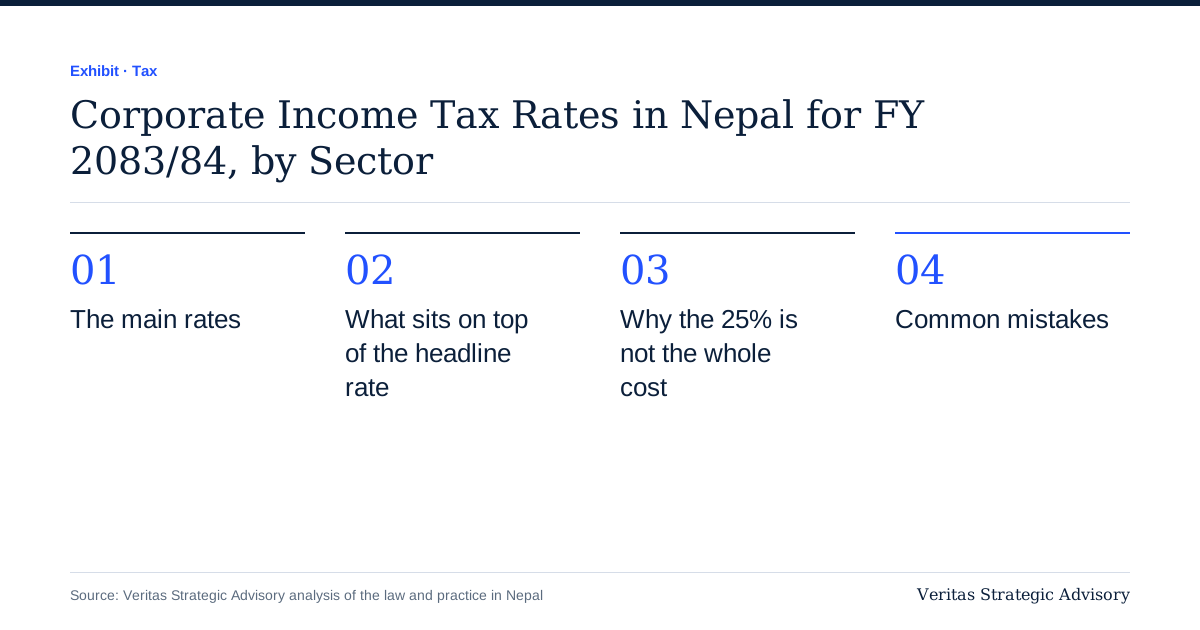
- general rate
- 25%
- banks, insurance, telecom, tobacco, alcohol
- 30%
- dividend withholding
- 5%
The main rates
| Type of business | Rate |
|---|---|
| General companies and most businesses | 25% |
| Banks and financial institutions | 30% |
| Insurance companies | 30% |
| Telecommunications | 30% |
| Tobacco and alcohol | 30% |
| Special industries (qualifying manufacturing and similar) | Lower rate under the Act's schedule |
| Cooperatives | Rates set by type and area; revised in recent budgets |
The Act's schedule defines each group in detail. A company with more than one activity may need to keep separate accounts so each part gets the right rate.
What sits on top of the headline rate
Incentives and exemptions: tax holidays, reductions for exporters, special economic zones, and sector rules. Use the tax exemption finder.
Dividend withholding at 5%, final, when the company pays out profits.
Minimum tax and carry-forward rules for losses.
Depreciation that moves taxable profit; see depreciation rates.
Tax treaties that can lower withholding on payments abroad; see the Nepal–India treaty.
Why the 25% is not the whole cost
A company pays 25% on taxable profit. Then it deducts 5% when it distributes a dividend. An owner choosing between a sole proprietorship and a company should compare the combined tax, as well as costs and flexibility; see private limited vs sole proprietorship.
Common mistakes
Applying the 30% or 20% rate without checking the definition.
Mixing a concessionary activity with a general one in the same accounts.
Assuming last year's incentive continues. Several sector rules changed in recent budgets.
Ignoring advance tax on the new profit estimate; see advance tax instalments.
We confirm which rate and incentive applies, set up the accounts and test the position. For this year's changes, see the 2083/84 budget. Rates change with each Finance Act, so verify before you rely on a figure.
A worked example: how the rate changes the result
Three companies each earn NPR 2 crore of taxable profit in FY 2083/84. Illustrative only.
| Company | Rate | Corporate tax | Profit after tax | Dividend tax if all distributed at 5% | Cash to owners |
|---|---|---|---|---|---|
| A trading company | 25% | 50,00,000 | 1,50,00,000 | 7,50,000 | 1,42,50,000 |
| A telecom or insurer | 30% | 60,00,000 | 1,40,00,000 | 7,00,000 | 1,33,00,000 |
| A qualifying special industry at a lower rate | Lower rate under the Schedule | Depends on the rate | Higher | 5% of the larger amount | Higher |
A five-point difference in rate is NPR 10 lakh on this profit. That is why the classification of the business matters, and why mixed businesses must be careful about how their activities are described and accounted for.
Why the same company can face more than one rate
A company's activities sometimes fall under different rates. A manufacturer that also trades, or a company with a concessional unit and a general unit, may need separate accounts. If the unit that earns a lower rate cannot be separated, the whole profit may be taxed at the higher one. Keep a separate cost centre, separate bank accounts where practical and an allocation method for shared costs.
Examples of where this arises:
Manufacturing with a separate trading arm. The manufacturing profit may enjoy a special rate; the trading profit does not.
An IT company with export and domestic income. The export income may qualify for a concession, and the domestic income does not. See IT exporters.
A hotel or tourism business with several activities. Each may be treated differently.
An infrastructure company with a tax holiday period. The holiday ends on a date, after which the full rate applies.
Incentives: what to check each year
Sector incentives are among the most volatile parts of the Act. Every budget can add, trim or end a concession. For each incentive you rely on:
Read the exact condition: the activity, the location, the investment size, the date of start-up, and the documents that prove it.
Check the end date and any transitional rule.
Confirm the approval needed, if any, from a government office.
Keep the evidence that supports the claim in the form the IRD expects.
Note any condition that can cancel the benefit, such as a change of ownership or activity.
Use the tax exemption finder as a first screen, and then confirm in the Act.
Questions people ask
Is 25% really the general rate? Yes, for most companies. Specific sectors are listed in the Act with higher or lower rates.
Do banks pay 30%? Banks and financial institutions are commonly listed at 30%, along with insurance, telecom, and tobacco and alcohol businesses.
What about cooperatives and non-profits? Their treatment differs. Cooperatives are taxed under specific rules that have changed in recent budgets, and non-profits can have exemptions with conditions; see cooperatives.
Does a foreign-owned company pay a different rate? Not simply because of its ownership. Foreign investment can bring incentives or restrictions through sector rules; see the FDI approval guide.
Is there a minimum tax? The Act has provisions for loss-making companies and for tax computed on turnover in certain cases. Check the current rules for your situation.
What about the dividend tax? Dividends are subject to withholding at 5% on distribution, final in many cases; see TDS rates.
We help you identify the right rate, structure the accounts and test the position before you file. See tax services, the 2083/84 budget and filing your income tax return. Rates change with each Finance Act, so verify before you rely on a figure.
How to identify which rate applies to your company
Follow this sequence, and write the answer down for your file.
Start with your registered activity in the memorandum of association and the registration certificate. This is the first evidence of what the company does.
List your actual revenue streams with their approximate share of turnover: for example, manufacturing, trading, services, exports, interest income and rent.
Compare each stream with the Schedule of the Income Tax Act as amended by the latest Finance Act. Note the rate, the definition and the conditions.
Check for licences or approvals that the definition requires, such as an industrial registration, a sector licence or a Department of Industry approval.
Look for incentives that attach to the activity or location, and note their conditions and end dates.
Decide how to account for each stream, including separate cost centres and a method for shared costs.
Write a short position note with your conclusion and the references, and update it each year.
If your answer differs from what your advisers or the IRD believed in the past, find out why before you file. The IRD may have accepted your classification for years and still change its view on an assessment, so the note and the evidence behind it matter.
Sector notes
Manufacturing. Many manufacturing companies fall within the special industry classification, which carries a lower rate. The definition requires an actual manufacturing process, and the IRD reads it narrowly. Assembly, packaging and trading are not automatically manufacturing. Keep production records, bills of materials and licences. See manufacturing costing.
Banks and financial institutions. The 30% rate applies, and capital adequacy and provisioning rules affect taxable profit. They also have specific rules on interest, provisions and write-offs.
Insurance. The 30% rate applies, and the treatment of reserves and technical provisions is specific to the sector.
Telecommunications. The 30% rate applies, with additional sector levies and fees outside income tax.
Tourism and hotels. The general rate applies, with specific incentives available in some cases. Seasonal cash flow and VAT questions are common; see hotel and tourism cash flow.
Hydropower and energy. Long tax holidays and concessions have existed for qualifying projects, with conditions for the start of commercial operation. See hydropower finance.
IT and software exporters. Concessions for export income have been reported to be reduced in 2083/84, so projections built on the earlier percentage need updating. See IT exporters.
Construction. Contract accounting, retention and TDS are the recurring issues; see contract accounting.
Education and healthcare. Treatment depends on the legal form and the Act's provisions for exemptions or concessions. See schools and colleges and hospitals and clinics.
What happens when the rate you used was wrong
A company that applied the wrong rate faces two kinds of problem. If it applied too low a rate, the IRD can assess the difference with interest and a penalty where the law applies. If it applied too high a rate, the company overpaid, and may be able to claim a refund or credit within the time allowed, though this is rarely quick.
The practical steps are:
Do not ignore the issue. Find out the correct position, and how much is involved.
Check the time limits for amended returns and refund claims.
Quantify the exposure over the years in question.
Decide whether to disclose by an amended return before the IRD raises the point.
Consider an amnesty or settlement if one is available; see the 2083 amnesty.
Fix the process so the same mistake is not repeated: the classification note, the accounts structure and the annual review.
If the matter becomes a dispute, see IRD assessment defence and the Revenue Tribunal appeal process.
A quick annual review for directors
Directors do not need to know every rate, but they should ask five questions each year:
Which rate do we pay, and why? Is it documented?
Which incentives do we rely on, and when do they end?
What changed in this year's Finance Act that affects us?
What is our expected tax for the year, and are we paying advance tax on a current estimate?
What would an assessor challenge first, and are we ready?
A short meeting with your tax adviser covering these points each Shrawan prevents most surprises. See our tax services, and read the 2083/84 budget for this year's changes. Rates and incentives change with each Finance Act, so confirm them against the enacted text.


