
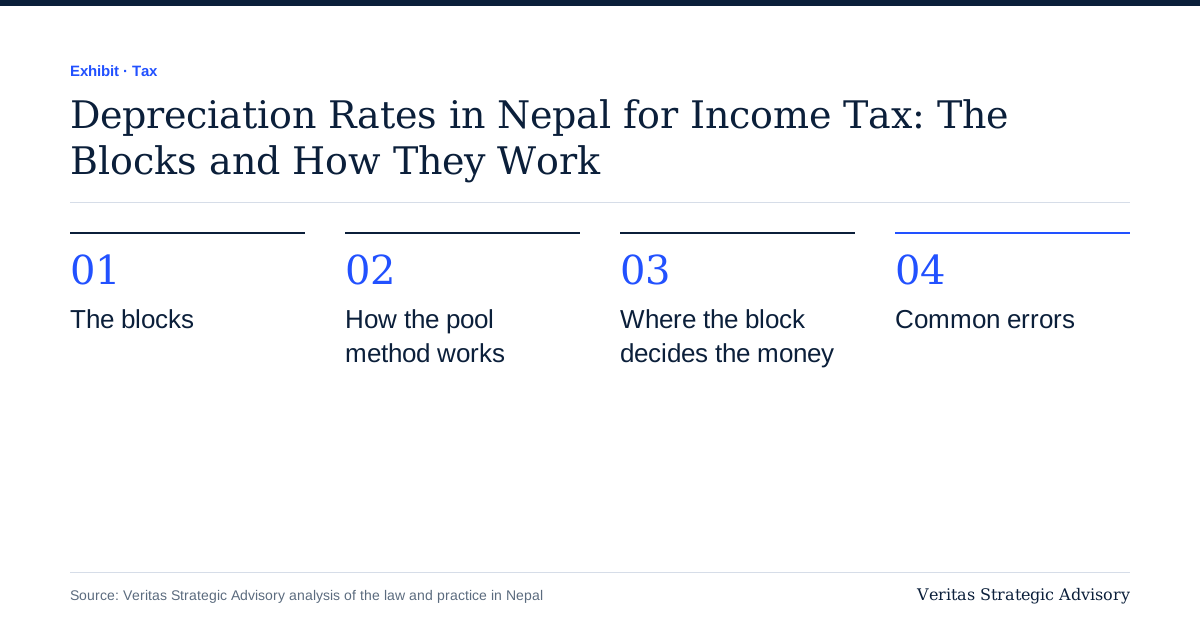
- blocks A to E
- 5
- rate range
- 5%-25%
- pool method
- 1
The blocks
| Block | Typical assets | Rate |
|---|---|---|
| A | Buildings, structures and similar permanent works | 5% |
| B | Computers, data processing equipment, furniture, fixtures, office equipment | 25% |
| C | Cars, buses and minibuses | 20% |
| D | Plant, machinery, construction and earth-moving equipment, other assets | 15% |
| E | Intangible property: patents, copyrights, rights of use | Written off by the right's life |
How the pool method works
Take the opening written-down value of the block.
Add the cost of assets acquired in the year.
Deduct the proceeds of assets sold or disposed.
Apply the block rate to the result.
The balance carries forward as next year's opening value.
You do not track depreciation for each asset. If disposals exceed the block, the excess is income. Try your own figures in the depreciation calculator.
Where the block decides the money
Fit-out on rented premises. The Supreme Court accepted class E treatment tied to the lease in one bank's case; see the leasehold improvements case. Another taxpayer's facts may differ.
A building shell versus fittings. The building is A at 5%, but movable fittings may fit a faster block. Splitting the cost needs support.
Software. Treatment depends on whether it is bought, developed or licensed. Check the class.
Special entities. Some projects and entities receive an addition to the rates under the Act.
Common errors
Capital items expensed straight to the profit and loss account, or revenue items capitalised.
Accounting depreciation used for tax. The two usually differ; the return needs the tax version.
Disposals not removed from the block.
No fixed asset register that links the cost, date, block and disposal.
Keep the register, and review it before each return. See filing your income tax return and our tax services. Confirm the blocks and rates in the current Schedule 2.
A worked example, block by block
A trading company starts FY 2083/84 with these written-down values and makes the following additions and sales. Figures are illustrative.
| Block | Opening WDV | Additions | Disposals | Base | Rate | Depreciation | Closing WDV |
|---|---|---|---|---|---|---|---|
| A, building | 1,00,00,000 | 0 | 0 | 1,00,00,000 | 5% | 5,00,000 | 95,00,000 |
| B, computers and furniture | 8,00,000 | 4,00,000 | 1,00,000 | 11,00,000 | 25% | 2,75,000 | 8,25,000 |
| C, vehicles | 15,00,000 | 12,00,000 | 6,00,000 | 21,00,000 | 20% | 4,20,000 | 16,80,000 |
| D, machinery | 40,00,000 | 10,00,000 | 0 | 50,00,000 | 15% | 7,50,000 | 42,50,000 |
Total depreciation claimed for tax is NPR 19,45,000. In the following year, the closing WDV of each block becomes the opening balance. The company does not keep a separate record of depreciation per asset for tax purposes, but it should keep a fixed asset register by asset so it can show the cost, date and disposal of every item in each block.
A point that surprises owners: the vehicle sold for NPR 6,00,000 is deducted from the block, whatever its original cost. If the sale had been for more than the whole block balance, the excess would have been income. This is why disposals need to be recorded at the true price, with documents.
Capital or revenue: the line that matters first
Depreciation applies only to capital assets. Before you choose a block, decide whether the spend is capital at all:
Repairs and maintenance that keep an asset in working order are generally revenue expenses, deductible in the year.
Improvements that extend the life or raise the capacity of an asset are capital and join the block.
Small items may be expensed under the company's policy, but the tax rules, not the accounting policy, decide the treatment. Keep a written capitalisation threshold and apply it consistently.
Software and licences depend on the facts: a perpetual licence bought outright is different from a subscription, which is a running expense.
An assessor often tests the line between repairs and capital, because it moves profit between years.
Special cases to watch
Leasehold improvements. Treatment turns on the lease and the nature of the work. The Supreme Court accepted class E treatment in one bank's case; see the leasehold improvements decision. Do not generalise from it without checking your facts.
Assets bought in the year. The pool method includes additions in the base, so the full-year rate generally applies; check any restriction for assets brought into use late in the year.
Assets for exempt or concessional activities. Where income is exempt, depreciation rules and the treatment of losses may differ. Check the Act.
Entities that receive an addition to rates. Certain projects and entities get an extra portion of the normal rate, such as an added one third. Check whether your entity or project qualifies.
Assets used partly for private purposes. Only the business part is deductible.
Questions people ask
Can I choose faster depreciation for tax? No. Rates are set by the Schedule, not by the taxpayer.
Is accounting depreciation the same as tax depreciation? Usually not. Accounting follows the standard and useful lives; tax follows the blocks. The return reconciles the two.
What about land? Land is not depreciable. A building on the land is in block A. When you buy land with a building, the price must be split on a reasonable basis.
What if I never claimed depreciation in earlier years? You may be able to claim it in a later return, depending on the law and the status of earlier assessments. Take advice before amending.
What happens when the block reaches zero? If the business has no assets left in a block, the final balance is dealt with under the Act, which can give a deduction or an income. Check the rule before closing a block.
Which tool helps? Use the depreciation calculator for the annual figure, and keep a register to support it.
For a review of your fixed assets and the depreciation in your return, see tax services and filing your income tax return. The Schedule can change with each Finance Act, so confirm the blocks and rates for your filing year.
Building a fixed asset register that supports your claim
A good register is the difference between a depreciation claim that survives an assessment and one that does not. For each asset, record:
A unique identifier and a description specific enough to find the asset physically.
The date of acquisition and the date brought into use.
The cost, including the purchase price, import duty and non-refundable taxes, freight, installation and other directly attributable costs, with the supplier's invoice number.
The block to which it belongs and the reasoning, especially for borderline items.
The location and the person responsible.
Disposal details: date, buyer, proceeds and the document that supports them.
Any special conditions, such as a grant that financed part of the cost, or a lease that limits the useful life.
Reconcile the register to the ledger every year. Differences are normally caused by items bought and expensed, items sold and not removed, or items transferred between branches without a record.
Borderline cases and how to think about them
A generator installed in a building. It is movable machinery and normally belongs with machinery, not in the building block, unless it is built into the structure in a way that makes it part of it. Record the reasoning.
Fit-out of a rented office. Partitions, flooring and fixtures paid for by a tenant may be treated by reference to the lease. The Supreme Court's decision in a bank's case is a useful guide but depends on its facts; see the leasehold improvements case.
A truck bought for business use. It belongs in the vehicle block. If part of its use is private, such as occasional use by the owner's family, only the business portion is deductible.
Software developed in-house. The costs of development, such as staff time and consultants, may be capitalised if the software has lasting value to the business. A subscription to a service is an expense. Decide the policy and apply it consistently.
Solar panels, water systems and similar installations. Depending on what they are and how they are attached, they may belong in the building block or in machinery. Look at the Schedule and the IRD's practice notes, and document the choice.
Land improvements. Roads, drainage and levelling of land can be treated differently from buildings. Seek advice where the amounts are significant.
Interaction with other taxes
Depreciation affects more than income tax.
VAT. Input VAT on capital purchases is claimed under VAT rules, regardless of the depreciation. Do not include recoverable VAT in the cost of the asset.
Capital gains. Where a depreciable asset is sold, the treatment follows the block method, not a separate capital gain, except for certain assets as specified in the Act.
Advance tax. A fixed asset purchase late in the year reduces taxable profit and therefore the estimate. Update your estimate; see advance tax instalments.
Transfer pricing. Assets bought from related parties should be priced at arm's length, or the cost base may be challenged; see transfer pricing explained.
Deferred tax in accounts. Differences between accounting and tax depreciation give rise to deferred tax under the reporting standard. See NFRS applicability.
An annual depreciation review in six steps
Update the register with additions, disposals and transfers.
Check capitalisation: review items expensed during the year for any that should be capital, and vice versa.
Assign blocks to each addition and record the reasons for unusual choices.
Compute the block totals and the depreciation; use the depreciation calculator.
Reconcile to the accounts and prepare the tax versus accounting difference schedule.
Record the closing balances as opening balances for the next year, and file the schedule with the return; see filing your income tax return.
Doing this once a year, in a consistent format, saves hours at filing time and gives you the evidence to answer an assessor's questions quickly. We build and maintain fixed asset registers and depreciation schedules for clients; see tax services and bookkeeping. Check the current Schedule 2 for rates and any changes for your filing year.


