
- lawful grounds under Labor Act 2074
- 4
- notice period or payment in lieu
- 1 month
- gratuity per completed year
- 1 month
- documentation retention recommended
- 5 yrs
Employers who have terminated staff in other jurisdictions often assume Nepal's rules work similarly — at-will where a notice period or payout resolves things cleanly. Nepal's Labor Act 2074 is more prescriptive than that, and the gap between what employers assume and what the law actually requires is where most wrongful-termination exposure originates.
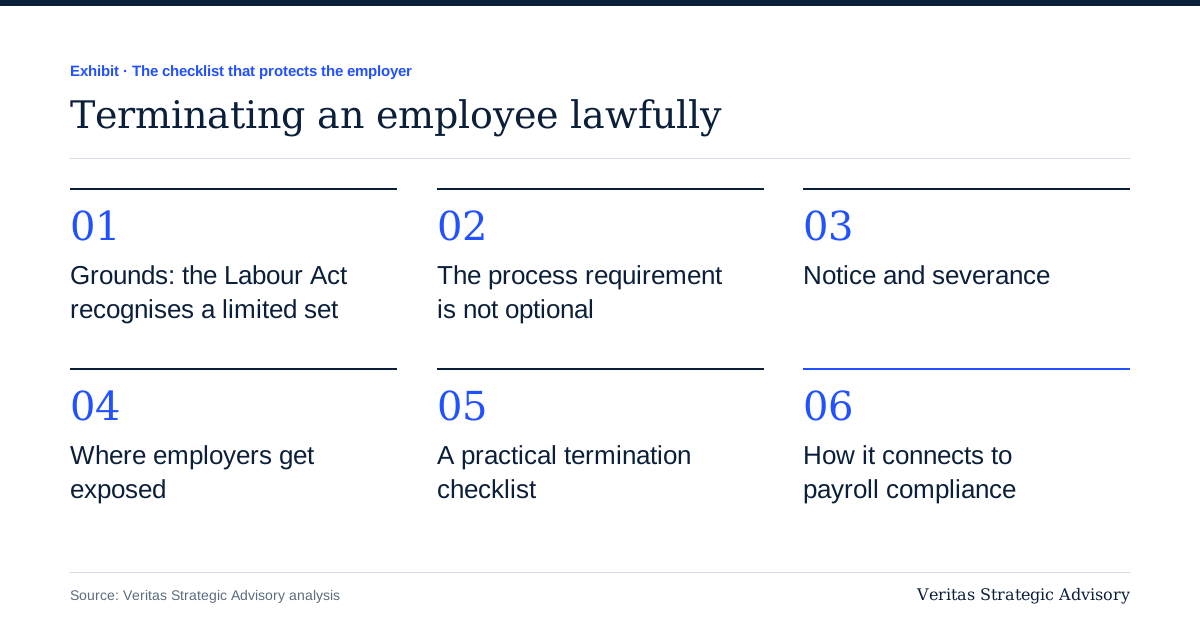
Grounds for Termination
The Labor Act recognizes a limited set of lawful grounds: misconduct (as defined and evidenced through a proper process, not merely alleged), incapacity or poor performance (again requiring a documented process, not a single incident), redundancy arising from genuine operational or economic need, and completion of a fixed-term or project-based contract where the contract itself defines the end point. Termination outside these grounds, or without following the required process for the ground being relied on, exposes the employer to a wrongful-termination claim regardless of how the decision is documented internally.
The Process Requirement Is Not Optional
For misconduct-based termination specifically, the Act requires a defined disciplinary process before termination is lawful: a written notice of the alleged misconduct, a genuine opportunity for the employee to respond, and a documented decision. Skipping straight to termination — even for misconduct that seems obvious to the employer — is itself a procedural violation that can make an otherwise justified termination unlawful on process grounds alone.
Notice and Severance
Notice period: generally one month's written notice, or payment in lieu, for permanent employees terminated other than for proven misconduct.
Severance/gratuity: accrued gratuity (broadly, one month's salary per year of completed service, where the employee is not covered under the Social Security Fund) is payable regardless of the reason for termination, provided the employee has completed the qualifying service period.
Final settlement: outstanding salary, accrued and unused leave encashment, and any other contractual dues must be settled at termination — final settlement disputes are among the most common sources of post-termination claims, usually because the calculation is disputed rather than the termination itself.
Redundancy-specific obligations: genuine redundancy carries its own compensation requirements on top of standard severance, reflecting that the employee is losing employment through no fault of their own.
Where Employers Get Exposed
Treating probation as unrestricted at-will employment. Probationary employees have fewer protections than confirmed staff, but "fewer" is not "none" — process and documentation still matter.
Undocumented performance management. A termination for poor performance with no prior written warnings, improvement plan, or documented conversations is difficult to defend if challenged, however genuine the underlying performance issue was.
Miscalculating final settlement. Gratuity, leave encashment, and Social Security Fund or provident fund reconciliation each have their own rules; an underpaid final settlement can itself become the basis of a claim even where the termination decision was entirely lawful.
Redundancy used to disguise a targeted termination. Where a "redundancy" affects only one employee and the role is refilled shortly after, the stated ground rarely survives scrutiny if challenged.
A Practical Termination Checklist
Confirm which ground applies and whether the required process for that ground has actually been followed, not just decided upon.
Issue the required written notice, or calculate payment in lieu correctly.
Calculate final settlement in full — salary, leave encashment, gratuity or SSF-linked dues, and any other contractual entitlements.
Document the entire process in writing, including any warnings, responses received, and the final decision.
Complete SSF or provident fund reconciliation and issue any required employment or experience certificate.
Retain the full documentation trail — the strength of an employer's position in a dispute is almost always determined by what was documented at the time, not what is reconstructed afterward.
How this connects to payroll compliance
Termination is one point in a compliance chain that runs throughout employment. Employers that keep payroll records in good order throughout the relationship -- salary sheets, TDS calculations, SSF contribution records -- are in a much stronger position when final settlement is disputed. See our guide to schools and colleges finance and payroll compliance for how these obligations layer together in practice, and our article on TDS on salary and the 25th-month deadline for the withholding rules that continue through to the last salary payment.
Frequently asked
What are the lawful grounds for terminating a permanent employee?
The Labor Act 2074 recognises misconduct, incapacity or poor performance, genuine redundancy, and expiry of a fixed-term or project contract. Termination outside these grounds, or without following the required process for the stated ground, is unlawful.
Is a one-month notice period always required?
Generally yes, for permanent employees terminated other than for proven misconduct. Payment in lieu of notice is an alternative but does not substitute for the correct ground and process.
What is gratuity and when is it payable?
Gratuity is broadly one month's salary per completed year of qualifying service, payable at termination to employees not covered by the Social Security Fund. It is payable regardless of the reason for termination, provided the service threshold is met.
Can an employer terminate a staff member during probation without documentation?
No. Probationary employees have reduced protections, not zero protections. A termination during probation still requires documented grounds and is subject to written notice requirements.
How long should termination records be kept?
At least five years is recommended. The documentation trail -- warnings, responses, final decision, settlement calculation -- is the primary evidence if a claim is made.
How Veritas Can Help
Our payroll and compliance practice calculates final settlements correctly the first time -- gratuity, leave encashment, SSF/PF reconciliation, and notice-pay -- and can review termination documentation before it goes to the employee, which is considerably cheaper than defending a claim after the fact. See our Payroll Compliance Tool for running the numbers, or talk to our team about a specific termination.
*General information only, not advice.*