- on tuition under Schedule 1 VAT Act 2052
- VAT 0%
- annual interest on late TDS
- Set by Act
- Nepali month TDS deadline
- 25th
- minimum payroll record retention
- 5 yrs
Schools and colleges in Nepal often arrive at their financial adviser with the same cluster of problems: a surplus that looks healthy on paper but produces no cash, a TDS arrear that has been accruing interest for two or three years, a VAT registration they neither needed nor wanted but obtained by mistake, and governance documents written for a charitable trust that now operates more like a commercial business.
Each of these problems has a specific cause. None of them is unusual. And each one is significantly less expensive to address before an IRD notice arrives than after.
Is your school actually VAT-registered and should it be?
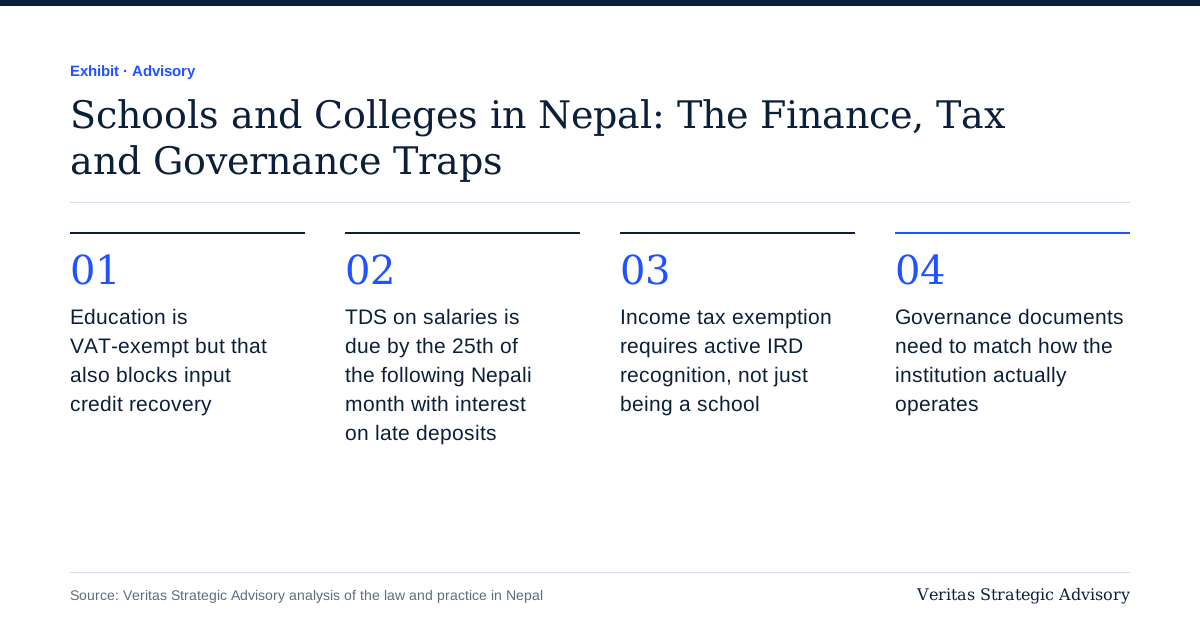
Education services are listed as exempt under Schedule 1 of the Value Added Tax Act, 2052. The exemption applies to tuition and the standard activities of a registered educational institution. A school or college whose income is entirely from education does not need to register for VAT and, if not registered, has no VAT filing obligation.
The catch is the other side of the equation. Under the VAT Act, a supplier of exempt services cannot claim input credit on purchases. This means that every purchase your school makes that carries VAT -- construction materials for a new building, computers, laboratory equipment, buses, printing and stationery, electricity for larger commercial connections -- bears a 13 percent cost that you cannot recover. That stranded VAT becomes a permanent overhead embedded in every capital project and in ongoing operating costs.
Salary TDS: the most common source of IRD problems
Schools and colleges are typically one of the larger employers in their locality and often have payroll in the tens of millions of rupees per year. Every employer is a withholding agent under the Income Tax Act, 2058. This means you must:
Calculate the annual estimated taxable salary for each staff member at the start of the tax year.
Divide that figure by 12 to determine the monthly withholding amount.
Deduct that amount from each salary payment.
Deposit the withheld tax with the IRD and file the e-TDS return by the 25th day of the following Nepali month.
The 25th of the following month is a hard deadline. A deposit made on the 26th is already late, and the Income Tax Act charges interest on the outstanding amount from the due date. Confirm the current rate in the Act, as it is set by statute and revised. Over two or three years of accumulated shortfall -- common when a finance team has been filing but depositing less than required -- that interest can materially exceed the original shortfall itself.
The practical traps in school payroll are specific:
Bonus and festival allowances. A Dashain bonus paid in Ashwin or Kartik is a one-time payment that changes the projected annual taxable income and therefore the monthly TDS calculation for all remaining months. Many schools treat the bonus as a standalone payment and forget to recalculate the withholding schedule for the rest of the year.
SSF contributions. Employers are required to register with the Social Security Fund and make contributions for each staff member. Register as soon as you take on employees, and confirm the current enrolment time limit with the Fund. The SSF contribution is calculated on a prescribed base and is due within 25 days of month-end (extended from 15 days by a 2025 amendment), separately from the salary payment. Failing to comply now draws attention at business renewal and annual compliance time.
Mid-year salary revisions. When a teacher is promoted or given a scale increment, the revised basic triggers a recalculation of the full-year projected taxable income. The new monthly TDS figure applies from the month of the revision, and the prior months' TDS is not adjusted retrospectively.
Income tax: exemption is earned, not assumed
Many schools assume that being an educational institution means being exempt from income tax. This is only partially true, and the conditions matter.
Under Section 2(s) of the Income Tax Act, 2058, the definition of an "organization entitled to enjoy exemption" includes certain types of non-profit and social entities. An educational institution that meets the relevant criteria and has obtained formal recognition from the IRD can qualify for an exemption on income it applies toward its educational purpose.
The critical point is that exemption requires active recognition. An institution that has never applied, or whose recognition certificate has lapsed, is not exempt. If you are operating as a private company (a private limited or public limited company) rather than a trust or foundation, the situation is even more complicated: a company does not automatically qualify for the same exemption pathway, and the income it earns from tuition fees is ordinarily treated as business income subject to income tax.
A practical example. Consider a private boarding school in Kathmandu registered as a private limited company. It collects NPR 8 crore in fees, pays NPR 6 crore in salaries, utilities and maintenance, and ends the year with a NPR 2 crore surplus. If the company has not obtained an income tax exemption and there is no qualifying status that removes the surplus from taxable income, that NPR 2 crore is ordinary business income subject to income tax at the applicable rate. Many owners are genuinely unaware of this until an amended assessment arrives.
Governance: the informal trust problem
A substantial share of schools and colleges in Nepal were originally established by a founder or a founding family and operate under a board that includes family members in a majority. Over time, as the institution grows, this informal governance structure creates specific problems:
Related-party transactions. When the founder's family owns the building and leases it to the school at above-market rates, or when a family member is on the payroll in a senior administrative role without a market rate justification, these transactions are potential grounds for adjustment in an amended assessment. The IRD has broad powers to recharacterise transactions that are not at arm's length.
Charitable trust vs. commercial operation. If the institution was registered as a charitable educational trust (under the Trust Act, 2044, or as a foundation), its deed typically restricts distributions to founders or members. When that same institution generates a comfortable surplus and the founder draws compensation beyond what the deed permits, the trust's exempt status is at risk.
Annual compliance. A school registered as a company has annual Company Act filing obligations: audited financial statements submitted to the Office of the Company Registrar, an AGM, and director disclosure requirements. Many institutions that started as trusts converted to companies for operational reasons and then fell behind on company compliance because they still thought of themselves as a school, not as a registered company.
What an annual bookkeeping and compliance schedule looks like
A school or college that takes compliance seriously runs on a defined calendar across the Nepali fiscal year (Shrawan to Ashadh):
| Period | Obligation |
|---|---|
| By 25th of each Nepali month | Salary TDS deposit and e-TDS return |
| Within 25 days of month-end | SSF contributions |
| End of Ashwin (mid-October) | Annual income tax return for salaried staff |
| Within 3 months of year-end | Audit of accounts (if required) |
| Within 6 months of year-end | Audited financials to Company Registrar (if a company) |
| Annually | PAN renewal confirmation, professional tax |
Getting this calendar into a proper system -- rather than relying on the finance staff to remember -- is the first practical step. A missed TDS month discovered six months later costs more in interest than the original oversight.
The cash flow issue that most schools overlook
Fee income in a school arrives in two or three large tranches: at admission, at the start of each term, and sometimes at year-end. Salary and other operating costs accrue every month. This timing mismatch creates predictable cash pressure in the months between fee collections, particularly in the months leading up to Dashain.
The error most institutions make is treating the high-collection months as surplus rather than reserving for the following months' obligations. A cash flow plan that maps expected collections against committed outflows -- including TDS and SSF liabilities, which are monthly obligations that do not pause between terms -- is a basic management tool that is still absent in a significant share of schools.
Links to related reading
The full withholding schedule, including the rates that apply to the suppliers a school pays outside payroll, is in our TDS rate table for FY 2083/84. If you are reviewing broader tax compliance obligations, our article on TDS withholding on payments to foreign vendors covers withholding obligations that apply if your school or college makes any payments to foreign curriculum providers, software vendors, or consultants. For the mechanics of handling an IRD assessment letter if one arrives, see your company received a tax notice: what to do first.
Frequently asked
Does a school need to register for VAT?
Not if its income is entirely from education services, which are exempt under Schedule 1 of the VAT Act 2052. Registration is required only if the school also makes taxable supplies above the threshold, or voluntarily chooses to register.
Can a school claim back the VAT it pays on purchases?
No. Suppliers of exempt services cannot claim input VAT credit. The VAT on construction, equipment and supplies is a direct cost.
When must salary TDS be deposited?
By the 25th day of the following Nepali month. Late deposits attract interest under the Income Tax Act.
Is a school automatically exempt from income tax?
No. Exemption under Section 2(s) of the Income Tax Act 2058 requires the institution to meet the qualifying conditions and obtain recognition from the IRD. A private limited company operating a school is not automatically exempt.
How long do payroll records need to be kept?
At least five years. These include salary sheets, TDS calculation worksheets, bank payment receipts and e-TDS return acknowledgements.
---
Veritas supports schools and colleges with bookkeeping, payroll and TDS compliance, annual reporting, and tax positioning. See our bookkeeping and accounting services for how this works in practice.
*General information only, not advice.*