

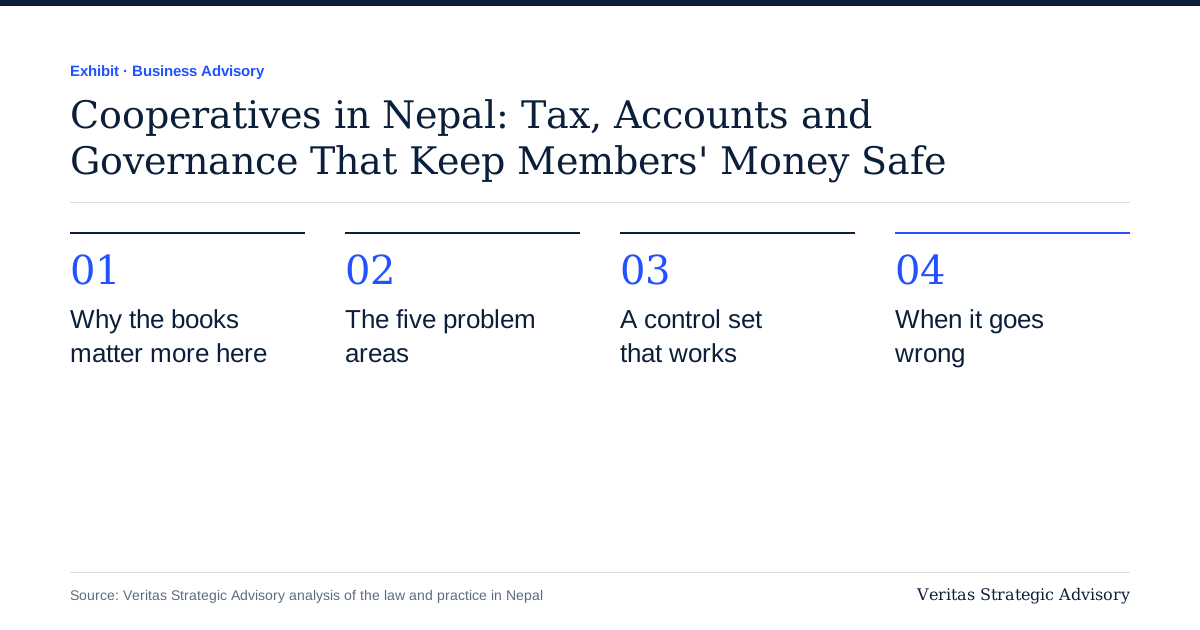
- risk areas
- 4
- ledger that ties to members
- 1
- audiences: members, regulator, tax office
- 3
Why the books matter more here
A cooperative's liabilities are members' savings. Its assets are mostly loans to members. If the loan book is overstated or the interest accrued is not collectible, the profit is not real and the deposits are at risk. Members are owners and depositors at the same time, which makes honest reporting both a legal and an ethical duty.
The five problem areas
1. Loan classification and provisioning. Loans overdue by set periods must be classified and provided for. Rolling over loans to hide delinquency is the commonest red flag.
2. Interest accrual. Accruing interest on loans that will not pay it inflates profit and the dividend or bonus declared.
3. Member records. Each member's deposits, loans and interest need to reconcile to the general ledger. Without this, balances cannot be defended in a dispute.
4. Tax. Income tax rates differ by cooperative type and area, and recent budget changes have increased them; confirm the current schedule. TDS applies to interest and fees the cooperative pays, and to its own income in cases; see TDS rates.
5. Audit and governance. The annual audit, the audit committee and the board's oversight must be real. Related-party loans and insider concentrations need board-level disclosure.
A control set that works
Monthly reconciliation of the member ledger to the general ledger.
Quarterly loan ageing with a documented provision.
Approval limits and a loan committee with minutes.
Independent review of the largest 20 loans.
A tax calendar for TDS, returns and advance tax.
A member report that shows the real position: deposits, loans, arrears and reserves.
When it goes wrong
Regulators and the courts have acted on cooperatives where deposits could not be matched to assets. The cost to the board in time, reputation and personal exposure is high. A cooperative that can show clean reconciliations, honest provisioning and a clear tax position is far safer.
We support cooperatives with accounting clean-up, loan-book reviews, tax compliance and pre-audit preparation; see bookkeeping, internal audit and audit support. The Cooperative Act and its rates have changed recently, so check the current text.
A worked example: reading a cooperative's loan book
A savings and credit cooperative has 4,000 members, NPR 80 crore in member deposits and NPR 72 crore in loans. It reports a profit of NPR 3 crore and proposes to pay a 10% dividend on share capital of NPR 8 crore. Illustrative.
A review of the loan book finds the following.
| Loan status | Outstanding (NPR crore) | Policy provision |
|---|---|---|
| Performing | 58 | 1% |
| Overdue up to 90 days | 6 | 5% |
| Overdue 90 days to 1 year | 4 | 25% |
| Overdue over 1 year | 4 | 100% |
Provision needed: NPR 0.58 crore plus 0.30 crore plus 1.00 crore plus 4.00 crore, which is NPR 5.88 crore. If the cooperative has provided only NPR 1.5 crore, the real result is a loss of NPR 1.38 crore, not a profit of NPR 3 crore. The proposed dividend would then be paid out of members' own deposits.
The example shows why provisioning is the most important control in a lending cooperative. The percentages are illustrative, and the actual classification and provisioning rules come from the Cooperative Act and the regulator's directives, so check the current ones.
A second red flag: the cooperative has renewed several overdue loans for another term without payment, so they appear as performing. A review of the renewals, matched against the borrowers' payment history, can reveal this. The result is to reclassify the loans, increase provisions and, where needed, pause the dividend.
Controls that protect members' money
1. Credit policy and approval. A written policy on who may borrow, the limits per member and for related parties, the security required and the approval levels. Loans to board members and relatives are approved by someone independent and disclosed.
2. Documentation. Each loan file has an application, an assessment of repayment capacity, security documents, a valuation, the sanction and the disbursement record.
3. Monitoring. A monthly ageing report, with calls and visits to borrowers who miss payments, and a record of each follow-up.
4. Provisioning. Automatic computation by policy, reviewed by the audit committee, with no manual override without approval.
5. Liquidity. A minimum percentage of deposits held in liquid form, and a forecast of withdrawals. A cooperative that lends out almost all deposits cannot meet a rush of withdrawals.
6. Interest rates. Deposit and loan rates set with a margin that covers costs and risk, and reviewed against the market.
7. Segregation of duties. The person who approves a loan is not the one who disburses it, records it or reconciles the ledger.
8. Internal audit and the audit committee. Independent review of the books and the loan book, with findings reported to the board and followed through.
9. Member communication. An annual report that shows deposits, loans, arrears, provisions and the surplus honestly, and a general meeting where members can question the board.
Tax calendar for a cooperative
| Item | Typical timing |
|---|---|
| TDS on interest, fees, rent and other payments | Monthly, deposited and reported by the due date |
| Employee payroll tax and SSF | Monthly |
| VAT, if registered for taxable activities | Monthly |
| Advance tax | In instalments if required |
| Annual income tax return | By the due date for the year |
| Annual general meeting and audit | As the Act and the by-laws require |
Rates and eligibility for the cooperative sector have changed in recent budgets, so confirm the figures for the current year, and keep the calendar up to date; see the tax calendar and corporate tax rates.
Mistakes we see
Paying dividends or bonus from profits that include uncollected interest.
Letting borrowers who are members of the board delay payments without consequence.
Keeping members' ledgers on spreadsheets without controls.
Not reconciling the sub-ledger of loans to the general ledger.
Failing to deduct tax at source on interest and fees paid.
Treating the annual audit as a formality instead of an opportunity to find problems.
Lending to a small number of large borrowers or to a single sector.
Starting new products without assessing risk and liquidity.
Questions people ask
Who regulates cooperatives? The Cooperative Act and the bodies it creates, with directives on classification, provisioning and governance. The regulatory landscape has been changing, so check the current authority and rules.
Is a cooperative audit different from a company audit? The audit follows the Act and the standards for the sector, with particular attention to the loan book, deposits and compliance with the by-laws.
Can a cooperative convert to another form? Some conversions are possible under conditions. Take legal and tax advice before you consider it.
What should a member ask? How much of the loan book is overdue, how much is provided for, who the largest borrowers are, how much is lent to board members and what the liquidity position is.
How can a board show good governance? By meeting regularly, keeping minutes, approving policies, reviewing independent reports and acting on findings.
We support cooperatives with accounting clean-up, loan-book reviews, tax compliance and pre-audit preparation; see bookkeeping, internal audit and audit support. The Act and its directives change, so confirm the current rules with the regulator.
What a good annual report to members contains
Members deserve to understand how their cooperative is doing. An honest annual report is the best defence against rumours and the best way to build confidence. It should include the following.
1. Key figures with comparatives. Total deposits, loans, share capital, reserves, surplus and the number of members, for the year and the previous two years.
2. Loan book quality. The share of loans that are performing, overdue by period and written off, and the provisions held. Say plainly how this compares with last year.
3. Liquidity. Cash and liquid investments as a percentage of deposits, and the policy minimum.
4. Concentration. The share of loans to the largest ten borrowers, and loans to board members and their families, with total amounts.
5. Income and cost analysis. Interest income, interest expense, operating cost and the margin, so that members see where the surplus comes from.
6. Dividend and rebate proposal. The amount proposed and the basis, with a statement that the surplus is after full provisioning.
7. Compliance statement. Taxes deducted and deposited, returns filed, audit completed and any regulator's directions.
8. Risks and plans. The main risks in the coming year and what the board intends to do.
A cooperative that publishes this, and answers questions at the general meeting, will find that members trust it more.
Early warning signs for members and boards
Deposits growing very fast, with high interest rates compared to peers.
Loans growing faster than deposits, funded by borrowing.
A rising share of loans being renewed or rescheduled.
A few large loans to related parties.
Delays in paying withdrawals or interest.
Resistance to audits, to showing the loan ledger or to answering questions.
Frequent changes in management or auditors.
Reported profit that does not match cash.
Any one of these needs attention, and several together need urgent action by the board and, where necessary, the regulator. See also restructuring a loss-making company for the steps if a cooperative's position has weakened.


