- types of PAN
- 3
- digits in a PAN
- 9
- government fee
- 0
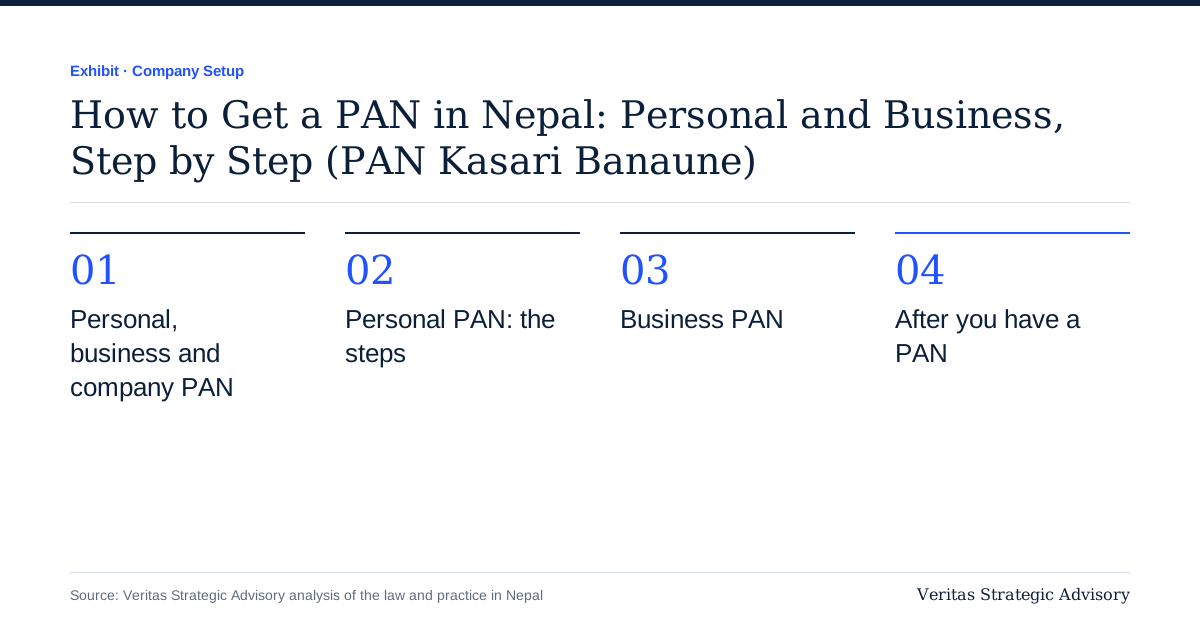
Personal, business and company PAN
| Type | For | Where |
|---|---|---|
| Personal PAN | Employees, freelancers, landlords, individual investors | IRD portal and tax office |
| Business PAN | Sole proprietorship or partnership firm | IRD portal after firm registration |
| Company PAN | Private or public limited company | Issued with OCR registration |
A person has one personal PAN for life. A business PAN is separate and is closed when the business closes.
Personal PAN: the steps
On the IRD taxpayer portal, choose Registration for PAN and then Personal.
Fill in your name, citizenship number, address and contact details. Save the submission number.
Upload or bring your citizenship certificate and a passport-size photo. Foreigners use a passport and visa.
Complete verification at the tax office for your area, or online where the portal allows it.
Receive your PAN card or number. Give it to your employer and bank.
There is no government fee for a PAN.
Business PAN
Register the firm first: with the Department of Commerce, Supplies and Consumer Protection, the cottage industry office, or the local ward, depending on the business. Then apply on the portal under Business, with the firm registration certificate, the owner's citizenship, the rental agreement for the premises, and a photo of the signboard where asked. Decide at the same time whether to register for VAT; see VAT registration in Nepal.
After you have a PAN
File a return every year, including a nil return, or penalties build up.
Cancel a business PAN formally when you stop trading. An unused PAN keeps generating defaults.
Keep your portal login safe. It is used for returns, the tax clearance certificate and the tax calendar deadlines.
PAN kasari banaune: in short
IRD ko taxpayer portal ma gayera "Registration for PAN" ma personal wa business chhannus. Nagarikta, photo ra thegana rakhnus, submission number saw garnus, ani karyalaya wa portal bata verify garaunus. PAN banauna sarkari shulka lagdaina. Company ko PAN chai OCR ma darta hunda nai aaunchha.
If you are starting a business, see company registration in Nepal.
Which PAN do you actually need? Four common situations
You are an employee. Your employer deducts tax from your salary and needs your PAN to report it. A personal PAN is enough. You do not need a business PAN or VAT registration merely because you are employed.
You earn from freelancing or consulting. A personal PAN is the starting point. Foreign-currency income received through a bank may qualify for the flat rate described in our note on freelancer tax. Registering a business later is possible, but start with the personal PAN so income is on record.
You are opening a shop or a service business. Register the firm first, then apply for a business PAN. Decide at the same time whether to register for VAT; see VAT registration in Nepal. Registering for VAT when you are not required to means monthly returns and invoices that follow VAT rules.
You are forming a company. The Company Registrar issues the PAN with the registration. See company registration in Nepal for the full sequence. Your personal PAN remains separate and is used for your own income, such as salary or dividends.
What the first year after getting a PAN looks like
Month one: give the number to your employer, bank and clients. Make sure the name and address on the portal match your citizenship certificate, because mismatches cause trouble later when you ask for tax clearance.
During the year: keep every invoice and receipt. Expenses are accepted only where the bill carries a valid PAN or VAT number in the right name.
At year end: file the return, even where tax was fully deducted at source and even if there is no income. A missing return is the most common reason a clearance certificate is refused; see tax clearance in Nepal.
If you stop earning or close the business: cancel the business PAN formally instead of letting it sit. Dormant PANs with missed filings build up fees and interest.
Questions people ask
Is there a fee to get a PAN? No government fee applies. Be careful of agents who charge for a service that you can do yourself on the portal, although some people prefer help with verification.
Can one person hold more than one PAN? A person has one personal PAN. A business PAN is a separate registration for the business, and a company has its own.
What if I lose my PAN card or forget the number? The number can be recovered from the portal or from the tax office with your identity documents. The card itself is a convenience; the number is what matters.
Do I need a PAN to open a bank account or buy property? Banks commonly ask for a PAN for transactions above set limits, and a PAN is generally needed when registering property or taking a loan. Check the limits your bank applies.
Do foreigners working in Nepal need a PAN? Yes, if they earn income in Nepal. Registration uses a passport and a visa instead of a citizenship certificate.
How long does it take? Online submission is quick. Verification depends on the tax office, and delays are usually caused by documents that do not match or addresses that cannot be verified.
Before you submit: a short checklist
Name spelled exactly as in your citizenship certificate or passport.
A mobile number and email that you check regularly, since the portal sends verification messages there.
A clear scan of the certificate and a recent photo.
The address you can prove, with a rental agreement or local ward letter where the form asks for one.
A plan for the next step: VAT, a bank account in the business name, and a bookkeeping routine from the first sale.
If you want help with the registration, the first-year routine and bookkeeping that keeps the PAN in good standing, see our tax services and bookkeeping. Portal screens and requirements change, so confirm the current steps on the IRD site.
Why PAN applications get stuck, and how to avoid it
Most delays are not the IRD's fault. They come from small mismatches that a verifying officer cannot resolve from the file.
Name differences. The name on the citizenship certificate, the bank account and the application differ by a spelling, a middle name or the order of names. Decide which version is correct, and use it everywhere. If your documents already disagree, correct the weakest record first.
Unverifiable address. The address entered cannot be confirmed with a document. Use the permanent address on your citizenship certificate, or attach a rental agreement or ward recommendation for the current address if the form asks for it.
A business address that is a home or shared space. Offices can ask for a rental agreement, a photo of the signboard and sometimes a visit. Have the lease signed in the business's or owner's name and keep it current.
Wrong registration type. An individual who is really running a business applies as a personal taxpayer, or a firm that has not completed its own registration tries to get a business PAN. Complete the firm registration first.
Old or duplicate PAN. If you have held a PAN before, and it was closed or lapsed, applying for a new one creates a duplicate problem. Ask the tax office to reactivate or correct the old record.
Contact details no longer used. Verification messages and queries go to the mobile number and email on the application. A number that is switched off can stall a case for weeks.
A useful habit is to keep a single folder, paper and digital, with the citizenship certificate, the PAN certificate, the firm or company registration, the lease and the latest returns. Banks, tender committees and the Registrar all ask for the same documents at different times, and having them together saves days.
PAN and VAT: when you need both
A PAN identifies you as a taxpayer. VAT registration is a separate step that allows you to charge VAT and claim input credit. The two are often confused, and getting it wrong costs money in both directions.
A PAN without VAT is right for a small business below the VAT threshold, for professionals who are not required to register, and for salaried people. You pay income tax but do not charge VAT, and you cannot claim VAT on your purchases.
A PAN with VAT is required when turnover passes the threshold for your type of business, and optional below it. Registering voluntarily lets you claim input credit and appear as a VAT-registered supplier to larger customers, but it also means monthly returns, invoices in the prescribed form and the possibility of a VAT audit. Read VAT registration in Nepal and our comparison of voluntary VAT registration before deciding.
Choosing too late. If you pass the threshold and do not register, you owe VAT on the sales since that date with penalties. Track turnover monthly.
Where your clients are VAT-registered businesses, they may prefer suppliers who are also registered, since they can claim input credit on what you charge. That is a commercial reason to register even when the law does not force you to.
Keeping a PAN in good standing: a yearly rhythm
A PAN is easy to get and easy to damage by neglect. A simple annual routine keeps it healthy:
Shrawan: confirm the portal profile is current: address, contact details, business activity and registration status.
Every month: file VAT and TDS returns if applicable, even with nil activity, and deposit tax by the due date. See the tax calendar.
Poush and Chaitra: if you pay advance tax, make the instalments; see advance tax instalments.
Ashoj to Poush: file the annual income tax return; see filing your income tax return.
Whenever something changes: a new address, a new partner, a new activity or a closure. Tell the tax office and update the Registrar if the entity is registered there.
When you stop: file the final returns, pay what is due and apply to cancel the PAN or VAT registration in the prescribed way.
A neglected PAN does not simply sit quietly. Late filing fees accumulate, tax clearance becomes unavailable and, in time, the taxpayer can be listed as a non-filer. That affects banking, tenders, foreign remittances and property transactions. If you inherit a PAN with a history of missed filings, find out what is owed before you build on it, and look at whether an amnesty window can reduce the cost of catching up.
Special cases people ask about
Students and homemakers earning small amounts. A PAN is needed if you earn taxable income that requires reporting, or if your bank, a platform or a client asks for it. It is not required simply to exist as a person.
Landlords. Rental income is taxable, and a tenant that is a business deducts tax at source. A personal PAN is the basis of reporting.
Non-resident Nepalis and foreigners. If you earn income in Nepal, you need a PAN. A passport and visa are used for identification. The tax treatment depends on residence.
Partnerships and joint ventures. The firm has its own registration and PAN. Partners keep their personal PANs for their own income and shares of profit.
Agents and intermediaries. Anyone you pay needs to provide a PAN or the payment may be treated as non-deductible or subject to a higher rate of TDS; see TDS rates.