- inputs that decide the price
- 3
- agreement to read first
- 1
- transaction covering every term
- 1
Start with the shareholders agreement
Before any number is discussed, read the shareholders agreement and the articles. They decide who may buy, at what price, in what order, and what happens if the parties disagree. Many disputes are fought over a valuation the agreement already settles.
Look for a pre-emption clause, which gives remaining shareholders the first right to buy. Look for a valuation mechanism: a formula, an independent valuer, or an agreed method. Look for good leaver and bad leaver provisions, which price the shares differently depending on why someone leaves. Look for drag-along and tag-along rights if a sale of the whole company is ever considered.
If the agreement is silent, the outcome depends on general law and negotiation. Silence weakens both sides, so resolve it early.
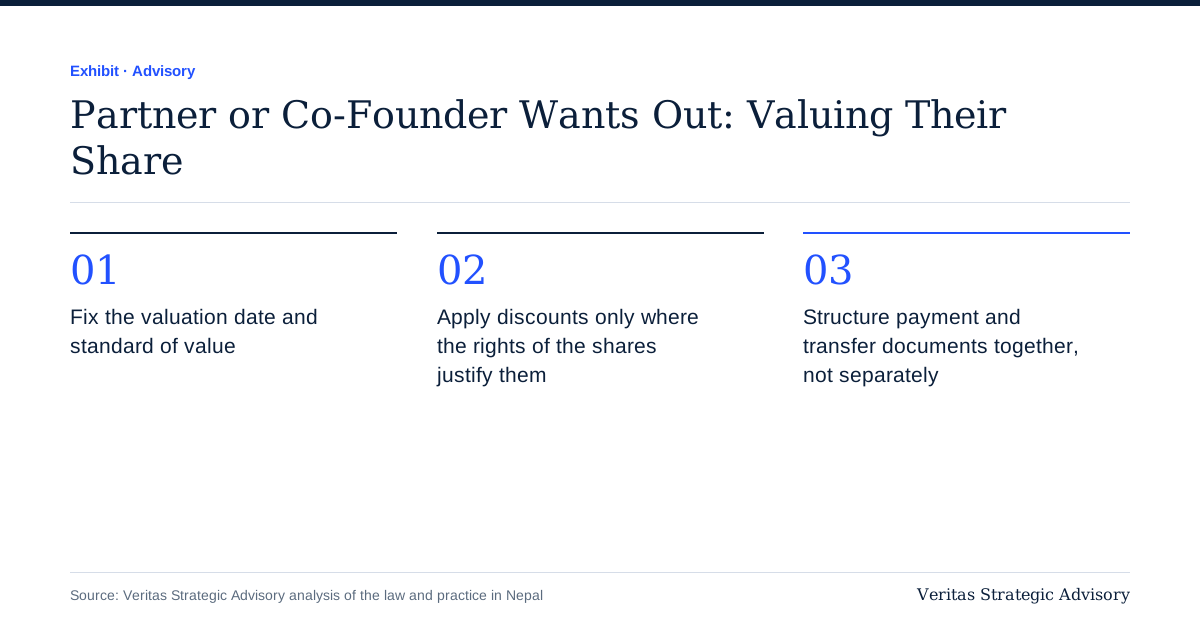
Fix the valuation date and standard
Two decisions shape the number more than any formula. The first is the valuation date: as of the date notice was given, or as set by the agreement. Values move, and the date changes the answer.
The second is the standard of value. Fair market value assumes a hypothetical buyer and seller. Fair value under the accounting framework is a measure applied to the financial statements. Be clear which applies before you calculate.
Value the business, then the shares
Use the methods set out in how to value a private company in Nepal: income, market and asset approaches, triangulated and normalised. Normalise the owner's remuneration, related-party transactions and one-off items first. A partner drawing an inflated salary through the business should see that adjusted, and the adjustment affects both sides.
Once enterprise value is set, deduct net debt to reach equity value. Then calculate the partner's share of that value.
Apply discounts only where the shares justify them
A minority holding is often worth less per share than a controlling one, because it has no control over decisions. Illiquidity can reduce value too, since private shares are hard to sell. These effects are real, but they are not automatic. The size of any discount must rest on the rights attached to the shares.
List the rights: board seats, vetoes, information rights, dividend entitlements. Shares with fewer rights justify a larger discount. Shares with strong protections may justify a smaller one. A discount applied at a round number, without reasoning, is easy to challenge.
Structure the exit as one transaction
Put the price, payment schedule, share transfer, release of guarantees, non-compete and non-solicit terms, and confidentiality into a single agreement. Partial documents leave gaps that surface later.
A buyout paid over time shifts risk to the seller, who depends on the company continuing to pay. Security, such as a charge over shares or assets, reduces that risk. Where the company funds the buyout, check its ability to pay and the legal limits on share buybacks and capital reduction under the Companies Act.
Remove the departing partner's personal guarantees to banks and suppliers at completion, not later. A departed partner still exposed to company debt is a common source of dispute.
Protect the business during the exit
A visible dispute harms customers, staff and lenders. Agree who speaks to customers and banks. Keep operations running and the books clean, since the valuation may be reviewed by the other side.
If negotiation stalls, the agreement's dispute clause applies. Mediation is usually faster and cheaper than litigation, and many disputes settle once the numbers are laid out clearly.
When the valuation is contested
Get an independent view if the parties disagree materially. A jointly appointed valuer, or one each side appoints with a mechanism for a third party to resolve the gap, keeps the process credible. Record the method, inputs and result in writing.
Our business valuation service prepares a defensible valuation on a stated basis for partner and shareholder exits. Related: what determines a company's valuation and founder and investor equity structuring.
Why the valuation disagreement usually starts with the agreement
Partner disputes rarely begin with the number. They begin with an expectation: one side believes the agreement gives a particular price, the other believes it gives a different one, and neither has read the clause carefully enough to know. The disagreement then grows around the valuation, when the real issue is the mechanism.
Start by mapping every provision that touches an exit. This includes the purpose clause, the transfer restrictions, the pre-emption and tag rights, the leaver provisions, the valuation and payment terms, the dispute resolution clause, and any non-compete or confidentiality obligations. Read them together, because provisions interact. A generous valuation clause can be limited by a payment term that defers most of the price for years.
The leaver provisions and why they matter so much
Leaver provisions set the price of a share depending on the reason for departure. A good leaver, typically someone who leaves through retirement, ill health or agreed exit, may receive full market value. A bad leaver, typically someone who leaves in breach of duty or to compete, may receive only the nominal value of their shares. Between these sits an intermediate category with a discount.
The definitions decide the outcome. Many disputes turn on whether a departure was voluntary, whether a breach occurred, or whether the leaver's conduct fell within a defined category. Before any negotiation, establish which category applies on the documents, and assemble the evidence that supports it. A partner who expects good leaver treatment but falls within the bad leaver definition will contest the position hard, so this classification is worth settling early.
Choosing the valuation method on principle
Once the basis is clear, the choice of method is a matter of principle, not preference. The income approach values the business by its expected future cash flows. The market approach values it by reference to comparable transactions or listed companies. The asset approach values it by net asset value, adjusted for the value of assets not shown in the accounts.
For a trading business with predictable earnings, the income approach is usually the most defensible, because it reflects what the business can actually generate. For a business whose value lies mainly in property or investments, the asset approach may be more appropriate. Where the methods diverge widely, the gap itself tells you something about the business, and the valuation report should explain why one method was preferred and what the others suggest.
Keep the method consistent with the standard of value. An income approach that assumes a control buyer will produce a different answer from one that assumes a minority seller. Mixing assumptions from different standards is one of the most common errors in partner disputes, and an opposing expert will exploit it.
Normalising the financials with the partner in mind
Normalisation is not a neutral exercise when a partner is leaving. The partner may have drawn an above-market salary, charged personal expenses to the business, or benefited from related-party arrangements. Those items affect the earnings the valuation is based on. Adjusting them is correct, but it must be applied to both sides consistently, and it must be explained in writing.
Expect the departing partner to ask for adjustments that increase value, such as the addition back of costs they consider one-off. Test each request against the same standard you apply to the business. A consistent standard is the strongest protection against the accusation that the valuation was built to a result.
Discounts, rights and the reasoning behind them
A minority discount reflects the lack of control. A marketability discount reflects the difficulty of selling a private share. Both are legitimate, and both can be large. They are also frequently challenged, so the reasoning must be specific.
Tie each discount to the rights attached to the shares. If the departing partner holds a board seat with veto rights, a smaller minority discount may be justified. If the shares carry strong information and dividend rights, the marketability discount may be smaller. If the agreement gives the other shareholders a right to buy at a pre-agreed price, that price may set a ceiling on the discount. Record the reasoning for each discount in the valuation report, so the discount can be defended line by line.
Structuring payment to protect both sides
The payment structure often matters as much as the price. A lump sum gives the departing partner certainty, but it may be difficult for the company or the remaining shareholders to fund. Deferred payment reduces the immediate burden, but it leaves the departing partner exposed to the company's future performance.
Common protections include a charge over the shares being sold, a guarantee from the remaining shareholders, an escrow account, or a step-down structure in which part of the price is paid on completion and the rest on defined milestones. Each protection has costs and legal requirements, so choose the one that fits the parties' real positions rather than copying a template.
Consider the tax position of both sides before settling the structure. The character of the payment, whether for shares, goodwill or other consideration, can affect the tax treatment, and an unexpected tax cost discovered after signing causes avoidable friction.
The documents that must match
An exit is complete only when the documents agree. The share transfer instrument must match the register. The board and shareholder resolutions must authorise the transaction and any buyback. The payment terms in the agreement must match the bank arrangements. The release of guarantees must be documented with each lender and supplier.
Check the company's register of members and register of directors after completion, and confirm that the departing partner is removed where required. A transfer that is agreed but not registered leaves the departed partner with rights they should not have, and that gap is a common cause of later disputes.
Keeping the business stable through the process
The period of negotiation is when the business is most vulnerable. Staff notice tension, customers hear rumours, and lenders become cautious. Agree in writing what will be said internally and externally, and keep operations on their normal footing. A stable business is worth more in the valuation, and a visible dispute can reduce the value the parties are arguing over.
Where the departing partner remains involved in any role during the transition, define that role, its duration and its end in writing. Ambiguous continuing roles produce arguments about authority, pay and exit that compound the original dispute.
When the parties cannot agree
Mediation is the most practical next step when direct negotiation stalls. A mediator helps the parties see the real differences, which are often narrower than the public positions suggest. Bring the valuation report, the normalisation schedule and the reasoning for each discount to the mediation, so the discussion focuses on evidence.
If mediation fails, the agreement's dispute resolution clause governs the next step. Litigation is slow and expensive, and its outcome is uncertain. The best protection is a valuation and a process that are defensible from the start, so that the dispute, if it comes, is decided on a clear record.
Frequently asked
Can the company buy back the partner's shares?
Often yes, but the Companies Act sets conditions on buybacks, including solvency and approval requirements. Check these before agreeing a structure that depends on the company paying.
Do I need a lawyer as well as an accountant?
Yes for the legal documents. The valuation settles the number; the lawyer makes it enforceable.
What if the partner will not sign?
Use the mechanisms in the agreement. If none apply, the matter moves to negotiation, mediation or the courts. A documented valuation makes each step shorter.