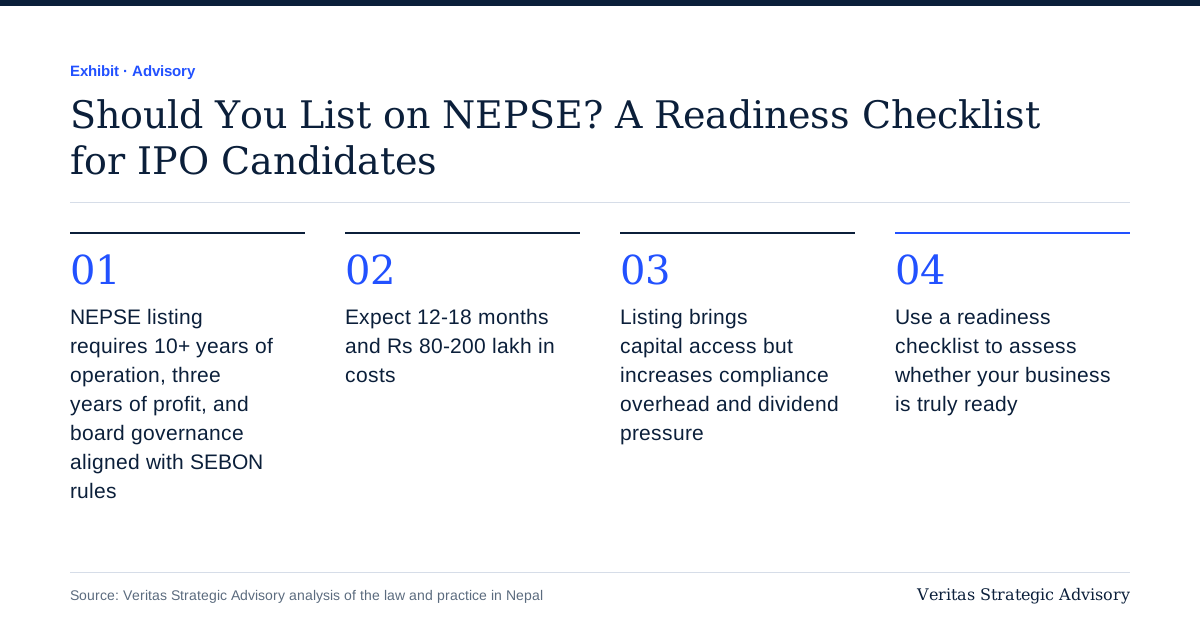

- Operating history required
- 10+ years
- Minimum paid-up capital
- Set by SEBON
- Typical listing timeline
- 12-18 months
- Typical listing cost range
- Rs 80-200 lakh
Why Companies Go Public
Listing on the Nepal Stock Exchange (NEPSE) is a major milestone. It gives you access to public capital markets, improves your brand visibility, and makes it easier for employees to benefit from company growth through employee share schemes. However, listing is not for every business. The decision hinges on whether you need significant capital, are prepared for public accountability, and can sustain profitable operations at the scale required.
Most Nepali companies use IPOs for three reasons: funding a major expansion or acquisition, providing an exit for early investors, or improving operational governance and credibility with banks and suppliers.
Core SEBON Requirements for IPO
The Securities Board of Nepal (SEBON) sets clear eligibility criteria. Your company must have:
Operating History and Size
Minimum 10 years of continuous operation (with some exceptions for greenfield projects in priority sectors)
Minimum paid-up capital: set by SEBON's Securities Registration and Issue Regulation, and materially higher than older guides suggest. Confirm the current figure with SEBON before relying on it.
After the IPO, at least 20% of shares held by the public (the "public shareholding" rule)
Financial Health
Three consecutive years of profit
Earnings per share (EPS) of at least Rs 2 in the financial year preceding the IPO
No accumulated losses (your retained earnings must be positive or zero)
Audited financial statements for the past three years, prepared in accordance with Nepal Financial Reporting Standards (NFRS)
Governance and Compliance
A Board of Directors with at least seven members (if you have fewer, you must expand before listing)
At least two independent directors
Compliance with SEBON's Corporate Governance Directive, 2080 (including board committees, audit committee, remuneration committee, and risk management framework)
A separate Chief Financial Officer (CFO) or equivalent role
Internal audit function and an internal audit report
Your auditor must be a firm registered with the Institute of Chartered Accountants of Nepal (ICAN) and not under any disciplinary action by SEBON or ICAN.
Financial Readiness: The Numbers
Beyond the headline requirements, prepare for SEBON's deeper scrutiny. Your financial statements are examined for:
Revenue Quality
Consistent or growing revenue trend (SEBON is alert to sudden jumps that lack explanation)
No single customer accounting for more than 20% of revenue (concentration risk)
Clear segregation of recurring and one-time income
Cost Structure
Sustainable gross and operating margins—nothing that looks like temporary cost-cutting before the IPO
Clear breakdown of fixed vs. variable costs
Depreciation and amortization that matches your asset base
Working Capital
Reasonable inventory and receivable days relative to your sector
No sudden changes in payment terms just before filing (SEBON sees this as a red flag for manipulation)
Tax Compliance
All personal income tax (PIT) withheld and paid to the IRD
VAT filing and payments current (no arrears)
Tax audit clearance certificate from the IRD if you have been assessed
Late tax payments, even if settled later, will raise questions during SEBON due diligence and may delay your IPO timeline.
The IPO Timeline and Process
From decision to listing typically takes 12 to 18 months:
| Stage | Timeline | Focus |
|---|---|---|
| Pre-filing | Months 1-2 | Hire merchant banker (IPO advisor), auditor, legal counsel; audit last 3 years |
| SEBON Application | Months 2-4 | Submit prospectus, SEBON issues observation letter with conditions |
| Remediation | Months 4-6 | Meet SEBON observations (governance changes, financial clarifications) |
| Underwriting | Months 6-8 | Merchant banker finalizes prospectus; pricing set; underwriter appointed |
| Public Offering | Months 8-10 | Application period opens; public applies for shares; allotment |
| Listing | Months 10-12+ | Share transfer to investors; trading commences on NEPSE |
Delays happen. Common reasons include incomplete financial disclosures, governance gaps, or a delay in SEBON's observation letter during high-volume periods. Build in a 3-6 month buffer.
Cost of Going Public
Plan for significant out-of-pocket costs:
Merchant banker fee: Rs 30-80 lakh (percentage of capital raised or fixed, depending on size)
Underwriter fee: Rs 5-15 lakh
Legal and regulatory: Rs 10-20 lakh
Auditor (special IPO audit): Rs 10-15 lakh
Printing, advertising, and road shows: Rs 10-30 lakh
Regulatory and filing fees: Rs 5-10 lakh
Total typical range: Rs 80-200 lakh depending on the size of the offering and the advisors you choose. Smaller companies list for less; large capital-raises cost more.
These costs are fixed largely regardless of how much capital you raise. For a company planning to raise Rs 10-20 lakh, the IPO cost becomes prohibitive—sometimes 50% of capital raised. For companies raising Rs 5 crore or more, the cost is more manageable.
The Operational Reality Check
After listing, your life changes:
Compliance and Reporting
Quarterly financial results must be published within 45 days of quarter-end
Annual reports, audited statements, and corporate governance statements published
Immediate disclosure of material events (contract wins, major losses, leadership changes)
SEBON on-site inspections at least once every two years
Cost of Capital
Public market investors demand consistent profitability and growth—quarter-to-quarter volatility in earnings can depress your share price
Dividend pressure: public shareholders expect annual dividends, typically 5-15% of par value
Earnings dilution: if you are a major founder-owner, your percentage ownership drops when shares are issued to the public
Governance Overhead
Board meetings quarterly (minimum); audit committee, remuneration committee, and risk committee meetings
Investor relations: quarterly earnings calls, annual shareholder meetings, site visits by analysts
Legal and compliance team: keeping up with new regulations, corporate governance updates, and stock exchange rules
Readiness Checklist
Ask yourself honestly:
[ ] Do you have 10 years of audited financial statements ready for submission?
[ ] Have you had three consecutive years of profit with positive retained earnings?
[ ] Is your EPS at least Rs 2 in the latest year?
[ ] Do you have seven or more board members, including at least two independent directors?
[ ] Have you appointed a separate CFO and internal auditor?
[ ] Are your tax returns filed and current (PIT, VAT, corporate tax)?
[ ] Is your revenue diversified (no single customer over 20% of total)?
[ ] Can you sustain your current gross and operating margins without cost-cutting post-listing?
[ ] Are you prepared to publish quarterly results and attend shareholder meetings?
[ ] Do you have Rs 80-200 lakh in capital available for listing costs without disrupting operations?
If you checked fewer than eight boxes, focus on those gaps before filing.
Frequently asked
How much capital can I typically raise from an IPO?
IPO size depends on your industry, growth story, and investor demand. Most Nepali IPOs raise Rs 5-30 crore. SEBON does not set a cap, but the merchant banker will guide you based on market conditions and your valuation.
Can I list if I have accumulated losses?
No. SEBON requires accumulated profits (retained earnings) to be zero or positive. If you have losses, you must first restore retained earnings to breakeven. This typically requires 2-3 years of profits after tax.
What if my company was formed less than 10 years ago?
You cannot list unless you fall into an exception—greenfield projects in listed priority sectors (power, hydropower, infrastructure) may be eligible with a 7-year history. Ask your merchant banker to confirm with SEBON if you believe you qualify.
Do I have to pay dividends after listing?
Dividends are not mandatory, but public investors expect them. Most listed companies pay annual dividends of 5-15% of par value, or reinvest profits for growth. Repeated years with no dividend can depress your share price. Plan your dividend policy before listing.
What happens to my founder shareholding after listing?
Public shareholding must be at least 20% post-listing. If you hold 100% today and issue shares to raise capital with a 20% public holding, your stake drops to 80%. The remaining 60% stays with you (unless you choose to sell part of your existing shares, which is called an "OFS" or Offer for Sale).
How long does SEBON approval take?
After you submit your application, SEBON typically issues an observation letter (a conditional approval) within 4-6 weeks. Meeting those observations and getting final approval can take another 2-4 months. The full process from application to listing approval is 6-12 months, followed by the public offering and trading start.
Can I do a partial IPO—list only a portion of my company?
Yes. You can list a portion and keep the rest private. However, at least 20% of the listed portion must be public-held. The more you list, the more capital you raise, but the less control you retain.
---
General information only, not advice. Consult with your legal and tax advisors and a SEBON-registered merchant banker before pursuing an IPO.
Read next: How to value a private company in Nepal · What determines a company's valuation · What makes a business investment-ready