

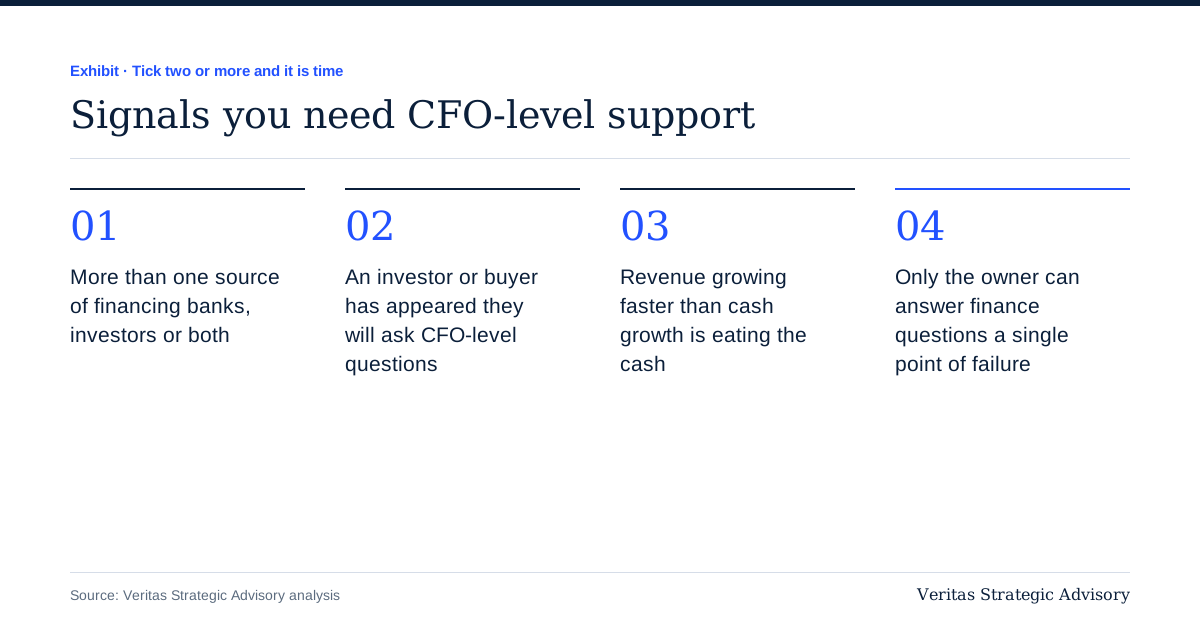
Most growing businesses cross this threshold quietly, well before anyone in the business names it, and the cost of not naming it accumulates in decisions made a little later, and a little worse, than they should have been.
The signals worth watching for, specifically
More than one meaningful source of financing. Once a business is managing more than one bank relationship, or a bank facility alongside investor capital, the reporting, covenant tracking, and renewal documentation this requires becomes a real and recurring workload, not an occasional task squeezed into a quiet week.
Revenue growing faster than cash. This is one of the clearest and most common triggers, and the mechanism behind it, growth consuming working capital faster than it generates visible profit, is set out in full in your sales are growing, so why is cash flow getting worse. A business experiencing this pattern without anyone actively forecasting and managing it is flying without the one instrument that would show the problem coming.
An investor, buyer, or new partner has entered the conversation. The moment outside capital or an acquisition becomes a live possibility, the business needs someone who can represent its numbers credibly under scrutiny, prepare for diligence, and negotiate from a position of financial fluency, not just produce historical statements after the fact.
Pricing and product-mix decisions are being made on instinct. Once a business has more than a handful of products, services, or client segments, the true profitability of each starts to diverge in ways that instinct alone reliably gets wrong, a gap covered in our companion piece on contribution margin by product or service line.
The owner is the only person who can answer a financial question. If every meaningful financial question, can we afford this hire, should we take this loan, what happens if this customer leaves, routes through one person's memory and intuition rather than a maintained model, the business has already outgrown informal financial management, whether or not anyone has said so out loud.
Full-time hire vs fractional or outsourced CFO: the actual trade-off
This is not simply a cheaper-versus-more-expensive decision made in isolation. A full-time CFO is the right choice once a business is large and complex enough to generate genuine daily demand for senior financial judgment: multiple business units, a sizeable finance team needing management, frequent financing or capital-markets activity. Below that scale, the honest reality is that daily demand for CFO-level judgment does not exist yet, and a full-time hire at that stage is often underutilised, expensive relative to the actual decision cadence of the business, and prone to inventing work to justify the role.
A fractional or outsourced engagement, structured around a monthly or quarterly cadence matching the business's actual decision rhythm, gives access to the same calibre of judgment without carrying a senior full-time cost for work that genuinely does not arise every day. This is the model that fits most Nepalese SMEs at the point they first cross the complexity threshold, with a transition to a full-time hire becoming appropriate later, as the business's own scale and decision frequency grow into it. Our companion piece on virtual CFO in Nepal: who actually needs one sets out what a working fractional engagement actually delivers month to month.
Why hiring too early is rarely the real risk
Owners often hesitate on the cost of bringing in CFO-level support, worried about paying for a function the business is not yet "big enough" to need. In practice, the more common and more expensive failure we see is the opposite: businesses that wait well past the point the complexity threshold was crossed, having already made a series of decisions, a loan structured against the wrong cash cycle, a pricing decision that quietly eroded margin, an investor conversation entered underprepared, that a CFO function would have caught and corrected in time. The cost of those decisions, compounded, is consistently larger than the cost of engaging support a few months earlier than felt strictly necessary.
A simple test to apply to your own business today
Ask honestly: in the last quarter, was there a financial decision made primarily on instinct or urgency, rather than on a maintained forecast or analysis, that, in hindsight, deserved more rigour than it received? If the honest answer is yes, and it is yes for most growing businesses at some point, the complexity threshold has likely already been crossed, whether the business has formally recognised it or not.
How Veritas helps businesses make this call
We run a short diagnostic against your current reporting, financing position, and the specific decisions on your horizon over the next two quarters, and recommend the scope and cadence that actually fits, rather than defaulting to a fixed package regardless of stage. See our virtual CFO and outsourced finance function service for how this diagnostic and the resulting engagement are structured.
Frequently asked
Can a business move from fractional to full-time CFO support later?
Yes, and this is the natural progression for most businesses that continue growing; the fractional stage is not a lesser or temporary substitute, it is the right-sized model for that stage of complexity, with full-time support becoming appropriate once the business's own scale justifies it.
Is there a revenue level at which a CFO becomes necessary?
No single figure applies across industries and business models; the complexity signals above are a far more reliable guide than any specific revenue threshold, since two businesses at the same revenue level can sit at very different points on the actual complexity curve.