

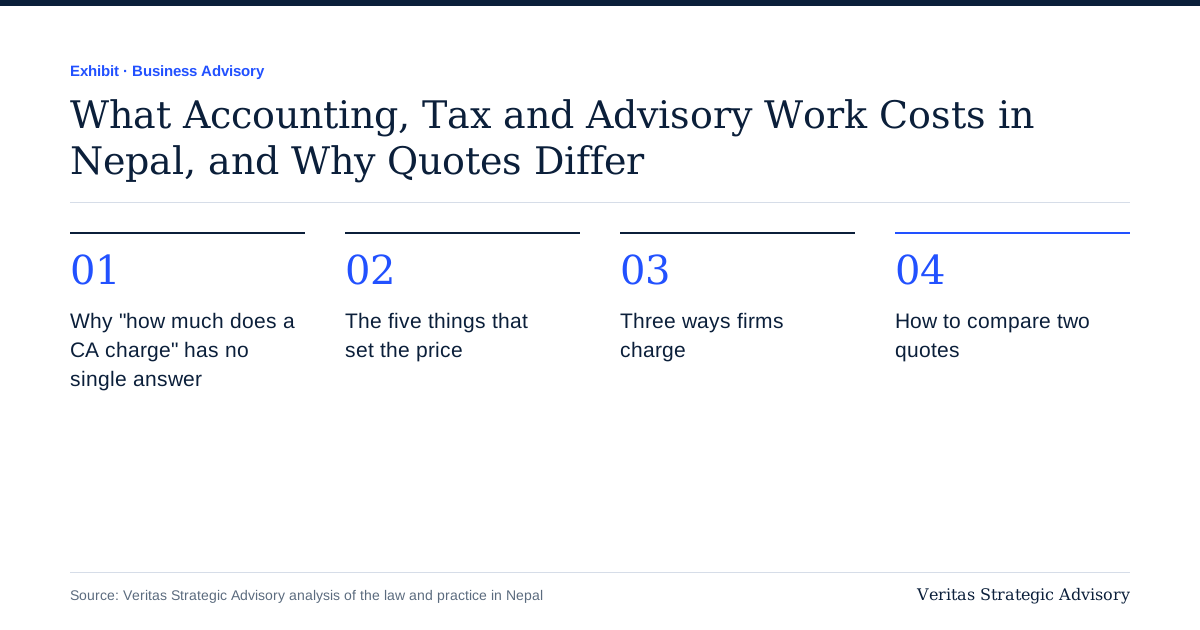
- cost drivers
- 5
- fee models
- 3
- written scope before work starts
- 1
Why "how much does a CA charge" has no single answer
Owners ask the question this way because they want a number before they call anyone. That is reasonable. The difficulty is that "accounting" covers work ranging from a monthly VAT return for a shop to defending a tax assessment worth several crore. A cheap quote is often a quote for less work, and the gap shows up later as an IRD query or a bank that will not accept the statements.
The useful question is not "what is the fee" but "what exactly will be done for it".
The five things that set the price
1. Volume. The number of invoices, bank accounts, employees and branches. A business with 40 sales bills a month and one with 4,000 need very different effort for the same VAT return.
2. Condition of the records. Ledgers reconciled each month cost far less to close than a year of receipts in a box. Catch-up work for past years is usually the largest single surprise in a quote.
3. Number of filings and offices. VAT, TDS, income tax, SSF, the OCR annual return, local tax, and for foreign-owned companies NRB and the Department of Industry. Each adds a deadline and a filing.
4. Deadline. Work requested a week before the Poush filing deadline, or just before a bank renewal, costs more because it displaces other work.
5. Risk. An IRD assessment, a valuation used in a share transfer, or due diligence before an acquisition carries professional risk and needs senior time. These are priced on the matter, not on hours of data entry.
Three ways firms charge
| Model | Suits | Watch for |
|---|---|---|
| Monthly retainer | Bookkeeping, payroll, VAT and TDS compliance, virtual CFO | What happens when volume rises; what is excluded |
| Fixed fee per deliverable | Company registration, annual return, tax return, valuation report | Exactly which documents and filings are included |
| Fee per matter or stage | IRD defence, tribunal appeals, FDI approvals, transactions | The fee for each stage, and whether government fees are separate |
Government fees (OCR registration fees, stamp duty, DOI and NRB charges) are paid to the government and should appear as a separate line, not inside the professional fee.
How to compare two quotes
Ask both firms for the same written scope: which returns, which periods, which meetings with the tax office.
Ask who does the work: a partner, a qualified accountant, or a trainee supervised by one.
Ask what happens if the tax office raises a query: is the reply included or billed separately?
Ask whether catch-up for earlier years is priced separately.
Check that the firm can sign what you need. A statutory audit must be signed by a registered auditor, and the auditor cannot also keep your books.
How we quote
We agree a written scope and a fee before work starts, show government fees separately, and tell you at the start if your records need catch-up work. For a quote, describe your business briefly, or see our bookkeeping and tax services.
What a good quote contains
A quote you can compare has seven parts. If a firm gives you a single number with no breakdown, ask for the rest.
The scope in plain words. For a monthly service: which ledgers, how many transactions are included, and what happens above that number.
The periods covered. One month, one year, or catch-up for earlier years.
The returns and filings included, named one by one: VAT, TDS, income tax, SSF, annual return.
The people. Who prepares, who reviews, who signs, and how much partner time is included.
Government and third-party fees, shown separately.
What is excluded, such as IRD queries, audits, valuations or new registrations.
Payment terms and notice, including how to end the engagement.
Three examples of how the same business gets different quotes
These are illustrations of the logic, not price lists.
A small trading shop with a few hundred bills a month, one bank account and monthly VAT needs light bookkeeping and monthly returns. A fixed monthly fee is usual. The thing that moves the price is the state of the records: if a previous bookkeeper left unreconciled accounts, expect a one-off catch-up charge.
A growing service company with twenty staff, payroll, TDS and an annual audit needs a team: a bookkeeper for transactions, a qualified accountant for review and a partner for tax and reporting. The price follows the number of people-hours and the sophistication of the reporting, such as monthly management accounts and a cash forecast.
A foreign-owned subsidiary needs the same plus approvals, repatriation files and reporting for the parent. Complexity and risk raise the price, and so does the timeline imposed by the parent.
In each case the cheapest quote is not the lowest-cost outcome. A quote that leaves out catch-up, queries or reporting will be topped up later.
Red flags in a quote
A price far below the others with no explanation of what is cut.
No named person responsible for your work.
A promise to reduce tax by a stated percentage. Legitimate planning shows the legal basis. A guaranteed saving is a warning.
Cash payment with no invoice, which leaves you unable to claim the expense and suggests a firm that does not follow the rules it advises you on.
A firm that offers to sign an audit and also keep your books. The two roles must be separate.
Pressure to decide today.
Green flags
A written scope and a sample of the monthly report you will receive.
A clear answer on what the fee does not cover.
References or at least a description of similar work, without naming clients who have not agreed.
A willingness to start with a small, paid review so you see the quality before committing to a full year.
A team that explains in plain language, including what could go wrong.
Questions people ask
Is a fixed monthly fee better than hourly billing? For routine work, usually yes, because you know the cost and the firm has the incentive to be efficient. For one-off or uncertain work, a fee per stage with a cap can be fairer.
Why do fees go up in Poush and Ashoj? Filing deadlines concentrate work. A firm that handles the work during the year charges less than one asked to rebuild everything a week before a deadline.
Should I pay a retainer to a firm for tax advice? If you face regular decisions on structure, payroll, VAT or transactions, a small retainer can be cheaper than separate billing for each question.
Can I negotiate? Yes, on scope and timing. A smaller scope, earlier delivery of records and a longer commitment can all reduce the price.
What should I give the firm to keep cost down? Records on time, organised by month, with bank statements and invoices matched. This is the biggest saving you control.
If you would like a written scope and fee for your business, describe it briefly. We will tell you plainly what the work needs and what it does not.
The cost of getting it wrong
The headline fee is a small part of the real cost of accounting and tax work. The larger costs are the ones a poor engagement leaves behind.
Penalties and interest. A missed VAT or TDS deadline carries a fee and interest. A year of missed filings can cost more than several years of a competent firm's fees. See the 2083 amnesty for how fees and interest are calculated.
Disallowed expenses. Bills without a valid PAN or VAT number are not deductible. A firm that does not enforce this at the point of bookkeeping leaves you with a taxable profit larger than your real profit.
Lost credits. Input VAT that cannot be claimed because the invoice or the supplier's filing is wrong is money lost. See VAT input credit and the Supreme Court.
Failed finance requests. A bank that rejects a loan because the statements do not reconcile has cost you the opportunity, not merely the fee. See why banks reject loans.
Management time. An owner who spends ten hours a month chasing numbers, answering queries or redoing reports is paying in the most expensive currency there is.
When you compare quotes, estimate what each firm's mistakes would cost you, not just what its fees cost. A firm that charges more, files on time and answers queries quickly is often cheaper in total.
Choosing the right type of firm for the job
Different providers suit different needs, and the price differences follow from the differences in service.
A sole practitioner or small firm gives personal attention and often lower fees, which suits simple compliance. The risks are capacity when deadlines cluster and a single point of failure if the practitioner is unavailable.
A mid-sized firm brings a team with specialists for tax, payroll, audit support and advisory. It suits growing businesses that need more than compliance, and its pricing is usually structured by deliverable or retainer.
A large international firm brings brand and global reach, and prices accordingly. It suits listed companies and multinational subsidiaries with group reporting requirements.
An in-house accountant gives daily presence and local knowledge, and can be the right choice once volume justifies a full-time person. An in-house accountant is not a substitute for specialist tax advice, and the business then carries the risk of a single person.
A virtual CFO or outsourced finance team suits a business that needs senior thinking and monthly management reporting without a full-time executive. See virtual CFO in Nepal and the comparison of in-house, outsourced and virtual CFO.
The right choice changes as the business grows. Many businesses start with a small firm for compliance, add a mid-sized firm for tax and reporting, and consider an in-house accountant when volume rises.
How to prepare, so the fee stays low
You control more of the price than you think. Before the firm starts:
Gather the last two years' returns and the opening balances. These save hours of reconstruction.
Sort documents by month: sales bills, purchase bills, bank statements, payroll records and loan statements.
Reconcile your bank accounts yourself, or at least list the unmatched items.
List your registrations with their numbers and dates: PAN, VAT, SSF, Registrar and any licence.
Write down what you want: the reports, the deadlines and the decisions the numbers should support.
Name one person in your business who answers the firm's questions within a day.
Firms notice when a client is organised, and a well-prepared client costs less to serve. Many firms will say so if asked directly.
What you should receive in return
A good engagement produces visible outputs you can check:
Monthly: a set of accounts with a bank reconciliation, a VAT and TDS summary and a short note on anything unusual.
Quarterly: a review of tax position, advance tax and cash.
Annually: returns filed, financial statements, a depreciation schedule and a list of open issues for the next year.
On request: answers within an agreed time to queries from the IRD, banks and investors.
If you are paying for these and not receiving them, say so early. If the firm cannot or will not deliver them, move on. See our bookkeeping, VAT and tax filing and payroll services for how we structure the work. Fees depend on your facts, so ask for a quote against a written scope.


